
 E-Paper



Positivity rate recorded below 10% across Chandigarh tricity
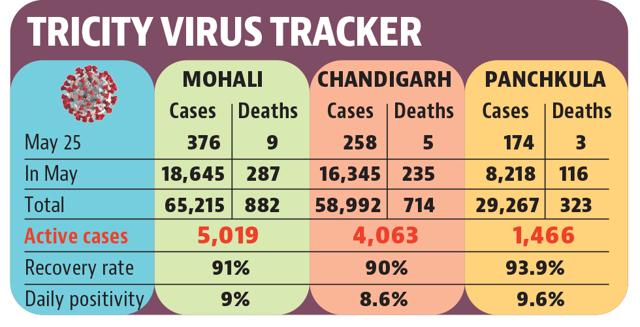
It was recorded at 8.6% in Chandigarh, 9% in Mohali and 9.6% in Panchkula, which means of every 100 people tested for Covid-19 less than 10 were found infected on Tuesday

 Prefer HTon Google


Amid a receding second wave, the daily positivity rate was recorded below 10% across the tricity on Tuesday.
Positivity rate is the true indicator of the growth or decline in the spread of an infection, as it is the proportion of people testing positive among all those sampled.
It was recorded at 8.6% in Chandigarh, 9% in Mohali and 9.6% in Panchkula, which means of every 100 people tested for Covid-19 less than 10 were found infected on Tuesday. During the peak of the second wave, it had remained around 20-25%.
Meanwhile, recovery rate has jumped above 90% across the tricity, while cumulative active case load stands at 10,548, down from the peak of 24,201 couple of weeks back.
In terms of cases, the tricity saw an uptick from Monday’s 611 to 808 on Tuesday, while there was a minor decline in daily fatalities from 20 to 17.
Mohali, which has been the worst hit, reported 376 cases and nine deaths, followed by 285 cases and five casualties in Chandigarh, and 174 infections and three deaths in Panchkula.
“Positivity rate has seen a steep decline after a steep rise in May. It is expected to come down further by the end of the month,” said Chandigarh health secretary Arun Gupta. “Even though there is a fluctuation in the number of tests due to low demand now, we are not seeing a rise in positivity rate, which suggests that infection spread has declined.”
While testing levels have been in the range of 3,000 to 4,000 daily, positivity rate has been between 8% and 10% in the past four days in Chandigarh, having touched 28% on May 12. In fact, the central government had time and again flagged Chandigarh’s high positivity rate.
Even Mohali has recorded less than 10% positivity rate four times in the past five days. It had once touched 25%.
“Sampling in the district has not decreased and we have ensured round-the-clock availability of a team at the district hospital with two dedicated mobile teams for the needy,” said Mohali civil surgeon Dr Adarsh Pal Kaur.
Mohali deputy commissioner Girish Dayalan attributed the downward trend to the lockdown and night curfew. “We are hoping it will continue. I urge people to follow the Covid-19 guidelines by wearing masks and maintaining social distance.”
Dr Jasjeet Kaur, civil surgeon, Panchkula, said the second wave, which started in March, is moving towards an end as the district has started seeing a decline in cases in the past four days. “People should not lower their guard as the behaviour of the new mutant variants is not easy to predict.”
“In epidemics we have lull and stormy periods. We have passed this stormy period once again and reached the lull period,” said Dr Rajesh Kumar, former head of community medicine and school of public health, PGIMER. “As a society, we are learning to remain afloat during the lull periods by taking precautions and in the stormy period by imposing restrictions. The longer we are able to take corrective steps, the longer the lull period remains.”


