
 E-Paper



At GBPSSI: Experts brainstorm over creating intellectual heritage, Mann Ki Baat
The session, held on the theme of “Vikas Yatra”, was an effort for creating intellectual heritage around various development actions and communicative interventions made by union ministry of education.

 Prefer HTon Google


A brainstorming session, to initiate dialogue on ‘creating intellectual heritage in India’ was organised by Govind Ballabh Pant Social Science Institute (GBPSSI) on its campus on Sunday.
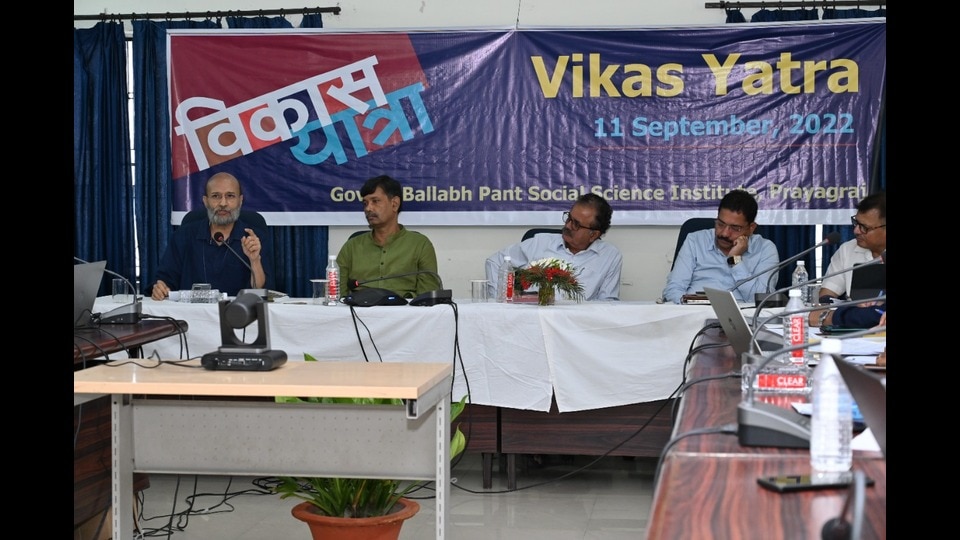
The session, held on the theme of “Vikas Yatra”, was an effort for creating intellectual heritage around various development actions and communicative interventions made by union ministry of education.
The event was conducted under the initiative of the Union Education ministry, called “Creative Intellectual Heritage” in collaboration with higher education to hold dialogue, document and research the process of making New India.
Under this, two sessions - “Policies for the Poor and Marginalised – A study of Garib Kalyan scheme in India” and “Inspiration, Empowerment and Development – A study of Mann ki Baat” were held.
In the first session, different government schemes such as Pradhan Mantri Ujjwala Yojana, Deen Dayal Upadhya Gram Jyoti Yojana, PM Gareeb Kalyan Anna Yojana, PM Jan Dhan Yojana, PM Awas Yojana, PDS Transformation: One Nation One Ration Card, and Swachh Bharat Mission remained the focus of the deliberations.
In the second session, the vision, implementation and impact of “Mann ki Baat” were discussed by eminent scholars across the country.
In the beginning of the first session, GBPSSI director Prof Badri Narayan talked about the importance of monitoring and evaluation of government schemes through secondary and primary data. He also outlined the role of universities in the development activities beyond academic discourse.
The key note speaker professor Santosh Mehrotra, eminent economist from the Centre for Development Studies, University of Bath, England, UK, discussed important issues in evaluating the programmes such as providing independent opinion on the scheme evaluation, using logical framework for evaluating a scheme, etc.
Experts also referred to government schemes like the Pradhan Mantri Ujjwala Yojana.
While commenting on GBPSSI’s associate professor Archana Singh’s presentation, experts urged incorporation of the programme on solar lights with it. On this same presentation, professor Santosh Mehrotra pointed need to evaluate the impact of the programme on the upper respiratory infection of women and children. The question on selection of BPL households for distributing the LPG gas was also discussed.
Prof Santosh Mehrotra and other experts also discussed different presentations particularly on Deen Dayal Upadhay Gram Jyoti Yojana by assistant professor Subhash Kumar of GBPSSI, PM Gareeb Kalyan Anna Yojana by professor DR Sahu from Lucknow University, PM Jan Dhan Yojana by professor Ripusudan Singh from Ambedkar University, Lucknow, PM Awas Yojana by assistant professor Manik Kumar of GBPSSI, PDS Transformation: One Nation One Ration Card by assistant professor Rekha Gupta of Allahabad University and assistant professor Puja Pal of GBPSSI, as well as on Swachh Bharat Mission by Rewa University’s Naleen Kant Dubey.
GBPSSI director also talked about the inspiration, empowerment and development through “Mann ki Baat”. Various dimensions of “Mann ki Baat” were discussed by eminent speakers like Anand Raja from Prof Rajendra Prasad (Rajju Bhaiya) University, Swapnil Dhanraj, J Jagannathan, Swadesh Singh from Delhi University, Abhinandan, Ramandand from Center of Policy Research and Governance, New Delhi and Archana Singh of GBPSSI.


