
 E-Paper



Powering tech education, the ‘desi’ way
Pratap Pawar aims to change the face of tech education in India and the world through his company, AIR Guruji


puneletters@hindustantimes.com
Pune: As a student who had just completed his Master in Telecommunication from VJTI
Mumbai, Pratap Pawar stepped out confidently with high hopes and big dreams of building products that would be useful for mankind and make the world a better (and easier) place to live in. To give wings to his dreams, he invited three of his friends to start a company. And, Microficial Intelligence was born, a company that would enable home automation. However, it did not work out as planned, and the start-up met with an early end.
But, the premature death of his dream venture could not restrain the budding entrepreneur from the lure of the business world, a calling that would get louder with each passing day. Pratap shifted from Mumbai to Pune in 2021, armed with a new idea and newer hopes, ready to explore what his mind wanted.
“There is a huge gap in what industry expects from young graduates and what they learn. As a student, I had seen how theoretical our education system is. What all we learn is on paper. Very little importance is given to practical knowledge, which is where you actually learn,” he says now, looking back.
So, Pratap made up his mind to give students an opportunity to acquire hands-on experience on Artificial Intelligence (AI), which was fast gaining momentum as the new face of technology. But the question before him was: to find out if there really was a need in the market as he had assumed. And, the bigger question was: how?
Making rounds of schools
He came up with the idea of doing seminars in schools and colleges on AI, where he could give them some ‘gyan’ and find out what the students really wanted. He brought some experts on board and started approaching institutions with offers for a short talk on new technology. “I charged only ₹1,000 per session but what we learned was invaluable.”
Pratap’s market research revealed that there was indeed a real need amongst students and an eagerness to learn new technology like AI, IOT, Robotics. “We covered more than a 100 schools and colleges and got feedback from 10,000 students, informing us that they were ready to take the leap into new technology.” But, how he would service this need was the question now.
He was clear from the beginning that whatever he would teach, it would be through
practicals and not theory. And, he stuck to that.
“Most schools, especially in tier-2, tier-3, and rural regions, lack modern labs, trained faculty, and access to real-world technology infrastructure. Even if technology exists, it is fragmented: coding in one place, robotics in another, and AI online. This gap prevents students from achieving international-level technological exposure and limits India’s innovation potential. I thought: why should global-standard innovation education be available only in elite schools or abroad? With this in mind, I focused on creating a product-based AI Infrastructure rather than a content based ed-tech platform.”
AIR Guruji launches Hexabrain.AI
He studied global leaders like LEGO Education, Kano Computing, and Intel AI Labs, and aligned these learnings with India’s education realities. He also studied the products available in the Indian market. And, in his small workshop in Pune, near Symbiosis Innovation Centre, he started working on his model. He said, “Most of the products are made in China and can teach only one technology, like IOT or AI. So I decided to launch one product that a student could use to learn different technologies.”
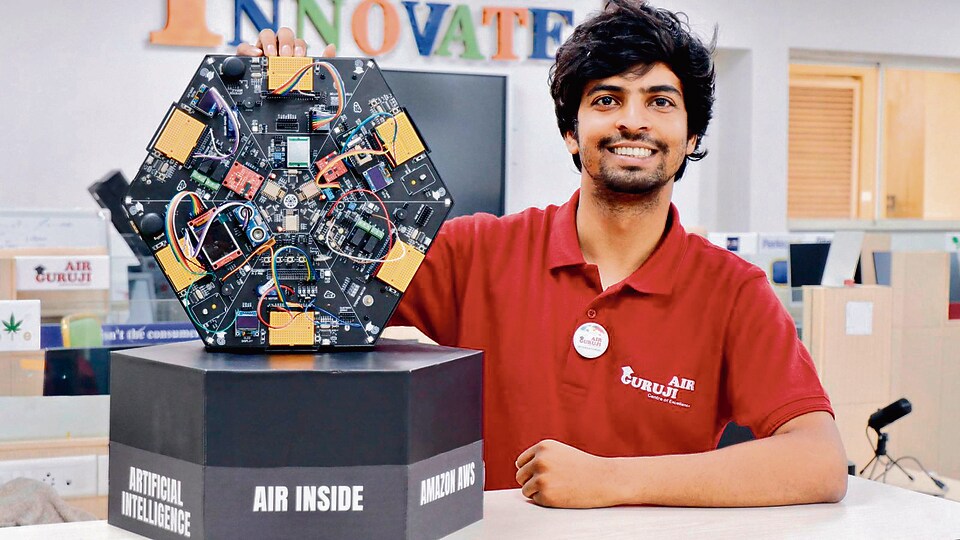
With this in mind, he set out to build what is now called the Hexabrain.AI. From 2021 to mid 2023, he built several prototypes to finally come up with ‘one’ that could be used to learn AI, IOT, Robotics and drone technology. Pratap was now ready with his Hexabrain.AI - a useful tool for practical education, to be marketed through his company, AIR Guruji.
“Until then, there was no such machine built in India that could be used to teach four different technologies. But, now, with Hexabrain, a student can build an agri tool, auto prototyping system, or a healthcare tool to collect data and send it directly to the cloud or detect a signal on the way to the cloud,” said Pratap.
This multi-use learning tool is now being used by PhD students to detect bacteria and even by Standard 5 students to build LED based joysticks. But the question now was, how to get this into institutes so that students have easy access to it?
Lady Luck steps in
“Initially, I gave demos to schools and engineering colleges to show them how this could be very
useful to their students. But, Lady Luck, too, had a role to play! Around that time, All India Council for Technical Education mandated that all institutions should teach AI to their students. National Education Policy, too, states that all schools under CBSC must teach students a
vocational subject, and they have started teaching AI. Even the State Education Board is going to mandate the same soon. So this provided us a foot in the door.”
Soon, Pratap had six engineering colleges and 50 schools using his Hexabrain.AI.
Cut above the rest
“The USP of global players like LEGO Education, Kano Computing and Pi-Top is brand or single-domain focus,” said Pratap. “But our USP is an integrated innovation infrastructure. We are completely a made-in-India technology with deep institutional partnerships and long-term lab engagement. We compete on outcomes, access, and impact, not branding alone.”
Money story
Pratap initially invested ₹15 lakh and one and a half years to build this product. “So far, we have invested a total of ₹1.5 crore via angel investors. We started in Feb 2023 and in April, our product was valued at ₹2.4 crore, and our angel invested ₹10 lakh. Later, we got one more
angel investors, who put in ₹16 lakh at a valuation of 24.8 crore, and the last investment was ₹32 lakh.” He plans to raise ₹3 crore in the near future for customer acquisition and scalability.
Revenue building
Pratap has two business models. One is where he builds his own centre in the school or college
with 10 Hexabrain.AI machines. Each gadget can be used by six students simultaneously. “We
provide them with our trainers and charge ₹3,000 per annum per student. Or, the school can build its own lab that would cost around ₹15 lakh and use our Hexabrain.AI. We provide training to their teachers and also update the training every year.”
In the first year, AIR Guruji had revenues of ₹10 lakh; in the second, it jumped to ₹25
lakh, and last year, it was ₹45 lakh. Says a confident Pratap: “This year, we will close at ₹1.5 crore.”
Endorsements galore
AirG received an official endorsement from the Ministry of Education, Ethiopia, which will
impact multiple African countries. Currently, they are helping over 6,000 students in Ethiopia.
Recently, it was also invited by the Ministry of Education, Government of India, and the minister Dharmendra Pradhan invited them to collaborate further.
As a start-up AirG has managed to build a complete ecosystem that spans advanced AI and Robotics hardware and labs. They have successfully built 35 labs and have an order to build another 60 for schools and universities. “We design and manufacture advanced AI, Robotics, IoT, and VR systems - hardware and learning infrastructure that power the next generation of innovators.”
Looking ahead
Currently, AirG has 35 innovation labs. “We aim to expand to 10,000+ innovation labs
across the country. We want every student to learn technology through our products. We also want to deepen our presence across Africa and other global regions, and launch a fully
AI-powered learning SaaS platform. I would also like to build a connected global student
innovation network linked to the industry.”
Pratap made it clear that his is not just an EdTech company, but one that is building
the education infrastructure for the AI age, with India leading the global movement. “Our vision is to build the world’s largest innovation network — starting from India and expanding globally — so that every student learns at international standards, regardless of geography,” he summed up.


