
 E-Paper



Breaking shackles while baking bread
Women of Chandu don’t just bake here but joke, laugh, dance and sing aloud, all while carving their own identities and their own slice of history.

 Prefer HTon Google


Large steel ovens evoke a rosy glow on the pink and green walls of the room. A buttery fragrance floats through the air, bursts of laughter and happy chatter seem omnipresent. An all-woman bakery in Chandu, a village 20km away from Gurugram, comes alive on a cloudy morning as its inhabitants hustle to make hundreds of walnut, flaxseed and oatmeal cookies that will soon adorn shelves of the city’s most upmarket stores and malls.
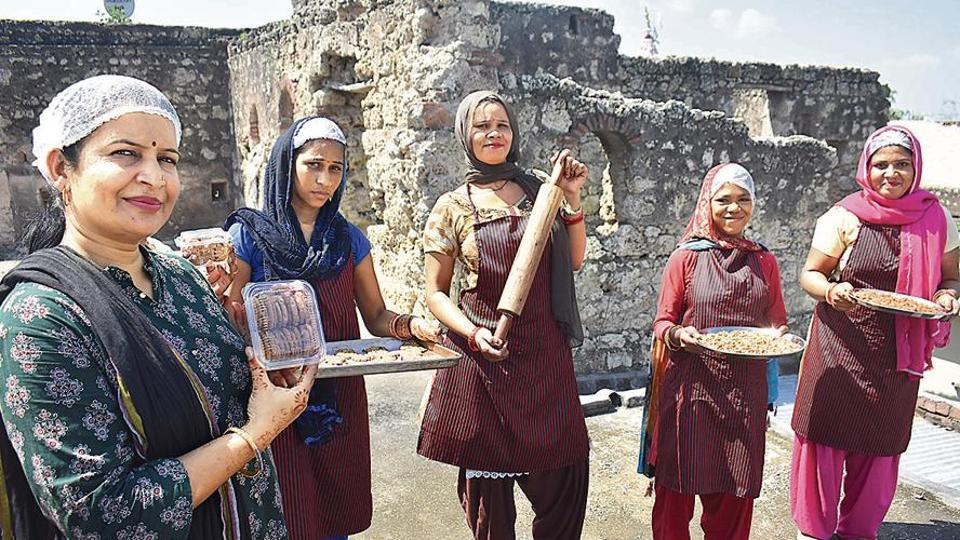
In a village shackled by patriarchy, matters took a turn when 39-year-old Pooja Sharma had to move out of her ancestral home with her family due to a feud. Today, there are also around 150 women who work at this bakery and make a living, dishing out boxes of confections under the Zingzest brand.
In 2005, Sharma’s family had no shelter or source of stable income. With help from a family member, they built a house but the family of five was struggling to make ends meet. Three years later, Sharma started doing odd-jobs to support her family, and later on, she walked for 5km every day, to nearby Iqbalpur village to work in a primary school. History was made. Sharma said she was the first woman of Chandu village to work and go outside the house.
“People would taunt me and my family because I was working. But I had three children and needed to support my family,” Sharma said. She was on a contractual job, and it didn’t last for long. By 2010, she was on the lookout for new avenues again. Opening up a nearly 250-year-old, family-owned , and widely believed to be ‘haunted’ haveli (mansion) in the village, opened up new opportunities for her.
“No one in the village had entered the haveli for decades. It belonged to my father-in-law. People believed it to be cursed and haunted, and so did I. I would also be scared and never stepped inside it when we lived with my husband’s family,” Sharma said.
To earn a livelihood, Sharma wanted to breed cows and sell milk for a living. With no money and no place available, the haveli became her last resort .
With a prayer on her lips, she cleaned a part of the haveli and took a loan from a family member to buy a cow. Over time, the number of cows increased to five.
“Villagers looked at me like I was a rebel, but they softened over time. They started calling me a courageous ‘jatni’ who opened the locks of a haunted haveli. But residents of the village would only come till the entrance of the haveli and never enter the building.”
In 2013, officials of the central government’s Krishi Vigyan Kendra (KVK) came to Sharma’s village to train women in vocational skills like sewing and stitching. “I told the officials that there would not be enough stitching and sewing jobs in the village and asked them to train us in something that can help us earn a livelihood,” she said.
She found support from other women and KVK trained 10 women in the village in making soya nuts. Sharma and the other women asked KVK to help them manufacture and sell these nuts. Sharma then installed a nut-making machine at the haveli. Soon, the women led by Sharma started packaging dalia, jowar, wheat ladoos and other products growing on their fields. “The idea was to do something that would benefit and give a boost to the crops we grow here,”says Sharma
“We started going to trade fairs. Our products were always sold out,” said Nirmala, among the first village women to join Sharma.
During this time, while Sharma’s efforts were being lauded and appreciated outside, the shackles of orthodoxy tightened around the working women within the community. Families were questioned and probed by other villagers as to how they were letting their women out to work.
But as fate would have it, an NGO approached Sharma in 2017. They wanted to create livelihoods for rural women and had heard of Sharma and the courageous Chandu women. “A volunteer from an NGO called Access Development Solutions met me and said they can help create jobs for women by setting up a bakery.”
The haveli’s fortunes turned further as dough machines and colossal industrial ovens started getting installed in its once abandoned rooms and corridors. More than 150 village women learnt how to bake from a Mumbai chef. Next followed the NGO marketing and supplying the products.
Between them, these rural bakers could roll, slice, cut, bake, wrap, paste and get a shiny tempting box of Zingzest cookies ready in minutes.
“Our cookies were being supplied to the top hospitality chains and stores in Gurugram, and demand increased over time,” said Saroj, one of the bakers, with a glint in her eye.
A nutty whiff and cackles of laughter emanate from the once desolate building. Sharma has now formed nine self-help groups with 150 village women, where they can avail financial assistance.
“Women who sneered at us for stepping out to work now ask if there is any work in the bakery. I am not living in fear anymore that a money-lender will someday come asking for money or exploit us by asking us to work for them,” said Pushpa, a self-help group member, who came to Chandu 13 years ago from Uttar Pradesh with her husband, a migrant labourer.
She continued, “Today I can buy something for my child when I want to without asking my husband or family for money. I have been able to take loans for our field’s seed requirement through the group.”
As emotions run high in the bakery, the women draw attention to a slew of photographs in the bakery wall — Sharma speaking at different platforms, the women in trade fairs and a photographic tapestry of all that the women had achieved together.
The women said that they earn around ₹5,000 every month and have understood the benefits of a two-income household, but more importantly the significance of living a life of dignity and self-dependence.
“This is not work for us. This is freedom. Earlier, my family hated that I went out, but today they are proud of me. My children and mother-in-law love the double chocolate chip cookie we make. It brings a smile to their faces every time I take one home,” Asha said, while making perfectly round oatmeal cookies.
For Saroj, the bakery is her solace, where she can be completely uninhibited. Sharma is less a boss and more her counsellor, she said. “She gives us so much guidance, not just professionally, but personally as well. Every time something bothers me or weighs me down, she gives me advice.”
The grit and commitment of one woman has clearly given Chandu not just a great production unit, but a place where many women of the village find a place to be themselves, step out of their households, don chefs’ hats and feel empowered. Women of Chandu don’t just bake here but joke, laugh, dance and sing aloud, all while carving their own identities and their own slice of history.


