E-Paper



India responds to Donald Trump’s comments, says ‘diversifying energy purchases’
MEA spokesperson Randhir Jaiswal said he was “not aware of any conversation yesterday [Wednesday]” between US President Donald Trump and PM Modi

 Prefer HTon Google


India said on Thursday it has been broad-basing and diversifying its energy sourcing, including expanding procurement from the US, while responding to US President Donald Trump’s claim that he had been told by Prime Minister Narendra Modi that New Delhi will stop buying Russian energy.
The Indian side also said there had been no conversation or phone call between the two leaders since October 9 - an assertion that ran counter to Trump’s claim that Modi told him on Wednesday about purportedly stopping Russian oil purchases.
External affairs ministry spokesperson Randhir Jaiswal, in the first formal response to Trump’s comments made at a media briefing on Wednesday, said India’s energy purchases are guided solely by the objective of safeguarding the “interests of the Indian consumer in a volatile energy scenario”.
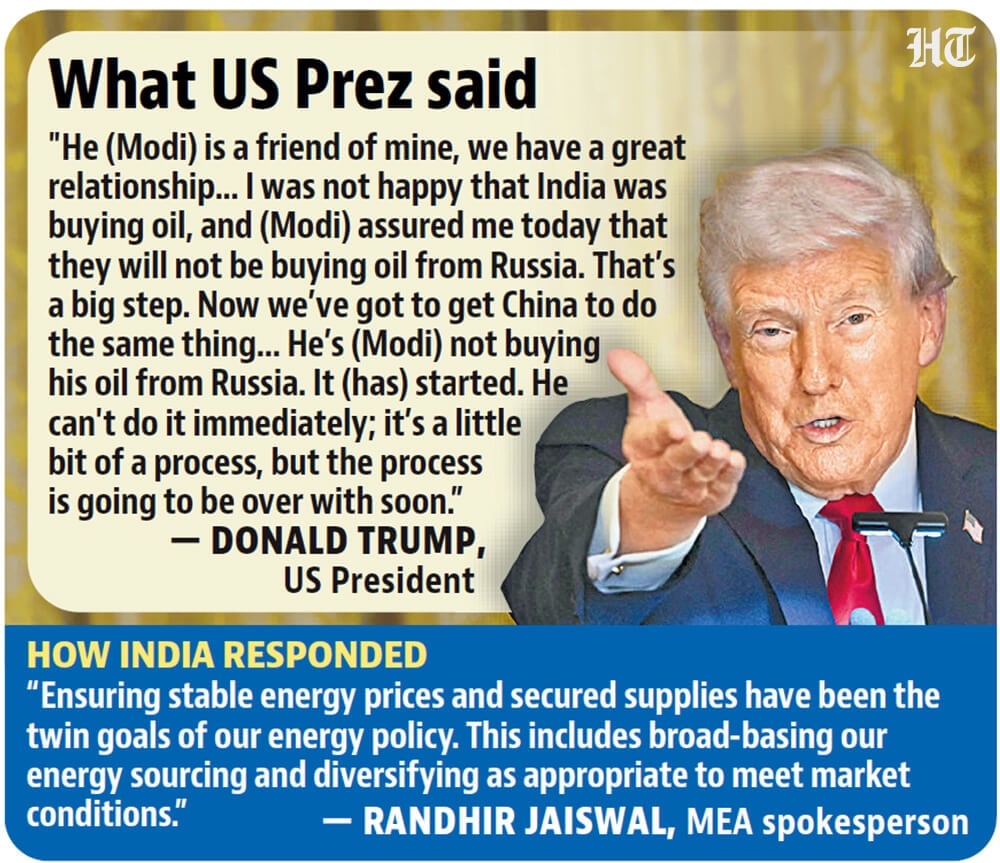
“Ensuring stable energy prices and secured supplies have been the twin goals of our energy policy. This includes broad-basing our energy sourcing and diversifying as appropriate to meet market conditions,” Jaiswal said in a statement.
India, Jaiswal said, has also sought to expand its energy procurement from the US for many years. “This has steadily progressed in the last decade. The current administration has shown interest in deepening energy cooperation with India. Discussions are ongoing,” he said.
When Jaiswal was subsequently asked at a weekly media briefing about Trump’s claim of speaking to Modi on Wednesday, he said the leaders had last spoken on October 9.
“On the question of whether there was a conversation or a telephone call between Prime Minister Modi and President Trump, I am not aware of any conversation yesterday [Wednesday] between the two leaders,” he said.
Jaiswal said that during their last phone conversation on October 9, Modi congratulated Trump on the success of the Gaza peace plan. The two leaders also reviewed progress in bilateral trade negotiations and agreed to stay in touch.
People familiar with the matter said on condition of anonymity that there had been a fall in Russian energy purchases in recent months, especially after the Trump administration slapped a 25% punitive levy on India over procuring Russian crude.
However, the people ruled out a complete and immediate halt to Russian energy purchases.
This issue has also been linked to ongoing discussions with the US on a bilateral trade deal to get over the problem of 50% tariffs on Indian goods.
Russian ambassador Denis Alipov, while addressing an event marking the 25th anniversary of the India-Russia strategic partnership on Thursday, said that his country continues to account for a third of India’s oil purchases as it is the “most cost-effective option” on the global market. Alipov also described Russia as India’s “most reliable energy partner”.
While talking to reporters on Wednesday, Trump said in the context of his efforts to stop the Russia-Ukraine conflict that he “was not happy that India was buying [Russian] oil”.
He added, “And he [Modi] assured me today that they will not be buying oil from Russia. That’s a big stop. Now, I gotta get China to do the same thing.”
Trump described Modi as a “friend” with whom he had a “great relationship” and said: “We were not happy with him buying oil from Russia because that lets Russia continue with this ridiculous war, where they’ve lost a million and a half people.”
India is the world’s third-largest energy consumer, and its needs are met through domestic production and imports of oil and gas from West Asia, Africa, North America, South America and Southeast Asia. The Centre for Research on Energy and Clean Air, a European think tank, said this month that India spent 2.5 billion euros on buying Russian oil in September, 14% less than in August.
Jaiswal responded to the UK's move to impose sanctions on Vadinar refinery in Gujarat, jointly owned by Russian energy firm Rosneft and an investment consortium, by saying there should be “no double standards” in energy trade.
“India does not subscribe to any unilateral sanctions. The government of India considers the provision of energy security a responsibility of paramount importance to meet the basic needs of its citizens,” he said. “Indian companies source energy supplies from around the world while taking overall market conditions into account.”