
 E-Paper



INS Vikrant is the first step towards India becoming an Indo-Pacific power
India has now acquired indigenous capability and capacity to build aircraft carriers, diesel- and nuclear-powered submarines and light combat aircraft. This capability and capacity cannot be left idle for lack of orders or sacrificed to exceptionally long manhours taken by defence public sector undertakings to build these hardware platforms.

 Prefer HTon Google


With the induction of indigenous aircraft carrier INS Vikrant, India has fortified its expeditionary force capability in the Indo-Pacific and is projecting maritime dominance from its eastern and western seaboards. This is a first among many steps that India needs to take to counter the rising maritime threat from China and securing freedom of navigation in the Indo-Pacific.
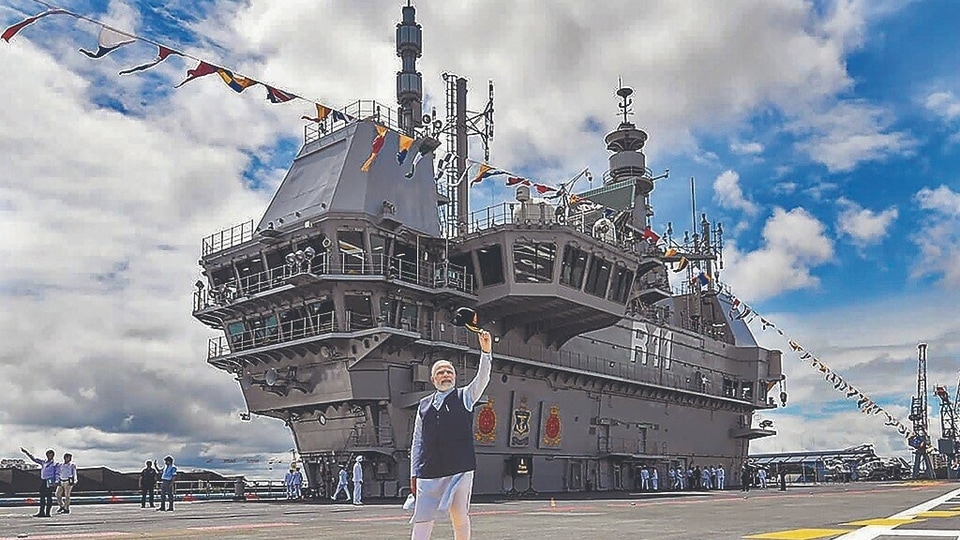
First step in this direction is to integrate the Indian military under one maritime theatre command under a Navy Admiral with dedicated support element from the Indian Army and Indian Air Force.
ALSO READ: INS Vikrant to project dominance in Indo-Pacific
Synergy amongst the fighting forces must be seen on ground and not on paper at the Integrated Defence Staff Headquarters. India cannot afford to have its armed forces operating in silos and out to protect their own fiefdoms and past imperial legacy. After the new Naval ensign was unveiled by Prime Minister Narendra Modi, Indian military must dump its British military past, Raj traditions, ceremonies and create its own identity.
India’s first Chief of Defence Staff Gen Bipin Rawat believed that India would become a true Indo-Pacific power by developing maritime security infrastructure in Andamans and Nicobar Islands. His national security plans included development of a container cum replenishment facility at Campbell Bay in Great Nicobar so that mercantile shipping and warships of friendly nations would get sustenance at India’s island territories while proceeding towards Malacca Straits rather than wait for their turn at Sri Lankan ports.
Dovetailed into the plan was creating a deep harbour in the same Campbell Bay so that Indian aircraft carrier could berth and have a faster response time to any global emergency including natural disasters. After the commissioning of INS Vikrant, the Modi government must activate its long-drawn-out plans by overcoming the usual military bureaucratic red tape.
India has now acquired indigenous capability and capacity to build aircraft carriers, diesel- and nuclear-powered submarines and light combat aircraft. This capability and capacity cannot be left idle for lack of orders or sacrificed to exceptionally long manhours taken by defence public sector undertakings to build these hardware platforms. For example, while countries from Malaysia to Argentina have shown interest in acquiring Tejas light combat aircraft from India, the Hindustan Aeronautics Limited needs to speed up its manufacturing capacities to the next level.
The present status of HAL building capacities for Tejas as well as upgradation work for existing Mirage 2000 fighter fleet be best left unsaid. The same can be said for Indian public sector shipyards as they are also routinely hit by delays and cost over-runs. Exporting hardware to friendly nations is the next step for Aatmanirbhar Bharat or else the specialized workmanship and tooling capacities will dry up and India will be back to square one.
The Indian military weaned on foreign hardware and expertise needs to have more faith in indigenous equipment. Albeit cliché, Rome was not built in a day. While PM Narendra Modi does not stop praising the fact that a DRDO developed and TATA-Forge manufactured 155 mm advanced towed howitzer with an effective firing range of nearly 50 kilometers was used on the 75th Independence Day, one must find out whether the Indian armed forces have placed any orders till now for acquiring this artillery gun.
The Indian military must promote Indian private defence sector by purchasing indigenous equipment rather than out rightly acquire foreign equipment. Foreign acquisition should be only for top end technologies which will take a long time for Indian R & D to develop. The future lies in foreign defence majors joining hands with Indian private players to manufacture hardware in India, which can later be used by Indian armed forces and exported to friendly nations.
With Russia virtually joining hands with China post Ukraine invasion and western defence equipment exorbitantly priced, it is only a matter of time when Russian hardware supply to India dries up. Today, barring France, all the major defence exporters, particularly Russia, are supplying to India’s archrivals China and Pakistan.
Under the circumstances, Aatmanirbhar Bharat is a necessity and not a mere political fad as some strategists think. The future theatre is Indo-Pacific and domination of this battle-ground can only be achieved through high end and focused research and development along with quality manufacturing and workmanship.


