MP drive unearths cache of India’s historical treasures
The collection is part of India’s Gyan Bharatam Mission under which the government last year asked citizens to submit rare manuscripts in their possession.
The Madhya Pradesh archaeology department has collected a treasure trove of historical documents including a rare record of the 1857 mutiny against the British signed by rebel Tatya Tope and a rare portrait of the Queen of Jhansi, commissioned by her.
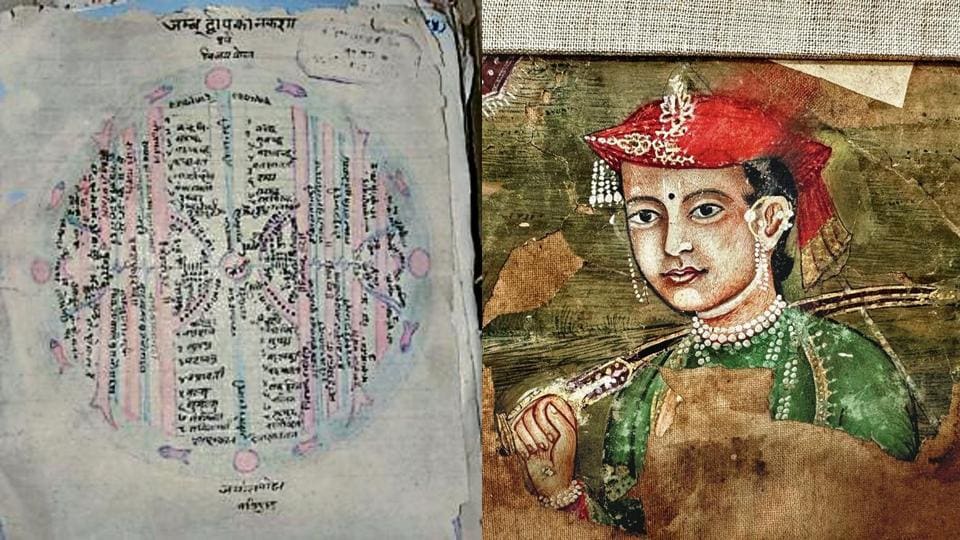
Among the finds: a map (left), a painting of the Queen of Jhansi.
The collection is part of India’s ambitious Gyan Bharatam Mission under which the government last year asked citizens across the country to submit rare manuscripts in their possession for preservation and digitisation (the deadline was June 30). The originals, under the scheme, were to be returned. District-level committees were formed to implement the programme.
Madhya Pradesh saw 3.4 million submissions of which 1.2 million have been verified – the highest number for any state in the country. Uttar Pradesh has 2.9 million followed by 2.3 million from Rajasthan and 1.5 million in Gujarat.
Madan Kumar, commissioner, state archaeological department, said the submissions have been verified using palaeography, the study of historical handwriting.
Among the finds is document related to Tatya Tope’s 1857 mutiny, bearing his signature. “This is the first document bearing his signature and never documented anywhere. This document was given to government by the princely state of Shivpuri after Independence and was with a heritage trust that gave it to us,” Kumar said.
The department has also received an original painting of Queen of Jhansi, who died while fighting the British, from a resident. The painting was commissioned by the queen herself and later found in a museum in Datia, officials said.
Archaeologist Wasim Khan said: “The paintings date back to 1853. The use of natural colours, gold, and intricate artwork clearly proves it is original. It was discovered in Jhansi palace by workers from Datia and placed in the museum after Independence. However, it remained confined there and never gained wider recognition. The popular painting of Rani Jhansi seen everywhere today was prepared after her death and commissioned by her son.”
Kumar said that they have also found an 18th-century compendium listing 62 rulers of undivided India --- from Muscat to Nepal and Kabul to Cochin.
Dated 1877, it contains portraits and details in Devnagri script with Persian/Urdu administrative language on the rulers and their relationship with other princely states.
It was in the possession of the Nawab of Ratlam for years before being preserved by Mahesh Sharma, a resident of Jawara Tehsil and president of the district Pujari Sangh.
Sharma said, “My forefathers gave me this. I knew it was very important, so I registered for its digitisation. I am happy that my collection has added value to the state’s historical manuscripts.”
The department has also been able to collect photographs of Rani Ahilyabai Holkar and her husband Khanderao Holkar, who ruled the Malwa province for 30 years in the 16th and 17th century. Rani Ahilyabai Holkar is known for her valour as she fought against invaders after death of her husband.
Equally striking is a 16th-century manuscript of Rasikpriya (Connoisseur’s Delight), composed by Keshavdas in Braj language during the century exploring the aesthetics of love and romance depicting Lord Krishna and Radha.
The 70-page collection found in Panna is considered a rare literary treasure. “This is a treatise on poetics that codifies the conventions of Shringara rasa (the erotic/romantic sentiment), nayika-bheda (the elaborate classification of heroines by circumstance, temperament and stage of love) and corresponding types of heroes. It is an original version as the papers and hand writing belong to the 16th century,” said Nilesh Lokhande, an archaeologist.
The department claimed it now has one of the oldest maps in the country, showing the earth in circular format, having seven regions and six mountain ranges, named Jambu Dweep (Jambu Island).
The department received it from a Jain temple and Lokhande said the temple administration told them that the manuscripts were present there for more than 100 years. “Its actual source is unknown, but from the palaeography test, it appears to be centuries old,” he added.
From Jain temples in Shivpuri, Vidisha and Tikamgarh, Lokhande said they have received several other maps and artwork related to Jain cosmology, traditional Indian cartography, and Digambara arts.
I have spent over a decade chronicling Madhya Pradesh’s political and social landscape, covering politics, investigative journalism, crime, human interest, and government policy, blending sharp insight with ground‑level depth.
I have closely tracked three assembly elections, three Lok Sabha elections, leadership transitions in MP while exposing governance lapses, tender irregularities, and flawed policy rollouts. My reports have revealed gaps in the Cheetah project, irregularities in medical education, rigging in recruitment exams, and loopholes in policy implementation.
In crime reporting, I have moved beyond FIRs to map systemic patterns — from organised crime networks and gender‑based violence to custodial accountability — balancing urgency with sensitivity.
My journalism is defined by a commitment to human interest. I have profiled the marginalised Bancchda community, documented atrocities against tribal groups, and highlighted efforts to preserve their culture through heritage liquor and revival of spiritual practices. I have reported on farmers struggling with failed MSP promises, giving voice to those often reduced to statistics in policy files.
Passionate about field reporting, I have reported on rampant sand mining in Chambal and Narmada, pharmaceutical companies supplying medicines under altered names, the dire condition of schools and colleges, the plight of commercial sex workers, and skewed sex ratios in specific districts.
Beyond deadlines, and as HT’s state correspondent and assistant editor in Madhya Pradesh, I engage with ministers, farmers, students, and activists, believing the best policy stories begin with a single human voice. A postgraduate in Journalism and Mass Communication, I also hold a diploma in sports journalism.Read More
Get the latest India News, breaking headlines, and real-time updates from across the nation. Stay informed on politics, government policies, crime, weather, and major national developments.
Home/India News/MP Drive Unearths Cache Of India’s Historical Treasures

 E-Paper