E-Paper



No sign yet of China virus surge in India Covid data
The rise in Covid-19 cases in neighbouring China now has the attention of the top authorities in India, including the prime minister and the union health minister. None of them has suggested any drastic measures yet (and rightly so), and only all advised pandemic-appropriate behaviour and more surveillance. There is good reason for this.

 Prefer HTon Google


The rise in Covid-19 cases in neighbouring China now has the attention of the top authorities in India, including the prime minister and the union health minister. None of them has suggested any drastic measures yet (and rightly so), and only all advised pandemic-appropriate behaviour and more surveillance. There is good reason for this. HT listed three of them (better vaccines, more and wider infection rate from earlier waves, and a longer presence of Omicron than China) on December 21 to show why India is unlikley to go the China way. Here are four more charts that show why there is no need for panic.
Cases in India are almost at an all-time low...
The seven-day average of new Covid-19 cases in India was 139 in the week ending December 21, the lowest since the week ending March 31 in 2020, the first month when Covid-19 cases were detected outside of Kerala in India. Daily cases averaged 118 in that week.
Also Read | Airports to randomly test 2%international flyers for Covid-19
To be sure, without even the bare-minimum of safeguards – such as masking up in public places or getting all three doses of a Covid-19 vaccine – at least some threat of surge will remain. For instance, after falling consistently from the peak of 312,180 cases in the week ending January 25 this year to a low of 996 in the week ending April 1, cases increased again to a relatively small peak of 19,935 in the week ending July 24. It was around this time that the first case of the BF.7 sub-variant (believed to be driving the surge in China currently) was sampled (on July 15). Since cases have declined since that minor peak, India may not be in any immediate danger.

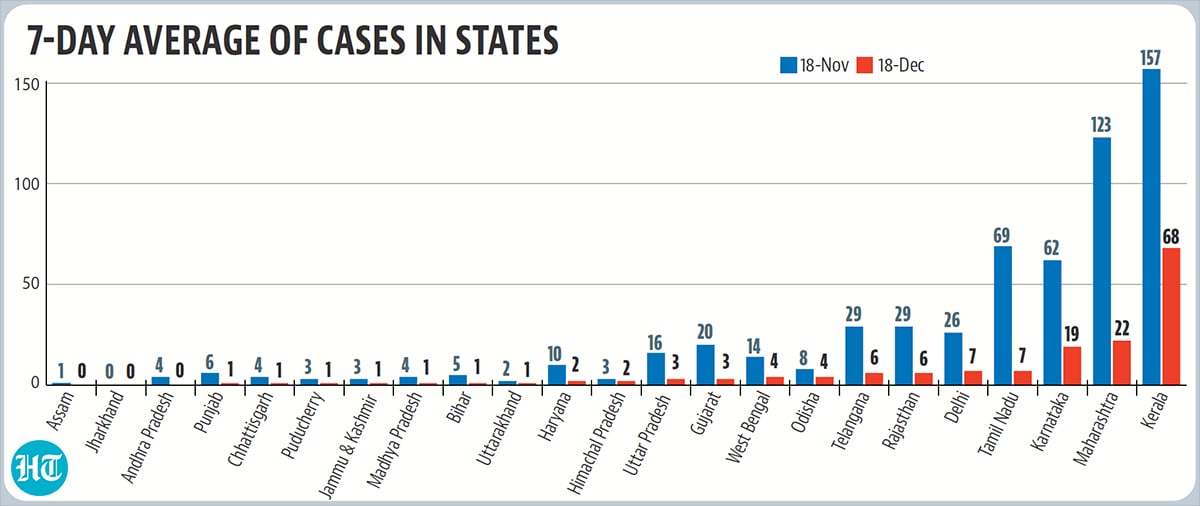
... and there’s not been any growth in cases in the past month even at the state-level .
To be sure, countrywide numbers can be misleading at the beginning of a wave. For example, at the beginning of the third wave, cases increased consistently in Delhi from December 16 compared, although they only started increasing nationally 10 days later, on December 26. This is not happening. In all states, the current weekly average is at least 30% less than that a month ago. The highest current weekly averages are also less than 100. The three states with the most cases average 67 (Kerala), 22 (Maharashtra), and 19 (Karnataka) currently.
Also Read | Expert panel suggests nasal Covid vaccine for adults: Centre
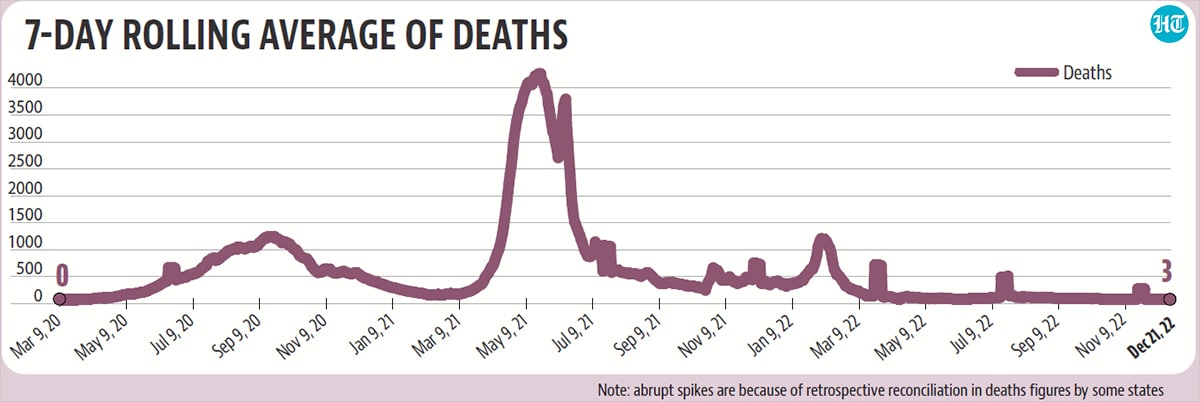
The risk of death is even lower ...
Deaths in India have followed a similar trajectory to cases in India with one difference. The fatality rate was lower in the third wave than in the first two. The peak of deaths in the first wave was 1.25% of the peak in cases, 1.07% in the second wave in 2021, and 0.36% in the third wave this year. To be sure, even a smaller ratio will not be meaningful if cases are overwhelmingly high. For example, despite a lower fatality to case ratio at the peak of the Delta wave, the number of deaths in that wave were the highest. There were a total of 149,036 officially acknowledged deaths due to the pandemic in 2020 and there have been 50,410 deaths in 2022, compared to 332,510 in 2021 (when the second wave took place).
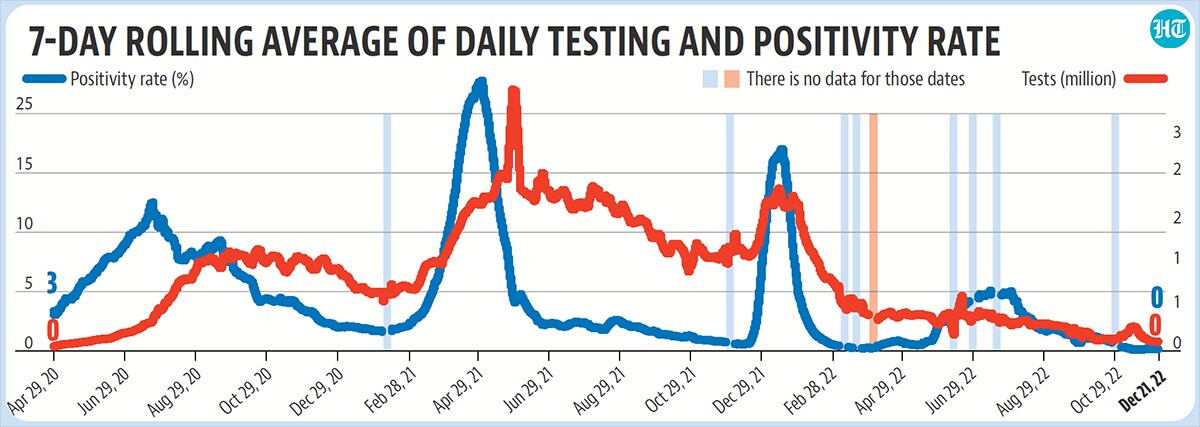
... but there is a possibility of cases going unrecorded now.
The one thing that does not inspire complete confidence in the current Covid-19 trajectory is low testing. Daily tests averaged 108,352 in the week ending December 21, the lowest level since the week ending 28 May 2020. To be sure, positivity rate (the share of tests that turn out positive) averaged 0.14% in the week ending December 21 compared to 5.9% in the week ending 28 May 2020. Since a consistent rate of 5% is considered to be one of the signs of a surge, one can assume safety at the country-level. However, this cannot be said for all states. State-level testing figures are published in bulletins issued by them, which they now publish sporadically or (in the case of some states) not at all.
There will be even lesser need for panic if all people take both their doses and boosters
The case and death trajectory highlighted above clearly shows that a spurt in cases is not happening either at the country or state-level right now. However, as HT pointed out on December 21, this is no guarantee of future protection as around 719 million of 940 million adults are yet to take boosters and a small number (75 million) has not even taken their second dose. This means that around 66% adults had their last shot 6 months ago, 53% over nine months ago, and 11% over a year ago. In addition, a larger share of teenagers (around 60 million out of 145 million) are yet to complete their two-dose vaccination. Fixing this problem and adding a bivalent vaccine that works against multiple variants is not a difficult task for a country that has managed to administer over 2 billion doses. It is also a small cost to pay for living with the pandemic without lockdowns, economic disruption, breaks in school education and all other problems that accompany a spike in cases.