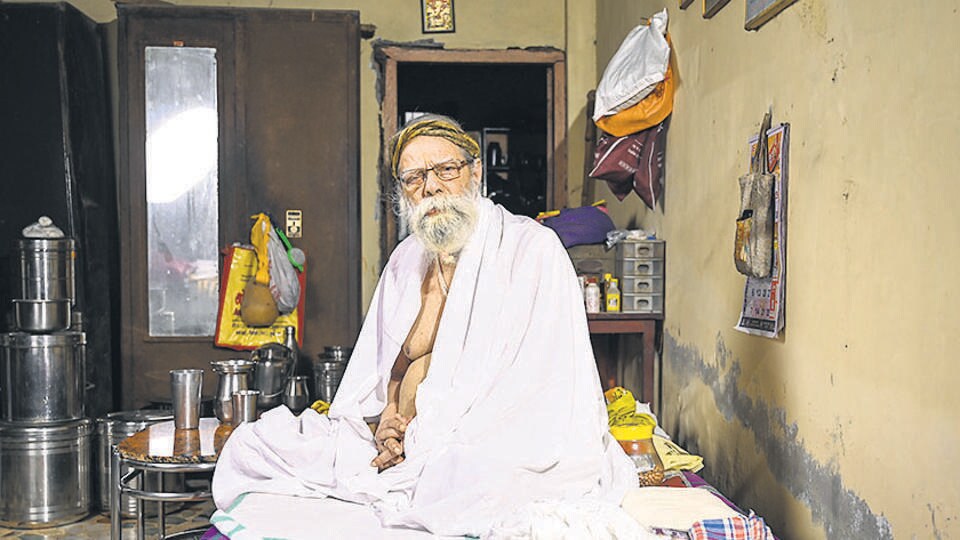
Mahant Dayaram Das, 100, is the head priest of the Veer Hanuman Mandir, located on a hilltop in a densely populated slum at Vikhroli Park Site in eastern Mumbai. He lives in a tiny room right behind the temple and wakes up at 4am every day for morning prayers and a pooja. He has a hearing impairment but is still mobile, although he relies on an assistant who helps him walk and converse with people.
Dayaram Das said compared to the past, there is a lot of chaos in today’s politics. (Raju Shinde/HT Photo )
Ahead of the Lok Sabha elections earlier this year, Das wasn’t sure whether he would be able to exercise his franchise – the polling station where he has been voting for the last five decades is four kilometres away from his home. “Until five years ago, I would go outside the temple premises and take a stroll around, but now I have no strength left to do so,” he says.
Luckily for Das, the Election Commission of India introduced a home voting initiative during the general elections for citizens aged 85 and above, and people with disabilities. “I could not have voted in the Lok Sabha elections, but then I was told that there was no need to go to the polling booth. An official from the collector’s office came to the temple with his entire machinery and a photographer to facilitate my voting,” he says, pointing to a small patch of indelible ink still visible on his fingernail. “I will vote again from my bed this time in the assembly polls, too.”
Das voted in elections for the first time in the mid-seventies, when local politician Shantaram Chavan helped him make his ration card and voter ID. Despite being in his fifties at the time, Das had never voted before that moment, as he had no permanent address to register himself as a voter.
Originally from Uttar Pradesh, Das started his career as a priest in Ayodhya and lived there until 1950. He then spent time at various temples across the country before reaching Mumbai in the early seventies. “I came to this temple in 1972, when my guru Baba Sitaram died. I lit his pyre, and since then, I have been the priest of this temple. Whenever I was in the town during the elections, I would go to the municipal school to vote. But most of the time, I would miss it because of my trips to various temples across the country,” he says.
Das says he has gone to all major temples in India and Nepal. “From Muktinath Temple in Nepal to Parshuram Kund in Arunachal Pradesh, Rameshwaram in south India, Shree Jagannatha Temple in Puri, I have gone to all the pilgrimages in the country. I would, until recently, attend all the Kumbh Melas that are held at four places every 12 years. I got badly injured in the Ghatkopar serial bomb blasts in December 2002. Despite that, I went to the Nashik Kumbh Mela the following year,” he says.
The centenarian has no recollection of his childhood but remembers India’s independence , the horrors of Partition and the assassination of Mahatma Gandhi. “I still remember the chaos after Bapuji was assassinated by [Nathuram] Godse. I was there in Nagpur when the then prime minister came there to inaugurate a Shivaji statue in Sitabardi. Maharashtra chief minister YB Chavan had accompanied him. I was in the crowd gathered on both sides of the roads when our first president, Babu Rajendra Prasadji, was going back to Delhi from Pachmarhi, where he would come during summer.”
Das said he was in Ayodhya when the Babri Masjid was demolished in December 1992, but refused to elaborate further. He is thrilled that a Ram temple has been built in its place. “We celebrated the [temple’s] consecration ceremony here at the Veer Hanuman temple,” he says.
He is aware of contemporary debates in Indian politics, especially the vexed debate around the demands by some right-wing groups and leaders to declare India a Hindu rashtra. But Das says he respects all religions.
“One can’t say whether [the idea of a Hindu Rashtra] is right or wrong. Religions and their leaders follow or do what they think is better and right. I recognise only Ram, and others would know about their religion,” he says, before reciting a religious hymn: “Jahi vidhi rakhe Ram tahi vidhi rahiye, hoga pyare wahi joh Ramjiko bhayega. (One should be happy in their current position, everyone should accept the position in which Ram has kept them).”
Das also says that compared to the past, there is a lot of chaos in today’s politics. He praised former prime ministers Jawaharlal Nehru and Indira Gandhi for being fair and impartial. “They were great leaders and did great work. Nehruji was praised by everyone. Itni dhandali nahi hoti thi. Aaj bahut dhandali chal rahi hai (There would never be such chaos. It is quite chaotic nowadays).”
In his life that has spanned a century, Das has seen multitudes, bearing witness to a changing country. But one thing has remained constant. When asked how he decides whom to vote for, Das says he has always based his decision on reading newspapers meticulously. “When in Mumbai, I prefer Navbharat Times, but I am getting another paper here. In Delhi, I prefer Hindustan. And in Kolkata, I read Vishwamitra,” he says.
Surendra P Gangan is Senior Assistant Editor with political bureau of Hindustan Times’ Mumbai Edition. He covers state politics and Maharashtra government’s administrative stories. Reports on the developments in finances, agriculture, social sectors among others.Read More

 E-Paper