
 E-Paper



S Jaishankar mentions Middle East conflicts, UNSC at BRICS Summit: ‘Widespread anxiety’
S Jaishankar called for a fair and durable approach to conflict resolution that leads to a two-state solution.

 Prefer HTon Google


External Affairs Minister S Jaishankar on Thursday spoke about the Middle East conflicts and reforms in the UN Security Council at the 16th BRICS Summit in the BRICS plus format.
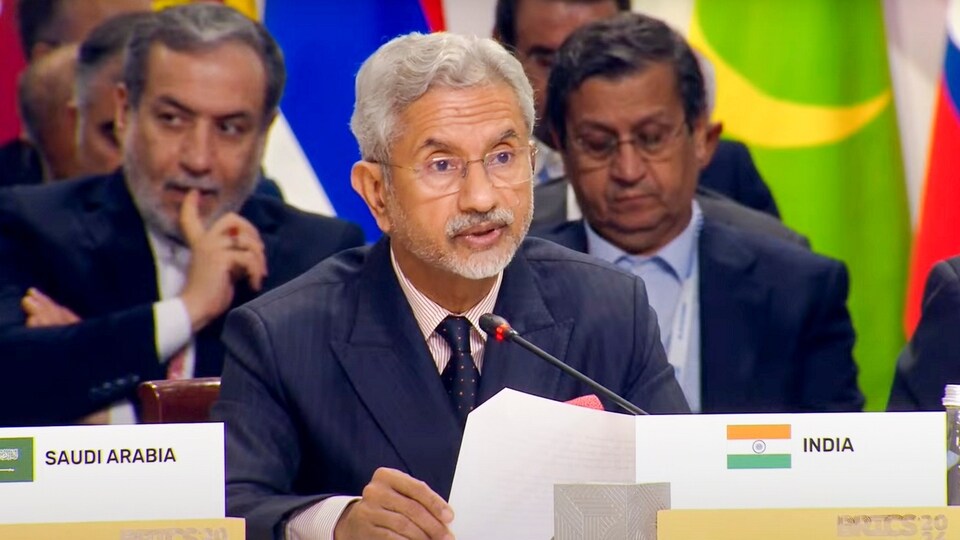
He said there is widespread anxiety that the conflict would spread further in the region. He called for a fair and durable approach to conflict resolution that leads to a two-state solution.
"Addressing conflicts and tensions effectively is a particular need of the day. Prime Minister Narendra Modi has emphasized that this is not an era of war. Disputes and differences must be settled by dialogue and diplomacy. Agreements, once reached, must be scrupulously respected. International law should be adhered to, without exception and there should be zero tolerance for terrorism. The situation in the Middle East - West Asia for us, is an understandable concern. There is widespread anxiety that the conflict will spread further in the region. Maritime trade has also been deeply affected. The human and material consequences of further escalation are truly serious. Any approach has to be fair and durable, leading to a two-state solution," he said at the Summit in Russia's Kazan.
Also read: PM Narendra Modi at BRICS Summit: ‘India supports dialogue and diplomacy, not war’
S Jaishankar elaborated on several measures to create an equitable global order.
"How do we create a more equitable global order? First, by strengthening and expanding platforms of an independent nature and by widening the choices in different domains and minimizing undue reliance on those that can be leveraged. This is really where BRICS can make a difference for the Global South. Second, by reforming established institutions and mechanisms, especially the UN Security Council in the permanent and the non-permanent categories. So too the multilateral development banks, whose working procedures are just as outdated as that of the UN. India initiated an effort during its G20 Presidency and we are glad to see Brazil take that forward. Third, by democratizing the global economy through creating more production hubs... Fourth, by correcting distortions in global infrastructure that are a legacy from the colonial era. The world urgently needs more connectivity options that enhance logistics and mitigate risks. This must be a collective endeavour for the common good, with the utmost respect for territorial integrity and sovereignty. And fifth, by sharing experiences and new initiatives," he added.
Also read: 'You managed to...': Why Vladimir Putin praised India, Modi at BRICS Summit
S Jaishankar pointed out that the world's long-standing issues have become more complex.
"We face the paradox that even as forces of change have advanced, some long-standing issues have only become more complex. On the one hand, there is a steady diversification of production and consumption. Nations that attained independence from colonialism have accelerated their development and socio-economic progress. New capabilities emerged, facilitating the harnessing of more talent. This economic, political and cultural rebalancing has now reached a point where we can contemplate real multi-polarity," he added.
Also read: Narendra Modi to Xi Jinping: ‘Maintaining border peace priority’
Prime Minister Narendra Modi on Wednesday attended the Closed Plenary Session of the BRICS Summit in Russia and said India supports dialogue and diplomacy, not war.
"We support dialogue and diplomacy, not war. And, just as we together defeated a challenge like COVID, in the same way, we are fully capable of creating new opportunities for a safe, strong and prosperous future for the future generation...Similarly, we should work for global regulations for cyber security, safe and secure AI," he said at the event.
He returned to Delhi today.
With inputs from PTI, ANI


