
 E-Paper



SC may set up bench to hear A370 pleas in July
Advocate ML Sharma filed the first petition on August 6, 2019 -- the same day when the presidential proclamation on abrogating Article 370 was issued.

 Prefer HTon Google


The Supreme Court may constitute a five-judge bench in July to take up a clutch of petitions relating to the abrogation of Article 370, thereby withdrawing the special status of Jammu and Kashmir, the reorganising of the erstwhile state into two Union Territories, and on the subsequent delimitation exercise in the region to earmark constituencies for future elections. Some of these have been pending before the court since August, 2019.
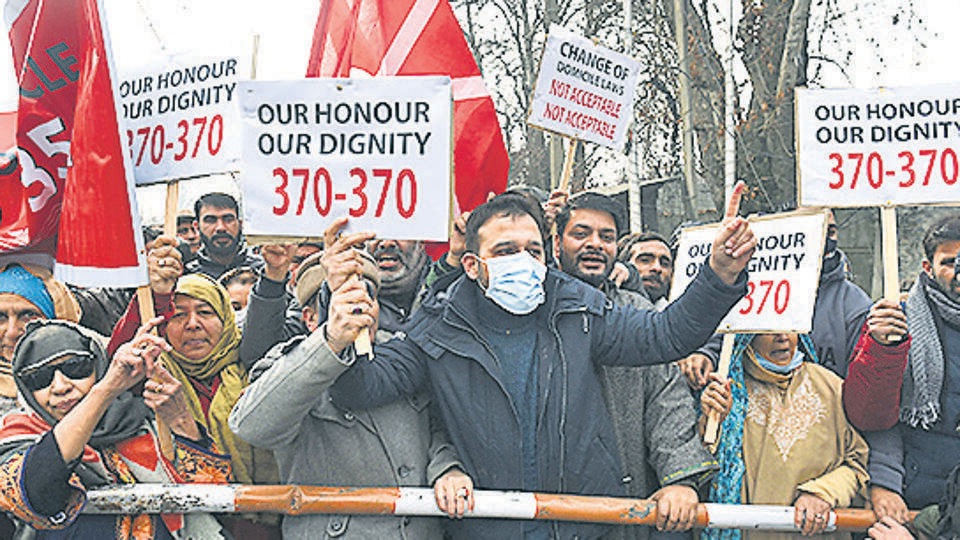
Advocate ML Sharma filed the first petition on August 6, 2019 -- the same day when the presidential proclamation on abrogating Article 370 was issued.
On Monday, Chief Justice of India NV Ramana agreed to consider listing the cases in July after the summer vacation before an appropriate bench. The top court will reopen on July 11 after the vacation, which starts on May 23.
The matter was mentioned by senior advocate Shekhar Naphade, who sought listing of the case citing the ongoing delimitation exercise in J&K.
The CJI responded that he will try to list the case. “This is before a five-judge bench. Give details…we will list it. There are some issues with judges and bench composition,” added justice Ramana.
At this, Naphade, appearing for petitioners that included retired Air Vice Marshal Kapil Kak and former member of the Union home ministry’s Group of Interlocutors for J&K, Radha Kumar, requested that the matter be listed on reopening of the court after the summer break.
“Let me see…after vacation. I will have to reconstitute the bench etc,” replied the CJI.
NEED POLITICAL RESPONSES FROM BJP/CONGRESS/NC/PDP, WHICH SUNETRA AND RAMESH SHOULD ORGANISE
Around two dozen petitions are pending before the top court challenging the Union government’s August 2019 decision to abrogate Article 370 of the Constitution. By abrogating the Article, the Centre revoked the special status of the state of J&K. The state was bifurcated into two Union territories, Ladakh and J&K, after the passage of a law at the same time.
In 2019, the batch of petitions was referred to a constitution bench, comprising justices Ramana, Sanjay Kishan Kaul, R Subhash Reddy, B R Gavai and Surya Kant.
In March 2020, the five-judge bench rejected a preliminary plea by some of the petitioners to refer the matter to a seven-judge bench in view of alleged contradiction in two previous judgments of the five-judge benches in dealing with the interpretation of Article 370. The March 2020 order held that there is no conflict between the two previous judgments and that the petitions could be decided by a five-judge bench. The petitions have not been listed after March 2, 2020.
The petitions challenged the constitutional validity of the J&K Reorganisation Act, 2019 and the August 5, 2019 Presidential Orders nullifying Article 370 that gave special status to J&K. The petitioners include Delhi-based advocate ML Sharma, J&K-based lawyer Shakir Shabir, National Conference Lok Sabha MPs Mohammad Akbar Lone and Justice (Retd) Hasnain Masoodi, bureaucrat-turned-politician Shah Faesal and his party colleague Shehla Rashid.
The PIL by former interlocutor Radha Kumar, Air Vice Marshal (Retd) Kapil Kak, Major General (Retd) Ashok Mehta, and former IAS officers Hindal Haidar Tyabji, Amitabha Pande and Gopal Pillai urged the top court to declare the August 5, 2019 Presidential Orders “unconstitutional, void and inoperative”.
The Sajad Gani Lone-led Jammu and Kashmir People’s Conference (JKPC), in November 2020 moved the Supreme Court demanding early hearing of petitions challenging the nullification of Articles 370 and 35A of the Constitution.
However, after the Covid-19 pandemic restricted the functioning of the Supreme Court which resorted to virtual hearings in March 2020, there have only been two instances when a five-judge bench conducted hearing through video-conferencing. These two cases included a legal tussle on whether Centre or states have the power to provide reservation to in-service candidates in post-graduate medical degree courses and the challenges to Maratha quota law.


