Sign in

Scientists develop method that may lead to more accurate, fast Covid-19 test

The study describing the new method has been published in the journal ACS Sensors.

Updated on: Nov 29, 2020, 09:22:52 IST
Hindustan Times, New Delhi | By
Share
Share via
  • facebook
  • twitter
  • linkedin
Copy link
  • copy link

Scientists have used nanopores (extremely small pores) and electric current to devise a new method to identify viruses. The method will be a breakthrough in new, fast and accurate tests for the coronavirus disease (Covid-19), they claimed.

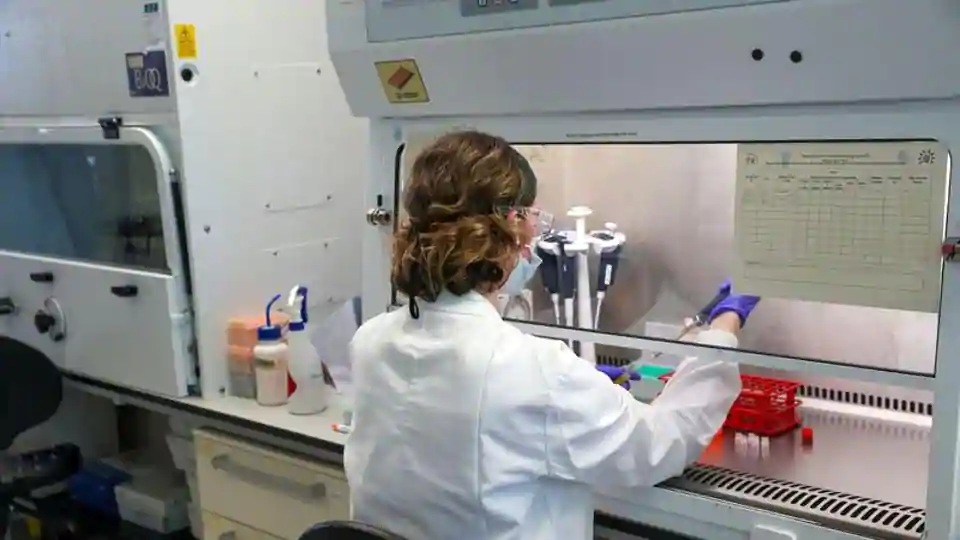
According to the study, the motion of the ions can be monitored by the current they generate, and when a viral particle enters a nanopore, it blocks some of the ions from passing through, leading to a transient dip in current. (Reuters image)

The study describing the new method has been published in the journal ACS Sensors.

Also Read: Scientists try to break down why some people develop Covid-19 as life-threatening disease while others remain asymptomatic

The study demonstrated a new system for identifying single virus particles using an algorithm trained to detect changes in the current passing across silicon nanopores, according to news agency PTI. The team of scientists include those from Osaka University in Japan, it further reported.

The scientists used a layer of the compound silicon nitride - just 50 nanometres thick - with nanopores added, for the study. The layer was suspended on a silicon wafer and when a voltage difference was applied to the solution on either side of the wafer, ions travel through the nanopores in a process called electrophoresis.

According to the study, the motion of the ions can be monitored by the current they generate, and when a viral particle enters a nanopore, it blocks some of the ions from passing through, leading to a transient dip in current. Each dip reflects the physical properties of the particle, such as volume, surface charge, and shape, the scientists said, adding that the method can be used to identify the kind of virus.

Click here for full Covid-19 coverage

The research team combined single-particle nanopore sensing with artificial intelligence to determine the identity of new samples and were able to achieve highly accurate identification of multiple viral species, PTI quoted senior author of the study, Makusu Tsutsui. Coronaviruses, due to their spiky outer proteins, are especially well suited for this technique, researchers said.

“This work will help with the development of a virus test kit that outperforms conventional viral inspection methods,” said Tomoji Kawai, another co-author of the study.

(with PTI inputs)

  • HT News Desk
    ABOUT THE AUTHOR
    HT News Desk

    Follow the latest breaking news, major developments and agenda-setting stories from India and around the world with the newsdesk at Hindustan Times. Operating round the clock, the desk brings together experienced editors, reporters and correspondents to deliver fast, accurate and contextual reporting across subjects that influence public policy, governance, business, society and international affairs. The HT News Desk covers politics, elections, government policies, the economy, business and markets, science and technology, the environment, law and order, infrastructure, education, climate issues and geopolitics, while closely tracking developments across states, institutions and global capitals. The team also leads coverage of major breaking news events, policy announcements, court proceedings, natural disasters, public emergencies and significant international developments. Reports published by the newsdesk are based on information gathered from reporters on the ground, official statements, government agencies, court records, regulatory filings, recognised institutions and other authoritative sources. Stories undergo editorial scrutiny and verification processes to ensure accuracy, fairness and relevance, and are updated as events evolve and additional information becomes available. Whether covering a key political decision in New Delhi, an economic policy shift affecting millions, a landmark court ruling or a major global event, the HT News Desk aims to provide readers with reliable, fact-based journalism that delivers not only the latest developments but also the context and analysis needed to understand their wider implications.Read More