E-Paper



Year after a violent eviction, Dholpur’s displaced wait for succour
It is not pervasive penury that is the cause of Mumtaz’s pain. Her life, as the wife of a marginal farmer, was never one of comfort. Her pain is from the memory of her husband Maynal Haque’s death, the mental picture of the events of that day still fresh in her mind — images that appalled much of India, and that tore her family asunder.

 Prefer HTon Google


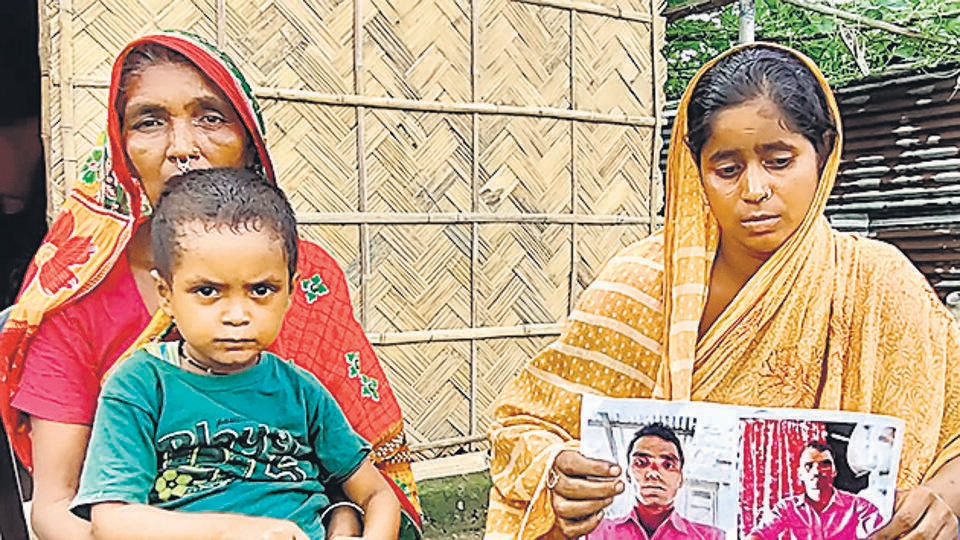
Mumtaz Begum, 29, sits on her haunches, on the floor of her two-room house in Assam’s Kharupetia, her eyes moist. Draped in a brown sari with a floral print, her head covered, she is sad, lost, and angry. Her small home is made of tin sheets and bamboo. In this ramshackle home live Mumtaz, one of her three children, her in-laws, and two brothers-in-law. As she rummages for a photograph of her late husband among the bare essentials scattered across the floor, her four-year-old son cries out in hunger.
It is not pervasive penury that is the cause of Mumtaz’s pain. Her life, as the wife of a marginal farmer, was never one of comfort. Her pain is from the memory of her husband Maynal Haque’s death, the mental picture of the events of that day still fresh in her mind — images that appalled much of India, and that tore her family asunder.
On September 23, 2021, the Assam government carried out a controversial demolition drive in Dholpur-3 in Darrang district, attempting to clear the area of what they saw as 800 families living illegally in settlements close to the banks of the Brahmaputra. The residents protested, arguing that they had lived there for more than four decades, and had been served notices just a day before the demolition. Things turned violent. At around noon, as the media beamed the images live, 29-year-old Haque rushed towards a posse of armed policemen, stick in hand. Before he could reach them though, he collapsed to the ground with a bullet wound in his torso. In the moments that followed, several policemen surrounded his supine body, and started beating him with sticks. Finally, Bijay Shankar Baniya, a photographer assigned by the district administration to capture the event, ran to his body and stomped on Maynal’s chest, even as he breathed his last.
One year later, Mumtaz can still see it all.
The violence during the eviction drive didn’t affect just her. It also claimed the life of 12-year-old Farid Sheikh, who lived 2km away from the demolition site, and was killed in the firing when he had ostensibly gone to collect his Aadhaar card from the local post office. Besides these two deaths, 20 others, including 11 policemen, sustained injuries on that day. Following the incident, the Assam government ordered a judicial inquiry, the details of which are yet to be made public.
Year since the eviction
On September 23, 2021, Mumtaz saw her husband die, and her four-room home in Dholpur, which housed 15 people, razed to the ground. In the days that followed, she moved with her three young children aged between 3 and 14, elderly in-laws, and seven siblings of her dead husband, to a makeshift shelter a few hundred metres away, where all of them spent the next five months.
But the temporary shanty made of tin and bamboo was at the mercy of the elements. The family had also lost not just their home, but eight bighas of land, now taken over by the government, that was their source of sustenance, and where they once cultivated vegetables and paddy. So while three of Haque’s brothers remained, Mumtaz, two of her brothers-in-law, two sisters-in-law, and their parents moved to Kharupetia, a small business town 35km away from Dholpur.
“We moved in February and managed to purchase a small plot for around ₹7 lakh, using all our collective savings. Earlier we used to work in the fields and ate reasonably well. Now me and my brother Ainuddin work as daily wage labourers. The income is irregular, around ₹400-600 a day. Some days, we are all forced to skip meals,” said Haque’s younger brother Jainuddin.
Circumstances have also forced two of Mumtaz’s children to live away from her. While her four-year-old son stays with her in Kharupetia, her 10-year-old daughter still lives in Dholpur with her uncles. Her eldest, a 14-year-old son, has been admitted to a private residential school in Howly in Barpeta district. There was simply no space or land to sustain the lives of the 14 members of the family together.
Mumtaz’s family alleged that, since September 23, they have received no compensation or solace from the district administration, or indeed from politicians. There was no compensation announced by the state government for those killed or injured. “It has been a year since my husband died, but till date not a single government servant, elected representative or minister has visited our family to inquire how we have been sustaining ourselves. The events of that day last year shattered and scattered my family. Who is going to take care of my children now?” asked Mumtaz.
The Darrang district administration rejected allegations of a lack of support to those evicted in Dholpur and said that medical aid and other basic facilities was provided following the violence. “But we need to understand that these people are encroachers and when it comes to rehabilitation, it has to be done under provisions of Assam Land and Revenue Regulation, 1886. According to that, encroachers are not eligible. On humanitarian grounds, we provided those evicted with medical and other facilities,” a district official said on condition of anonymity.
The relocation
The eviction drive in September last year saw 800 families evicted, and 200 homes razed. Officials of the state government said that several of them have been relocated by the administration, while some moved away of their own volition. “Of the families evicted from Dholpur, 544 have been shifted by the administration to seven different places in the Dalgaon circle of Darrang district. Each family has been settled in one bigha of government land which they are allowed to use for residential and agricultural purposes,” Darrang deputy commissioner Pranab Kumar Sarmah said.
Except, those uprooted from Dholpur allege that these sites, where they are now trying to rebuild a semblance of a sustainable life, are far from ideal.
Chaktula Badlibairali, for instance, where 42 families have been shifted, is 8km away from Kharupetia in the middle of paddy fields.
Their homes are shanties, erected with tin sheets, some bricks, and bamboo partitions brought from their former settlements acting as walls. There is no cement road leading to the hamlet, and it is only accessible by foot for well over a kilometre. “We had been staying in Dholpur for over 45 years before we were evicted. My family used to have 8 bighas of land where we grew seasonable vegetables. Now most of us work as daily wagers or help in fields of other farmers. Some families have moved to Kerala and Karnataka in search of work,” said 23-year-old Gulap Hussain.
Hussain said that once they were moved to Chaktula in February, local NGOs installed a few tube wells and some common toilets for the families, but they have had no such assistance from the state government.
“Here there is no electricity, roads or proper drinking water. There’s no clear demarcation of the one bigha plots allotted to us. Several applications to the circle office to clearly demarcate the plots have gone unheeded,” said 47- year-old Bached Ali.
A second official from the Darrang district administration however reiterated that one bigha plots have been given to these families, despite them being “encroachers”. “Any decision on demarcating plots and allotting them permanently to the families will have to be taken by the state government,” he said on condition of anonymity.
GARUKHUTI PROJECT
The Dholpur eviction drive was part of the Bharatiya Janata Party (BJP)-led Assam government’s move to launch a project called “Garukhuti”, an ambitious venture to free 77,420 bighas of land in and around Dholpur from “encroachers” and start agricultural and other allied activities by engaging indigenous local youth.
A society called Garukhuti Bahumukhi Krishi Prakalpa (GBKP) was registered in August 2021 and the state government set up an 11-member committee headed by BJP MLA Padma Hazarika to oversee activities of the project. Till early this year, the project was run by the Darrang district administration, but since August it is being overseen directly by the agriculture department.
“A lot of work has been accomplished in the past 12 months. Currently we have 3,739 bighas of land which are under cultivation in which 32 different crops including maize, mustard and pumpkin have been planted,” said Uddipta Gautam, CEO of the project.
Cultivation in the area is done by GBKP with the 374 locals from nearby villages, called agri-soldiers, employed in the project. Proceeds from the sale of vegetables and other produce goes towards providing salaries to those employed, the procurement of seeds and other materials.
The government has so far also brought 475 cows from Gujarat that produce 180 litres of milk every day. Currently, milk and curd produced by the project are sold in local markets and then sent to Guwahati by a private contractor.
Officials said that the number of those employed is expected to rise to 600 in the coming months. A sum of ₹5 crore has been earmarked for the project in this year’s budget, they added.
“The Garukhuti project will become a showpiece of the efforts undertaken by the state government to remove illegal encroachments and convert those areas to productive agricultural ventures. We have five zones at the moment and there are plans to increase the area under cultivation and start strawberry farming soon,” said Satish Deka, in-charge of the agricultural activities at GBKP.
More evictions to follow
While the eviction drive in Dholpur was the subject of much controversy, it is not the only one that Assam under chief minister Himanta Biswa Sarma has witnessed in the past year.
Replying to a query in the state assembly by Congress legislator Sherman Ali Ahmed on September 12, Sarma said that since May 10 last year when his government took charge, a total of 4,449 families have been evicted for alleged encroachments. According to government figures, the highest number of families, 2,153 were evicted in Darrang, followed by 805 families in the Lumding reserve forest in Hojai, and 404 from government land in Dhubri.
“Another 150 families staying close to the eviction site in Dholpur will be shifted in coming months to Dalgaon. Other villages in the vicinity which had not been evicted as part of the drive in September last year could also be shifted in future,” said the firstDarrang district official on condition of anonymity.
Some local leaders claim the evictions targeted the Muslim community. “These evictions carried out by the BJP government are a political gimmick targeting Muslims. As per the state land policy of 2019, evicted families should get 7 bighas of land, but that has not happened. Eviction is not the solution unless rehabilitation and other needs like education and health of those families are ensured,” said Md Aminul Islam, organising secretary of All India United Democratic Front (AIUDF).
The BJP, however, rejects these allegations. “There have been evictions all over the state and these drives are not targeted against one community. It is against illegal encroachers of government land. Organisations and parties like AIUDF and AAMSU, which have a role in settling people illegally in government lands, shouldn’t be making such accusations,” said Assam BJP spokesperson Rupam Goswami.
For Mumtaz, the looming threat of further evictions in Darrang, reignites a deep-seated fear. She may have been forced to move to Kharupetia, but her daughter and other family members still live in the hutments in Dholpur. An eviction may mean they lose their homes too.
Or, like her husband, their lives.