
 E-Paper



Read an exclusive excerpt from the book Floor Coverings from Kashmir

 Prefer HTon Google


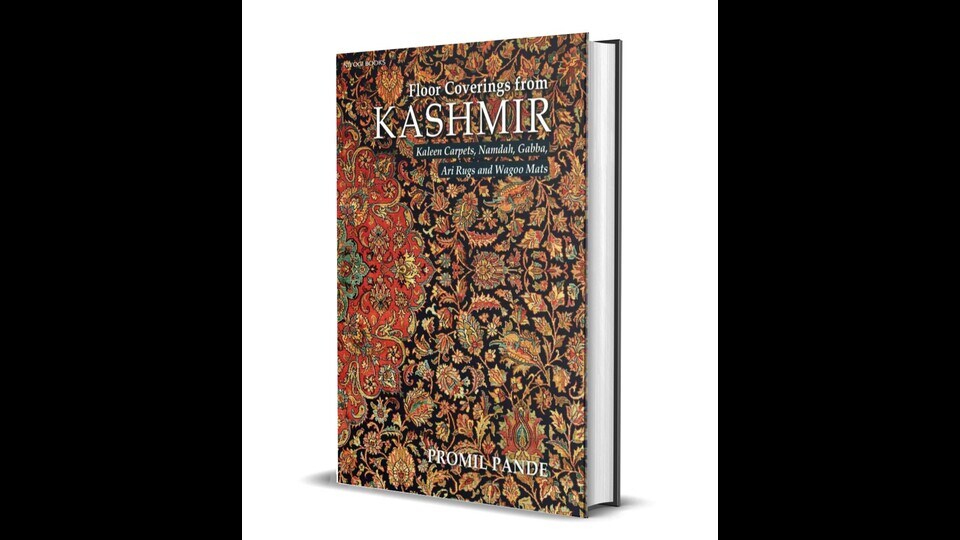
Promil Pande traces ancient traditions and knowledge systems around Kashmir’s unique floor coverings. An excerpt from a section on the wagoo mat.
The golden hued grass mats woven in Kashmir are called wagoo. They have been valued historically for comfort, adaptability and biodegradability, making them commonly used and widespread in both rural and urban family units. Traditionally, the room floors, which were covered by a thin layer of clay blends, after drying, were then covered by the patij and wagoo mats made of straw and paeich. Wagoo was used on floors in dwellings and as floor coverings and enclosures for passengers in boats (Pirie and Pirie, 1909: 18, 233; Jaitley, 1990: 169). They were also utilized in mosques, shrines and houses as their economic viability allowed affordability by all the households. The antiquity of the craft is attributed to the impressions of mat-weaving on the base of pottery excavated at Burzahom and Kanishkapura; however, with the continuous decline in demand in recent years, the mat that once existed in every household is struggling for its existence (Jaitley, 1990: 155; Mani, 2006: NA; Ashraf, 2016: NA).
Wagoo Framework
Unlike the kaleen and embroidered rugs such as the namdah, gabba and ari rugs,
where the spatial boundaries are divided into sections incorporating distinct design compositions, the wagoo does not comprise of a framework constituting of the hashiya, kunjvat and mattan. The entire wagoo constitutes the mattan, framed by the moschuh, selvedge on either side, and the thar on opposite ends. The mattan is patterned using two distinct weaves, categorizing the wagoo mats into two design varieties.
Design Categories
The wagoo mats are woven using undyed patij (rope made of grass from paddy residue) and paeich (reedmace), creating a natural golden hued mat (Figures 7.1 & 7.3). The entire mattan is patterned using one of two weave structures that categorize the wagoo designs into two types: seod or double wagoo and wallkhur or single wagoo. Seod wagoo incorporates the basket weave, while the wallkhur wagoo incorporates the plain or tabby weave.
Craft Practices in Production
The wagivgurs are the artisans engaged in the weaving and production of the wagoo mat. These mats, indigenous to Kashmir, are woven in Srinagar mostly by women, on portable looms fixed into the earth in open spaces surrounding their homes (Figure 7.1). The wagoo is woven to form a thick pliable mat by interlacing paeich in the weft and patij in the warp. Once a popular artefact, it was high in demand, giving employment to numerous artisans as each Kashmiri family could bear the cost of such mats comfortably (Ashraf, 2016: NA). The wagoo is usually 2 m long and 1.5 m wide, woven in either tabby (single) or basket (double) weave structures; however, dimension adjustments are made according to customer requirements and need.
Weaving wagoo, like other craft practices in the region, is also an outcome of a series of sequential tasks executed by the wagivgur that incorporate constituents of regional culture and craft practices.
(Excerpted with permission from Floor Coverings from Kashmir: Kaleen Carpets, Namdah, Gabba, Ari Rugs and Wagoo Mats by Promil Pande, published by Niyogi Books; 2023)


