
 E-Paper



Sear factor: Swetha Sivakumar, on the science of charring

 Prefer HTon Google


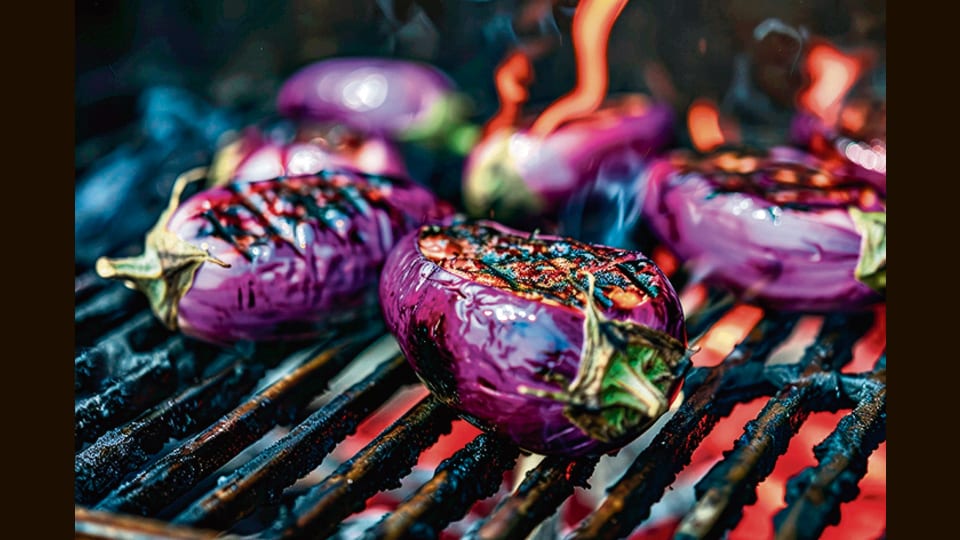
We only recently learnt how to tame fire well enough to allow for precision in the kitchen. Is is possible we love a bit of char, because we’ve always had some?
We’ve talked a bit about charring in the past, mainly as it relates to sugar and the sugars in vegetables and meat.
But burning a kadhai of vegetables recently (one really cannot afford to be distracted in the kitchen) made me think about how rare this kind of event now is, and I began to think about how we got to this point in the kitchen.
It’s easy to forget that our ability to fully control fire and prevent charring, is really very recent.
About 150 years ago, when wood-burning stoves were still the norm even in global cities such as London and New York, blackened spots in food were inevitable. Here in India, one saw them most clearly in naans and rotis, in aloo sabzis, and at the bottom of a vat of biryani.
Today, charring and even burning involve so much less mess. There is no smoke flooding rooms and lungs; no vessel marred, likely for all time.
In our world of stainless steel and silicone, is it possible that part of the reason we love a bit of char is that, for so many aeons, we’d always had some?
I certainly look for some char when eating out. If the phulkas arrive with black spots on them, I know someone out there is using a real tandoor. I know the naan will be thick and crisp, the chicken and paneer smoky.
Across Indian cuisines, we make marvellous use of charring techniques.
It isn’t a baingan bharta if the eggplant doesn’t start out roasted, the skin crackling and peeling away on an open flame. Maharashtrian masalas are enriched with charred copra (dried coconut); finger-licking chutneys are made with garlic, onions, chilies and tomatoes all first roasted on an open flame, then pounded by hand.
A number of ancient cuisines use charring to great effect.
In Mexico, the technique of tatemar (meaning “to put to the fire”) involves charring chillies, onions, garlic, spices, herbs and tomatoes on a flat griddle or an open flame. These fire-roasted vegetables are then pounded into salsas with a mortar and pestle.
Such vegetables feature in Mexican stews such as the mole as well, giving them a deep, savoury flavour. Charred onions and ginger play the same role in the incomparable Vietnamese pho.
To achieve a good char at home, especially on the flame of a gas stove, do not move the food around too much. Resist the urge to rotate it in seconds. Leave it undisturbed, to release its natural juices and develop a flavourful crust. Once you have the desired level of char, rotate to cook other areas.
The key is maintaining a balance between charred and non-charred parts. Behind the bitter, there should ideally be a burst of sweet and salt. Roasted bhutta is a prime example. In this juicy snack of roasted corn-on-the-cob smeared with lime and salt, the surprising bitterness balances out the other bold flavours.
Interestingly, while charred and smoky flavours are often mixed up, they aren’t necessarily the same thing. The reason wood-fired ovens are such a big deal, for instance, is that with wood involved, the smoky flavour comes not so much from the breakdown of elements in the food, as from the thermal breakdown of the fuel itself. And so the smokiness that permeates the food, be it salmon or pizza, takes on a different quality.
Foods rich in fats and moisture absorb smoke well, because these elements bind with the vapours and particles released by smoking fuel. And so, in the absence of an elaborate wood-fired oven, one can smoke meat or buttery kaali dal with just a bit of hot coal drizzled with ghee, placed in a katori in the centre of the pan for a few minutes.
It is worth noting here that charring starchy foods can produce acrylamide, a compound linked to cancer in animal studies. While its effects on humans are still being studied, it is perhaps best to enjoy charred foods in moderation, at least until we know more.
(To reach Swetha Sivakumar with questions or feedback, email upgrademyfood@gmail.com)


