
 E-Paper



Drawing Room: Why Schon Mendes is a fan of Valay Shende’s artworks

 Prefer HTon Google


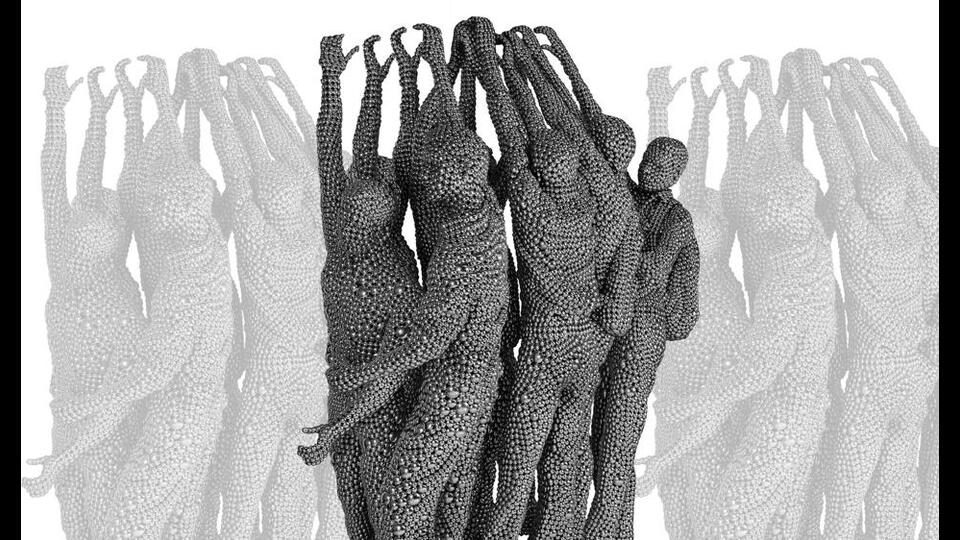
Valay Shende’s Virar Fast, depicts more than Mumbai’s constant state of rush. Despite the struggle, there’s empathy too
I’m drawn to Valay Shende’s life-sized stainless-steel sculpture Virar Fast. It depicts a group of men, shoved uncomfortably close, clinging to an invisible railing. The viewer is struck by the precarious hold they have on the imaginary bar and how they seem crammed into the constrained space. Yet, the figures seem willing to adjust and accommodate, aware and empathetic of each other’s individual struggles. The train after which the work is named is conspicuously absent. It’s represented only by the negative space surrounding the figures. But to anyone looking at Virar Fast, the commute, and what it means in Mumbai, is immediately obvious.
Look closely at the figures. Shende’s sculptures are made of hundreds of steel discs welded together to constitute each individual form. The disks come together to make human forms just as commuters seem to be interconnected as dots, forming the city. They symbolise the atoms and molecules that make all matter in the universe.
For me, Virar Fast represents the hopes and aspirations of the millions of youth who move to Mumbai for work. It’s their energy and vigour that collectively converges to keep the city in motion. Using only the steel discs, it evokes the sounds, sights and scents of a crowded local Mumbai train, and the crush of human beings continuously in transit. It reiterates that life is essentially a journey, in which people metaphorically speed past railway stations, moving towards an eventual destination. And while the figures seem frozen in the moment, they reflect the movement, activity and pulse of our times.
I first saw Virar Fast as part of the show Spirit of Bombay at Phoenix Palladium mall in Mumbai in 2019. On viewing the hundreds of glimmering steel discs welded together, it’s tempting to believe that the material was chosen merely for its seductively luminescent and reflective quality. In reality, however, it deconstructs the human form as an elementary and elemental unit. It emphasises the fact that all beings are composed of the same substance.
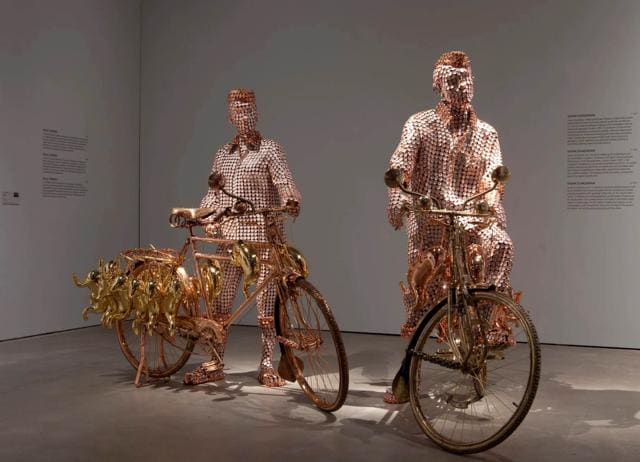
Shende’s father was a scrap merchant, so he grew up alongside machinery and metal scrap objects. I believe this early exposure influenced his art, and I see it play out in the attention he pays to people from the most humble walks of life. In many of his sculptures, he attributes an iconic, larger-than-life persona to those who may be unseen but play a significant role in society.
Schon Mendes grew up in Goa and is based in Vadodara. Goa’s visuals, iconography and culture have shaped his artistic language. His work depicts the human condition, highlighting people, their attitudes, views and behaviour.
From HT Brunch, November 02, 2024
Follow us on www.instagram.com/htbrunch


