
 E-Paper



UP’s incomplete tryst with ‘vikas’: A village deprived of basic development
Though the UP chief minister Akhilesh Yadav claims credit for high-end projects, the development needs of this Muslim majority village are more basic.

 Prefer HTon Google


A rough road leads up to Machrihawa primary school in Haripur Rani block of district. It is afternoon, and the school is deserted. But soon, a crowd gathers.
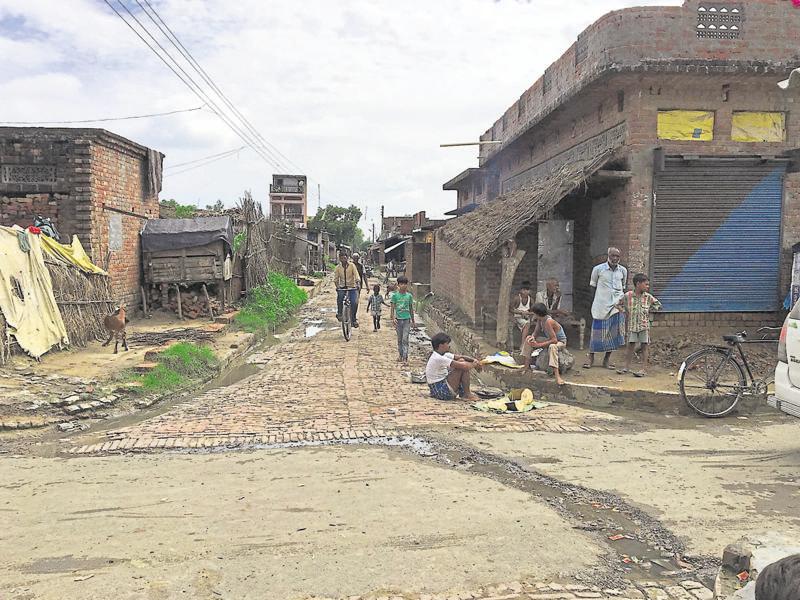
A parent complains the quality of education is poor. A young man wants opportunities at home so that he does not have to migrate. A teacher points to an electric transformer, and says it has not been replaced for 25 years.
Back in Lucknow, political parties have promised that the 2017 elections will be fought on development. Uttar Pradesh chief minister Akhilesh Yadav has claimed that his achievements include expressways, metro lines and upgrading city infrastructure. Mayawati has said she will not build any more statues, but focus entirely on development. The BJP says that because it is in power at the Centre, it can deliver development in the state if elected. But what does this ‘vikas’ mean on the ground? In Machrihawa, the development needs are more basic. So would be the case in a majority of UP’s 97,000-odd villages.
Read | Akhilesh woos Brahmins with cabinet expansion ahead of UP polls
The development matrix
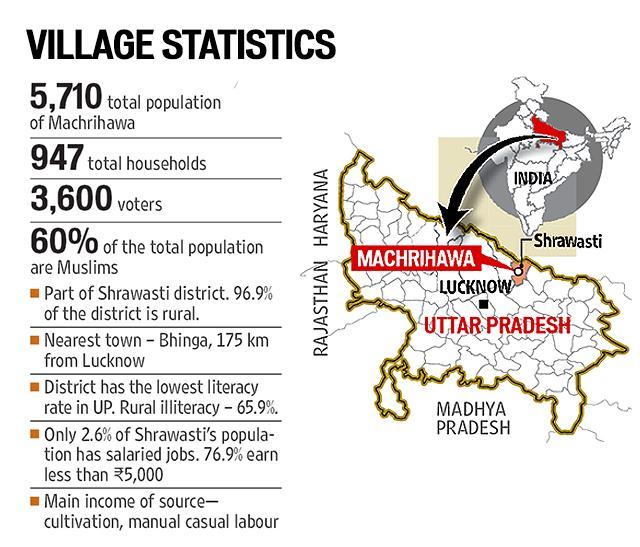
Shrawasti is in UP’s Terai region, which itself fares poorly on development indicators in the state. According to the Socio-Economic Caste Census of 2011, Shrawasti is over 96% rural. With only 34% rural literacy, it has the highest illiteracy in the state. Only 1.3% of Shrawasti’ s rural citizens are graduates. Almost 77% earns less than Rs 5,000 per month, and another 16% earns between Rs 5,000 and Rs 10,000. Within UP, Shrawasti is behind the development curve. Within Shrawasti, Machrihawa is way behind even a smaller urban centre like Bhinga. And within Machrihawa itself, certain communities seem more advantaged than others.
Two figures play an important role in the entire development apparatus: the Village Development Officer( V DO) and the gram pradhan. The V DO is responsible for the registration of all the births, death sand marriage sin the village. But their more onerous responsibility is of implementing ‘vikas’.
Explains Balaster Singh, the VDO for Machrihawa: “From ponds to tree plantations, from panchayat buildings to libraries, from hand-pumps to MNREGA, from widow pensions to allowances for old and disabled, from repairing ditches to ensuring street light, from drainage to housing, I identify the beneficiaries, or prepare the schemes with the pradhan, or funds are channelled through us.”
Politics of ‘Vikas’
But here is the rub. These development decisions are not made in a political vacuum. Village hierarchies and politics begin to play a part.
Machrihawa is a Muslim-dominated village. The village pradhan is Sudhir Singh, but his father, Narendar Singh, has the real power. The father says there are over 3,600 voters in the village, out of which 60% or so are Muslims, and less than 10% are forward castes. Yet, when asked if Muslims get elected as pradhans, Narendar Singh says, proudly, “There has never been a Muslim pradhan. They always vote for us. We take care of them.”
A Muslim villager subsequently told HT, “The forwards — Thakurs and Brahmans — use money and muscle and rotate the position. They control the village budget and do what they want. The assembly elections will change nothing for us on the ground.”
Read | UP game changer? Congress’ loan-waiver campaign for farmers gains ground
The space for discretion and corruption has reduced somewhat with Direct Benefits Transfer, but a government official admits that it still exists. In Machrihawa, for instance, about ` 20 lakh comes in annually for various development schemes. “Estimates are inflated and everyone takes a cut,” says one district official.
Machrihawa’s story is the story of UP’s incomplete tryst with ‘vikas’, development in one of the state’s most ‘backward districts’. The demands for development projects — housing, pensions, MNREGA, roads, drainage, jobs, school buildings—constitute the dominant relationship people in rural areas have with the‘sarkar ’. This development creates opportunities for improving livelihoods. It also creates opportunities for corruption and consolidating the hold of the more powerful social elites. How UP’s new government, elected in 2017, tackles the more general challenge of under-development with particular focus on the under-privileged will be a key test. Residents of Machrihawa will surely be keen to know the outcome.


