
 E-Paper



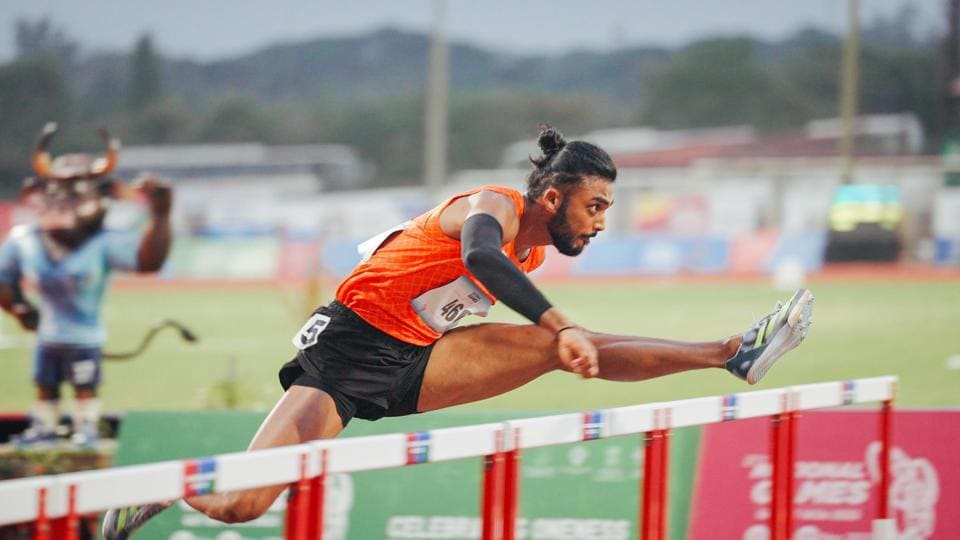
How Tejas Shirse turned a ‘gone case’ into a CWG shot
The 24-year-old hurdler from Maharashtra recovered from a serious ankle injury to come back even stronger

 Prefer HTon Google


Bengaluru: In mid-February this year, when Tejas Shirse sat down with his support team to assess where his season stood, the conclusion appeared obvious.
Forget the Commonwealth Games.
The 24-year-old hurdler from Maharashtra, who is a Reliance Foundation athlete, was still recovering from an ankle injury he suffered late in 2025. The qualification standard looked unrealistic, the timeline too short and the risk of rushing back too great.
“It was the sensible thing to do,” Shirse told HT from his training base in Poland, where he is putting the finishing touches on his preparations for the Commonwealth Games.
Injury had forced reality upon everyone around him. Shirse chose to cling to hope.
“In my mind, I was always like, ‘I want to go to Commonwealth Games. But I’m not going to force myself to do that’. “
Soon after his four-month injury-induced layoff, he posted a 13.27-second run at the Indian Athletics Series in June. It not only earned him a place at the Commonwealth Games but also broke the 110m hurdles national record – which he had set earlier. It also ticked off the first entry on a manifestation list he had scribbled on his iPad months earlier.
“The first thing on it was 13.27,” he says with a smile. “I ran exactly that number. Even if it had been 13.26 or 13.28, I would have been happy. But getting exactly 13.27 felt like a blessing.”
The next item is considerably more ambitious.
“Go to the Commonwealth Games and hopefully come back with a gold medal.”
The optimism is striking considering where he was only months ago.
The injury, suffered late last year, left multiple ankle ligaments badly stretched. At first, Shirse feared the worst. “I called my physio immediately and said, ‘Sir, I think I’ve messed up.’ I thought my career was over. It looked like I could never race again,” he says. “I had lost hopes of this season. I thought like, ‘okay, Commonwealth Games is a gone case.’ So, to be able to compete in Glasgow is like a bonus for me.”
The scans ruled out a fracture, but the rehabilitation ahead was extensive.
Unable to hurdle or sprint, he redirected his energy into the gym. His coach had one simple instruction.
“He wanted me to come back from the gym completely exhausted every day. Even if I wasn’t on the track, I had to feel like I had put in the work.”
Those months, he says, changed his body in unexpected ways.
His rehabilitation gradually evolved into strength work focused on both ankles. The result was not merely recovery but improvement.
“My ground contact is better now and I’ve dropped down time,” he says. “First we made sure the ankles were healthy. Then we worked on making them really strong.”
That painstaking process also erased the psychological scars that often accompany serious injuries.
“The key is trusting your rehab,” he says. “If you rush it, you’ll always have doubts. If you’re standing on the start line still wondering whether your body will hold up, then something has gone wrong before that. When you’ve done everything properly, that fear disappears.”
His comeback has coincided with one of the strongest phases of his career. He heads into the Commonwealth Games knowing the challenge will be formidable, with Jamaican and South African hurdlers expected to dominate the field.
But hurdles, he says, ultimately strip the race down to something simple.
“It’s my lane and 10 hurdles. Everyone has to cross the same hurdles. I’ll try to be the first one across.”
He knows the Asian Games in September is a more realistic target for a medal.
Sprint hurdles remain among athletics’ most technically demanding events, requiring explosive acceleration, rhythm and precision over barriers separated by fractions of a second. Ask Shirse what the biggest challenge is and he answers with characteristic brevity.
“Not getting tired.”
The technical improvements are important, but what fascinates him most is the mental state that produces his fastest races.
A perfect race, he says, is not one he remembers.
“If I’m running well, my mind and body are completely in sync. I don’t remember much afterwards. If I’m making mistakes or thinking about results or other runners, I’ll remember all of that. A perfect race for me is when my mind goes blank.”
Before races, he limits himself to one or two technical cues – perhaps keeping his arms tighter or leaning correctly – and repeats them throughout the warm-up until they become instinctive.
Away from competition, Shirse speaks warmly about the fraternity among men’s hurdlers. Unlike many events where rivalries can become intense, he says competitors often appreciate what others achieve because they understand the event’s difficulty.
“When I broke the national record, a lot of athletes I compete against messaged me. They were saying, ‘Now we’ve got to run faster’.” The next few months will determine whether his remarkable comeback gains another chapter.
The manifestation list has already delivered once.
He is hoping it has one more tick left in it.


