
 E-Paper



Sharath Kamal blooms as table tennis hits an Indian high
Mixed doubles remains a realistic medal hope, says the nine-time men’s India champion.

 Prefer HTon Google


“I just wish,” Sharath Kamal says with a sigh, “this had come around a decade ago.
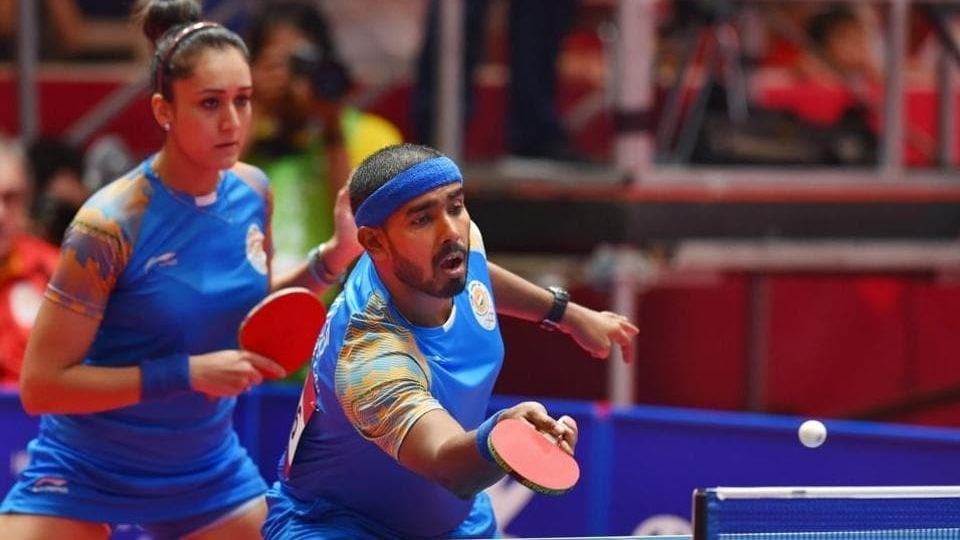
“This” is him feeling fit as a teen at 38; playing some of the best table tennis of his professional career close to two decades into it; being optimistic that his most productive Olympics --- his fourth, the most out of the officially qualified Indian athletes so far— would be in Tokyo one year before he turns 40.
“But, better late than ever,” he adds. “I guess everything has its own course of time.”
Sharath’s time, incidentally, has coincided with a high in Indian table tennis. His best shot at an Olympic medal in the twilight of his prolonged career is also the country’s brightest chance yet of a first table tennis medal at the Games --- in mixed doubles partnering Manika Batra. It comes after the record nine-time national champion’s growth as a player which coincided with the sport’s performance and popularity reaching levels seen never before in India.
In Tokyo, Sharath will have G Sathiyan for company in singles, both being inside the top-40 in the world rankings. Then there’s Batra and Sutirtha Mukherjee rounding off the quota of four singles players, and the Sharath-Batra pair looking to build on their historic 2018 Asian Games bronze at the Olympic stage. The players are likely to be followed by millions back home who celebrated their achievement three years ago at the Commonwealth and Asian Games.
Contrast that to the 2004 Games in Athens, where a 22-year-old Sharath—fresh from winning his maiden national title a year ago—made a quiet entry into his first Olympics as one of only two qualified paddlers (along with Mouma Das).
“When I started off in Athens, I didn’t even realise that I was playing the Olympics for India and what it actually meant. Sure, going into the Olympics you tell everybody, ‘I want to win an Olympic medal for the country’. But in reality, I knew it was very far-fetched. And nobody expected that from Indian table tennis as well,” says Sharath.
Ditto four years later in Beijing, where the Indian representation from the sport remained static, the difference being Sharath’s compatriot in women’s singles (Neha Aggarwal). Around that period, though, Sharath had established himself as India’s most proven table tennis performer. He gave the country its first Commonwealth Games (CWG) singles gold in the sport in 2006 in Melbourne, became the first Indian to clinch an ITTF World Tour title (now called Pro Tour) at the 2010 Egypt Open, won a bunch of international championships on the circuit, broke into the world top-50 for the first time in 2010 and was the undisputed numero uno in India, winning the consecutive national championships from 2006 to 2010.
Yet, his Olympic sojourn at Athens and Beijing was derailed in the second round. “At that point, the Commonwealth level wasn’t as high as it is now; success at the CWG couldn’t be compared to the Olympics. So even though I had won that CWG gold and a few international tournaments, at the Olympic level or the elite world level I was still a small fry,” says Sharath. “Even then,” he is quick to add, “I believe I would’ve had a fair chance of doing well in London if I had qualified.”
Hitting a low
The turn of the previous decade brought with it a steep slide that almost ended Sharath’s career. He failed to qualify for the 2012 London Games, losing to a lower-ranked Slovak in the second round of the world qualifiers. His iron-hold on the domestic scene was also melting when in 2011 Anthony Amalraj beat him in the final before a 19-year-old Soumyajit Ghosh stunned the six-time champion the next year.
“I hit my lowest point there,” Sharath says. “That was the only time I actually contemplated quitting the sport. I was into my 30s, and I thought, ‘Is there any point in carrying on?’”
The hunt for that answer led to the transformation of Sharath the paddler. Like most sport, table tennis was changing with increased use of technology, advent of data and younger pros shaking up the way the game was played. For Sharath, a predominantly forehand player, it meant adding a more solid backhand and the art of a deft touch to his power game.
“Earlier, I used to play only the forehand, and I am still pretty much a forehand-dominated player. But now I have a decent backhand, which wasn’t so good back then. I had to work really hard on it,” he says.
“I lost a few years in that struggle, and a lot of confidence.”
Just as he was gradually getting it back, a hamstring injury in 2015 pulled him down. Sharath spent months away from home recuperating in Germany, where he has been a regular in their prestigious league for around a decade. The injury took away the most of 2015, which hampered his preparations for the 2016 Rio Games where he exited in the first round.
“The injury was ill-timed,” Sharath says. “But that’s how it goes. When it comes too easy, then maybe you don’t respect it and value it as much as I do now.”
The upswing again
All those months of work and sweat before the injury was, however, not to be tucked into cold storage. It soon began to bear fruit, for Sharath personally as well as for the sport in India.
But first, it was imperative for Sharath to reaffirm his status as India’s best, which he did in 2016 by beating Ghosh in the final to end his six-year wait for another national title. “I needed that for my head,” he says. “To feel, ‘Ok, now I can push on for bigger things.’”
He did push alright. Sharath was back to his dominant self domestically breaking Kamlesh Mehta’s 23-year record of eight national titles by defending his title in 2018, which also turned out to be a watershed year for Indian table tennis.
Never before had India shone so glowingly as a table tennis nation than in the 2018 CWG in Gold Coast. Eight medals across seven events was an unprecedented feat, with Sharath contributing to three of them (team gold, men's doubles silver, singles bronze). It was no fluke at the Asian Games—with an even tougher field comprising powerhouses like China, Japan and Korea—proved a few months later. Before 2018, Indian paddlers had zero medals at the Asian Games; in Jakarta they got two, Sharath playing a key role in winning bronze with the men’s team and mixed doubles alongside Batra.
Batra and Sathiyan were the rising stars and Sharath was happy for them to share the spotlight. “Only when more athletes win major titles for the country at the international stage will any sport get its due recognition. I think that happened for table tennis in India at that point,” he says.
“We did very well at the CWG, but more importantly we stood up to the expectations at the Asian Games. Not just us, even younger players like Manav Thakkar (who became junior world No. 1 last year) and Archana Kamath (who became the first Indian paddler to enter a Youth Olympic Games semi-final in 2018) were doing very well in the junior circuit. So there was a lot of promise in Indian table tennis.”
Carrying the group
Sharath hopes to take that promise to Tokyo where, despite the pandemic-hit preparations, he says the unlikely dream of a table tennis medal is now a realistic shot in mixed doubles. Sharath also has Sathiyan and Batra to share the load of delivering India’s best-ever showing in singles. “Still, somehow, people do look up to me,” Sharath says. “That pressure will always stay, and I think it has become a part of my character and who I am—someone who takes the group along. Over the years I’ve understood how to work with that pressure instead of trying to evade it. And I’m better equipped to handle it now than before.”
In March last year before the pandemic halted sport, Sharath won a Pro Tour title in Oman after 10 years. He returned from the break to beat world No. 16 Patrick Franziska in the first international tournament in Doha earlier this year. He is currently ranked 32 in the world, by far his highest in the lead-up to any of his Olympics.
“I’m a more complete player now: mentally, physically and psychologically,” says Sharath. “And I expect the best performance from myself now, forget about anyone else expecting from me.”
His mind darts back to the “I wish” phrase. But it quickly glides to the present, and the future.
“If I had done what I feel I can do now back in London, maybe it would not have been so prominent,” he says. “Because it would still be just Sharath Kamal out there. Now, there’s Sharath Kamal, Manika Batra, Sathiyan and all those promising younger players around us.”


