
 E-Paper



The $160,000 Mechanic Job That Ford Can’t Fill
Ford’s CEO says 5,000 jobs are open. Mechanics say there is little wonder why.


 Prefer HTon Google


KENT, Ohio—Just after 7 a.m. on a recent morning, Ted Hummel leapt up onto the front bumper of a 2019 Ford F-150 and reached under the hood to disconnect a pair of oxygen sensor connectors.
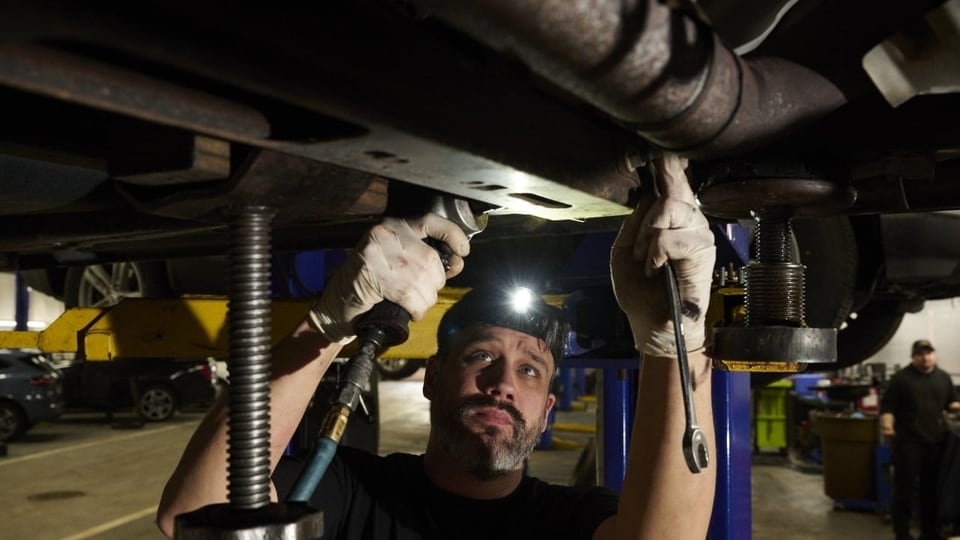
It is the first step of dozens to replace the truck’s transmission, a job that is expected to take about 10 hours. Hummel is confident he can do it in half the time. “I should have it out of there by lunch,” he said.
Most mechanics at the Klaben Ford dealership in Kent, Ohio, hate messing with transmissions, the duffel-bag-shaped, 300-pound machines that transfer power to the vehicles’ wheels. Hummel is one of the few who relish diagnosing their problems, taking them apart and finagling them in and out of trucks.
A soft-spoken, 39-year-old father of two, Hummel is one of Ford Motor’s highest-status automotive technicians—a “senior master.”
For that, he is rewarded. Hummel said he earned about $160,000 in 2025. There is almost always a transmission for him to work on, and in the unconventional system for mechanics’ pay, Hummel’s efficiency means more money for him and for his dealership.
“I wish we could clone Ted,” said Sean Bradford, Klaben Ford’s service manager and Hummel’s boss.

There aren’t enough Teds. Not only at Klaben Ford, but across the country.
The automotive industry has faced a shortage of mechanics for decades, and Ford Chief Executive Jim Farley put the issue back in focus in November. Speaking on a podcast, Farley said Ford dealerships have 5,000 open jobs.
“We are in trouble in our country,” Farley said. “A bay with a lift and tools and no one to work in it.” Farley said the jobs can pay $120,000 a year, but they take five years to learn.
Only a small sliver of mechanics stick around long enough to get to that level of pay. The work is physically grueling. It is costly to start because mechanics need tens of thousands of dollars worth of tools. And the starting pay is closer to fast-food wages than to six figures. The 2024 median pay for a dealership mechanic or technician in the U.S. was $58,580, according to the Bureau of Labor Statistics.
The costly path to six figures
It was these sorts of promises that helped lure Hummel into the profession. Hummel got a two-year degree focused on automotive technology that cost about $30,000.“They always advertised back then, you could make six figures,” he said. “As I was doing it, it was like, ‘This isn’t happening.’ It took a long time.”
Hummel’s automotive trade school helped him land his first job at a muffler shop in 2007. He said he earned less than $10 an hour. After a stint at another shop, he joined the Ford dealership in 2012. Hummel’s path to a six-figure paycheck with benefits required him to put up his own money.
Like most dealership mechanics, he had to buy his own equipment, frequenting “tool trucks” to finance thousands of dollars in gear on payment plans up to $200 a week. These days he owns his own tools, like specialized torque wrenches—required by Ford—that cost up to $800 apiece.
While his earnings grew from year-to-year, Hummel found that six-figure payday elusive. Some of it he chalks up to bad luck. One year, for example, he developed a herniated disc, which caused him to miss about two months of work.
His pay increased when he achieved Ford’s highest certification in 2015, allowing him to command a higher rate for his work. He also started supervising apprentices, for which the dealership pays him extra—accounting for about a third of his earnings, he said.In 2022, a decade after he started at the dealership, he finally crossed the $100,000 mark. He was 36 years old. “I think it was a great accomplishment,” he said. “It felt good.”
Racing the clock
One of the hardest parts of the job—and the reason it can be so lucrative for skilled operators like Hummel—is racing the clock.The way pay works in most dealership service departments is essentially a piecework system called “flat rate.” Technicians are paid a fixed amount per job, regardless of how long the work actually takes. Making six figures requires working fast, so you can bill more hours than you actually work.

Back when he was starting out, Hummel said a transmission job could take him 15 to 20 hours. He had to walk back and forth between the truck and his workbench checking Ford’s workshop manual to ensure he followed each of dozens of steps in order.
But now, Hummel is like a chef who has memorized a complicated recipe.
On that overcast morning with the F-150, Hummel stood on his tiptoes and reached both arms overhead into the tight crevices under the pickup. With his eyes closed and his face grimacing, he grappled for a bolt. He needed to get it onto a two-foot-long metal rod called a socket extension.
“I know where it is,” he said through the grimace. “I just can’t see it.”
As Hummel moved through the job, a nice payday was shaping up for him. Ford is set to reimburse 14.6 hours for this job, even if Hummel can do it in less than half the time.
While the flat-rate system has made Hummel’s career, it has also ended many others.
Russell Wickham, a technician at a Chevrolet store in Indiana, worked for several dealerships across three states for about a decade. The most he grossed was about $89,000 in 2022, he said.
“There’s no guarantee,” he said. “If the customers aren’t coming in, they don’t have a problem letting you sit around because you’re not costing them anything.”
Rich Klaben, president of Klaben Auto Group, which owns Klaben Ford, said the flat-rate pay system is the best way to reward fast workers like Hummel. “We need productivity. If we get productivity, we can pay,” he said.

Consumers are paying, regardless. The costs of car maintenance and repairs have been rising faster than inflation—up 6.9% in November from a year earlier, according to data released in December. But wages aren’t keeping up. While car-repair costs rose 59% from 2014 to 2024, mechanic wages grew by 34% over the same period.
Ford said senior master technicians like Hummel average about $67,000 after five years on the job, while only those “at the pinnacle of the profession” earn $120,000 or more. The company said it is working to address the mechanic shortage. Ford operates 33 technician training centers around the U.S. and offers scholarships to help with tuition and tools, among other initiatives.
Physical toll
Hummel was running ahead of schedule when the job entered its most physically taxing phase. He had to pull the 100-pound transfer case out of the truck’s underbody.That is when Hummel called for help. He is careful not to risk lifting more than he can handle, minimizing bodily wear-and-tear that might compromise his ability to do the job.

Like Hummel, Jim Eisenberger, 37, was another transmission-changing expert who earned six figures at Klaben Ford. But the physical wear got to him.
Eisenberger, who is married with two children, had a pair of hernias and put off surgery as long as he could. If he was out, he wouldn’t earn a paycheck.But after finally getting the surgery, he said he still felt creeping discomfort in his midsection. “I still pushed, and I tried to turn as many hours as I could, but it was never the same,” he said. He left the job a year ago to pursue a startup producing digital guides for mechanics.
‘Smooth’ return
As Hummel predicted, before his lunch break, he had gotten the old transmission out of the truck and was ratchet-strapping the hulking new transmission onto a jack to pump it up into place.
Once fully installed, all that was left was for Hummel to give the new transmission a test drive. He took the truck out on the four-lane highway dotted with other car dealerships.

“Everything feels pretty smooth,” Hummel said. After about 5½ hours of work, Hummel logged the completion of the job into the computer and turned in the keys.The remainder of his day was padded with easier work: He figured out what was causing a Lincoln Corsair’s check-engine light to come on (purge valve was stuck) and prepped another Corsair that just arrived from the factory.
The next morning at 7 a.m., he was ready for another transmission.
Write to Christopher Otts at christopher.otts@wsj.com


