E-Paper



What the fate of Imran Khan means for Pakistan
If the PTI and the Opposition PDM array their supporters against each other, as it now appears, Pakistan’s politics could take a messy turn into chaos and further uncertainty

 Prefer HTon Google


Pakistan has been on edge for the past few weeks over the fate of Prime Minister Imran Khan, whose government is set to face a crucial vote of confidence in Parliament on March 28, with the odds decidedly not appearing to be in his favour.
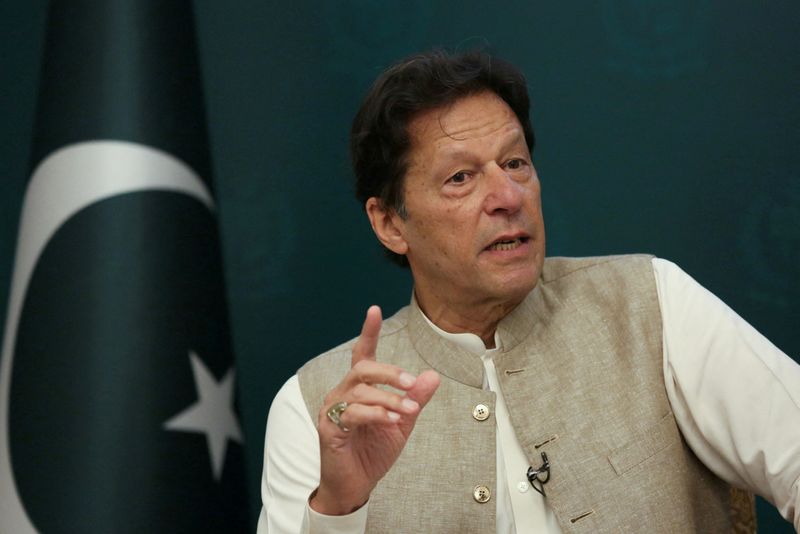
The government led by Khan’s Pakistan Tehreek-e-Insaf (PTI) party has squared off repeatedly in recent days with the Pakistan Democratic Movement (PDM), which has the backing of Opposition parties such as the Pakistan People’s Party (PPP), Pakistan Muslim League-Nawaz (PML-N), Awami National Party and the Jamiat Ulema-i-Islam faction led by Maulana Fazlur Rehman.
In an apparent bid to stymie the vote of confidence, the PTI announced on Sunday it would hold a public gathering at a square right outside Parliament in Islamabad as a show of strength on March 27, a day before the vote.
Hours later, the PDM said on Monday that the workers of the parties in the alliance would begin a “long march” towards Islamabad on March 23 with the aim of holding a sit-in protest at the same square outside Parliament till the completion of the vote of confidence.
Amid the uncertainty, the chief Pakistani military spokesman, Maj Gen Babar Iftikhar, told a media briefing last Thursday that the army was neutral on the issue of politics. “I have said it earlier that the army has nothing to do with politics. It is better for all of us to avoid unnecessary speculation on this matter,” he said.
An astute political analyst in Islamabad, who preferred not to be named, said the military’s position has added to the current state of uncertainty. “The army is like the gravitational force in Pakistan’s politics. Everything gravitates towards it and all the political players are just satellites,” he said.
According to the buzz in Islamabad’s political circles, Khan is on a sticky wicket and this has been reflected in his public outbursts in recent days. In an apparent dig at the army, Khan told a public gathering on Friday that “only animals are neutral”.
He added, “Human beings pick a side and stand with truth.”
Khan also challenged the Opposition to move the no-confidence motion against him in the National Assembly or lower house of Parliament, so that he could take the wickets of PPP leader Asif Ali Zardari, PML-N leader Shehbaz Sharif and Fazlur Rehman “with a single delivery”.
As things stand now, political analysts and Opposition leaders contend the PDM has some 160 lawmakers from the parties in the alliance and the backing of 40 more MPs, including dissidents from the PTI – more than adequate to unseat Khan as the prime minister.
The PTI government agreed on holding a vote of confidence on March 28 so that it could use the intervening period to try to convince its allies in the ruling coalition, such as Muttahida Qaumi Movement (MQM), Pakistan Muslim League- Quaid e Azam (PML-Q) and Grand Democratic Alliance, to remain on Khan’s side.
Some believe the PTI is also using this time to mend fences with, and regain the trust of the powerful military. Ties between Khan and the military establishment were affected when the prime minister held up the appointment of a new Inter-Services Intelligence (ISI) chief for weeks last year.
According to insiders, Khan dragged his feet on making a formal announcement about the next ISI chief for various reasons. Some said Khan believed the then ISI chief, Lt Gen Faiz Hameed, should remain because of the role he had played in shaping developments in Afghanistan. Others even contended that Khan’s wife, a pirni or spiritual guide, had suggested the time was not auspicious to make a change in the ISI.
The powerful army was upset as it had already made an official announcement in early October last year that named Lt Gen Nadeem Ahmed Anjum as the new ISI chief. Khan approved Anjum’s appointment weeks later.
If the PTI and the Opposition PDM array their supporters against each other in Islamabad, as it now appears, Pakistan’s politics could take yet another messy turn into chaos and further uncertainty.
“As the country braces for another political crisis, it is becoming increasingly clear that the government is doing precious little to calibrate its intensity. In fact, if the statements of the ministers and advisers are anything to go by, the ruling party looks to be increasing the political temperature,” the influential Dawn newspaper said in an editorial on Tuesday.
Murtaza Solangi, the executive editor of Nayadaur Media and a leading Pakistani political commentator, said he believes the current spell of uncertainty will end soon.
“Imran Khan is most likely to be dethroned and his party will collapse like the king's parties of the past. Even if he survives, though the chances are very remote, he will be too wounded and limp along to the election cycle. His goose is pretty much cooked,” he said.
Solangi also believes a change in Pakistan could open the door for better ties with India. “India-Pakistan relations are currently in a complete dead zone. The personal attacks between Imran Khan and Narendra Modi have buried any chances of revival. With a change of government, there is a chance of minute incremental revival. No major breakthrough is possible but both countries could come out of a cul de sac,” he said.