
 E-Paper



800 km an hour in 5 seconds: China's bullet train breaks its own world record
Maglev trains in China and Japan typically run at around 320 kmph, while China's fastest commercial high-speed rail services are capable of reaching 350 kmph.

 Prefer HTon Google


China's maglev bullet train, which is in its experimental phase, reportedly surpassed its own world record for acceleration. The bullet train went from zero to 800km per hour in 5.3 seconds, breaking its own record for the third time in sixth month.
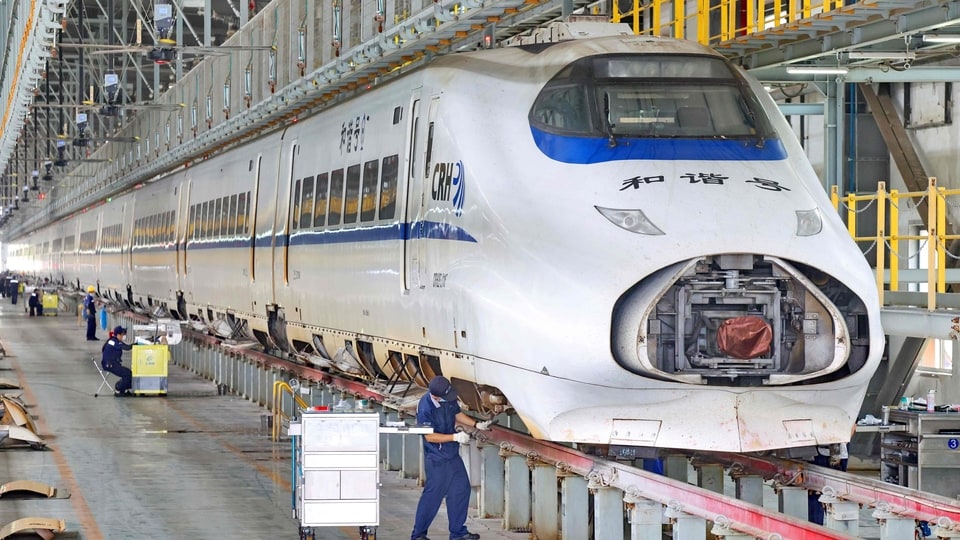
According to a report by Independent, ultra-high-speed maglev train gained the speed of 800km an hour a 1km test-track at the Donghu Laboratory in Hubei province.
Earlier, the 1.1-tonne bullet train broke its own record by acquiring an acceleration of 798km an hour. Its previous feat was reaching 700km an hour in 2 seconds in December 2025.
ALSO READ: China races to solve $148 billion property threat as leases end
The maglev train was first tested in June 2025, when it achieved the acceleration of 650km an hour in seven seconds.
Maglev trains in China and Japan typically run at around 320 kmph, while China's fastest commercial high-speed rail services are capable of reaching approximately 350 kmph.
How Maglev trains work?
Maglev technology allows trains to travel without direct contact with the rails by using magnetic fields to suspend the vehicle, removing associated friction. The magnetic wave generated by coils along the tracks propel it forward.
The track is built in such a way that it maintains precise alignment, allowing deviations no more than 0.5 millimetres, according to a report by CGTN. Similar electromagnetic technology can be used to launch spacecraft and aircraft.
Bullet train shows exceptional controlled braking
Chinese researchers further demonstrated that the experimental bullet train could handle both rapid acceleration and controlled deceleration. The vehicle surged from zero to 800 kmph before safely slowing down and coming to a complete halt over a distance of nearly 200 metres.
ALSO READ: Hydraulic systems failed, controls hit for 4 seconds on turbulence-hit Delhi-Phuket Air India flight
Several critical technologies tested
With the latest experimental bullet train, researchers also tested the limits of crucial technologies. These included high-power energy delivery, high-speed levitation control, electromagnetic propulsion, and emergency braking.
Chinese scientists are also exploring next-generation maglev systems designed to propel trains through tubes with extremely low air pressure or near-vacuum conditions.
China's Maglev push
Earlier, in 2020, CRRC Qingdao Sifang unveiled and tested a maglev prototype designed to operate at speeds of up to 600 kmph. Researchers at Southwest Jiaotong University in Chengdu have also been advancing high-temperature superconducting maglev technology to develop trains capable of exceeding the 600 kmph mark, according to reports by Xinhua.
Although the system is still at an experimental stage and cannot be used for passenger travel, researchers believe the technology could eventually be adapted for launching spacecraft and military aircraft.


