
 E-Paper



700 kmph in just 2 seconds: China's fastest maglev train sets world record | Video
The maglev train was tested on a 400 metre (1,310-foot) magnetic levitation (maglev) test line, and safely brought to a stop afterwards.

 Prefer HTon Google


China has set a world record in maglev technology, testing and successfully accelerating a tonne-class vehicle to a speed of 700 km/h (435mph) in only two seconds' time.
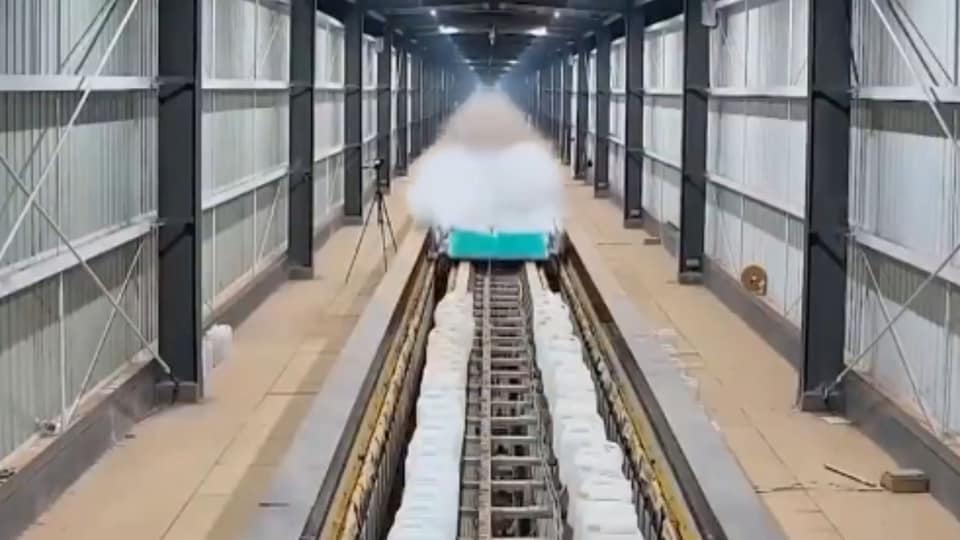
The maglev train was tested on a 400 metre (1,310-foot) magnetic levitation (maglev) test line, and safely brought to a stop afterwards, the South China Morning Post (SCMP) reported.
The test speed of the vehicle set a new milestone, becoming the world's fastest superconducting electric maglev to date.
Usually, the high-speed trains in China operate at speeds of 217mph and also support 5G connectivity, even in long tunnels. The average cruising speed for a long-haul commercial passenger aircraft ranged from approximately 547 to 575 mph.
A video footage of the test was released by China's state broadcaster CCTV on Thursday (December 25), showing a vehicle appearing like a chassis moving like a flash across the maglev line, SCMP reported. The vehicle achieved extreme acceleration immediately and came to a rapid stop at the end of the line, leaving a trail of mist behind.
The test, which was significant in terms of achieving extreme acceleration and keeping high-power control, also “resolves core technical challenges” SCMP cited CCTV report as saying. These challenges include “ultra-high-speed electromagnetic propulsion, electric suspension guidance, transient high-power energy storage inversion, and high-field superconducting magnets.”
The CCTV report further said that the test had signalled China's entry into the global top-tier in ultra-high-speed maglev technology. It also expanded the scope of more possibilities for the vacuum-pipeline maglev or “hyperloop” transport in the country.
In the maglev technology, the magnets on the train have the ability to interact with the metal on the sides of the pipe to levitate the train, and propel it forwards, according to The Sun report. Magnetic levitation, also known as maglev, use superconducting magnets in a low-vacuum pipe to strengthen the magnetic field.


