
 E-Paper


America’s Democratic Socialists are having the summer of their lives
Could a populist-left candidate win the Democrats’ presidential nomination in 2028?


 Prefer HTon Google


Four years ago the Democratic Socialists of America (DSA) were in a funk. Jacobin, a left-wing magazine, depicted on its cover three DSA-friendly lawmakers in a waiting room and declared the group in purgatory. Joe Biden’s victory over Donald Trump in 2020 had made Democrats complacent—they had gone “back to brunch”, in the pejorative of the left. Then came the war in Gaza; progressives found their animating cause in Palestine. Mr Trump’s defeat of Kamala Harris strengthened their case for change: what were establishment Democrats good for if they couldn’t stop his second coming?
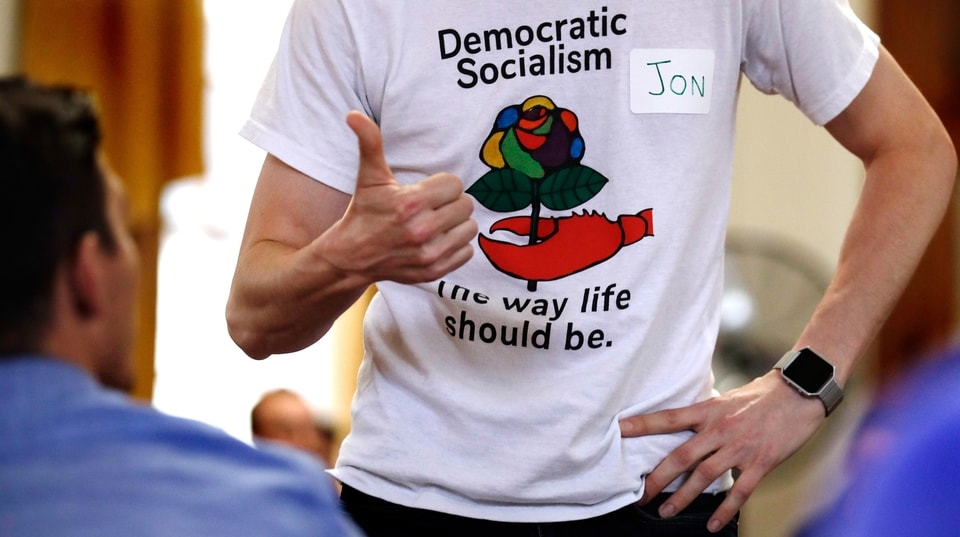
These days the far left is ascendant. New York has a DSA mayor and soon Washington, DC, will get one too. DSA-backed insurgents have trounced incumbents in several congressional primaries. On August 4th Abdul El-Sayed beat Haley Stevens, a centrist backed by pro-Israel groups, in Michigan’s Democratic primary for Senate. Dr El-Sayed is not a DSA member—he calls himself a capitalist—but he draws support from the socialist crowd. In Wisconsin, Francesca Hong, an out-and-proud socialist, looks likely to win the Democratic primary for governor on August 11th. The momentum is fuelling speculation that a DSA-aligned candidate could nab the party’s presidential nomination in 2028. It is a remarkable development for a group with quirky governance, few members and many unpopular positions.
The DSA has a structure unique in American politics: it is a discrete entity but its candidates compete on the Democratic Party ballot line, enabling it to change the party from within. Unlike the top-down model of the two big parties, where officeholders and donors hold sway, DSA members decide most things by vote. Their activism extends to union organising and agitating against data centres. This keeps the rank and file engaged outside campaign cycles. The DSA, says David Purucker, a sociologist and member, thrives during periods of Republican governance because “it’s on the barricades much more naturally than the Democratic Party”.
The DSA likes to say that populist economics can carry the day. They point to Zohran Mamdani, New York’s mayor, who campaigned on rent control and free buses while downplaying other far-left positions. But those other positions are still part of the DSA programme, which includes amnesty for all immigrants, non-citizen voting and reparations for black Americans. An unsuspecting visitor to their recent summit in Chicago would have wandered out with two questions. Had a Hyatt Regency ever hosted so many people sporting keffiyehs and septum rings? And had this group missed the backlash to the Great Awokening? In recent years many Democrats have concluded that far-left positions such as “defund the police” are an electoral dead-end.
In the House socialists occupy just a handful of seats in the 200-plus Democratic caucus. Most DSA primary victories have been in deeply Democratic terrain. In places where it is ascendant, like New York City, the DSA is out-organising mainstream Democrats. The group combines social-media savvy with old-fashioned door-knocking. It has an ardent army of volunteers at the ready. The two major parties became so reliant on consultants and donor-funded advertising that their canvassing muscle atrophied, says Nate Knauf, a DSA leader in Atlanta. “You need actual human beings to move your politics, right? Our strength is our members.”
Their number has swelled more than twentyfold in the past decade, but still totals only around 120,000. The prime target is the downwardly mobile millennial. Michael Lange, a political analyst and DSA member, says the question to identify prospective joiners is: “Are you under 50 and do you rent?” At its latest survey, in 2021, four-fifths of DSA members over the age of 25 had a college degree—twice the share of American adults. A third had a postgraduate degree and a third were gay or queer. Ashik Siddique, a co-chair of the DSA, says it is the largest queer membership organisation in the country. Members found to be working as cops can be expelled.
Therein lies the paradox: a group that claims to represent the working class looks and speaks nothing like it. On all manner of social issues, from trans rights to policing to immigration to abortion, college graduates are far to the left of blue-collar workers. Take protections for trans people, a plank of the DSA platform. Only half of working-class people tell pollsters that it should be illegal to fire or evict a trans person, compared with 82% of left-leaning college grads.
On economics, too, working-class and older voters tend to be more sceptical of the sweeping changes promised by the young new left, says Adam Carlson, a pollster. Mr Siddique, sounding a bit like Lenin, says the DSA’s task is to cultivate a working-class consciousness. The wrinkle is that working-class voters believe strongly in merit and hard work, notes Nicholas Jacobs, a political scientist at Colby College. They tend to be less enthusiastic about expanding government services while distrusting pointy-headed types who use words like “systemic”. Tellingly, in polling, only white left-leaning college grads count “tax the rich” as a top-ten priority.
Michigan and Wisconsin are battleground states with close general elections, unlike most races where progressives compete. Dr El-Sayed and Ms Hong, presuming she wins her primary, will test the left’s electability thesis in November. Victory in Wisconsin will disprove the idea that a socialist can never appeal to moderates, says the DSA.
Some Democrats contend the party should welcome socialists within its big tent and that moderates ought to learn from their organisational prowess. Centrists fear the only lesson will be in defeat. “I actually do think it’s time for Democrats to talk the S word—schism,” James Carville, an ex-aide to Bill Clinton, said on his podcast recently. David Axelrod, a former adviser to Barack Obama, has called Democrats’ battle in Wisconsin a “slow-rolling car headed for a cliff”.
Stay on top of American politics with The US in brief, our daily newsletter with fast analysis of the most important political news, and Checks and Balance, a weekly note that examines the state of American democracy and the issues that matter to voters.


