
 E-Paper



Zelensky survives another episode of the Trump show
America hints at providing security guarantees for Ukraine


 Prefer HTon Google


“I CAN’T BELIEVE it,” said Donald Trump, America’s president, as he greeted Volodymyr Zelensky, his Ukrainian counterpart, outside the White House on August 18th. “I love it.” Mr Trump was referring to Mr Zelensky’s decision to bow to American pressure and wear a suit-like garment to the meeting, an issue that had contributed to an acrimonious blow-up in the Oval Office in February (when Mr Zelensky wore a black sweater). It was a promising start to a pivotal summit, with a clutch of European leaders in attendance to support the Ukrainian leader.
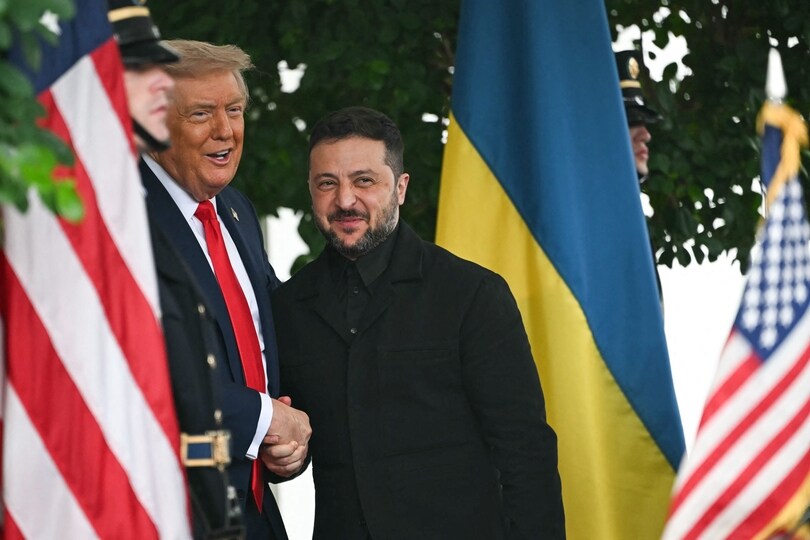
As he was hailed by the Europeans for his diplomatic efforts, Mr Trump announced that preparations were under way for a summit between Mr Zelensky and the Russian leader, Vladimir Putin, to be followed by three-way talks with Mr Trump, too. Where and when such talks might take place is uncertain. But, crucially, Mr Trump offered some form of security guarantee for Ukraine to support any peace agreement. “Everyone is very happy about the possibility of PEACE for Russia/Ukraine,” Mr Trump wrote on his Truth Social network.
The on-camera discussions left unclear many details of the deal on the table. But the mood was surprisingly positive. Mr Zelensky handed Mr Trump a letter from his wife, Olena Zelenska, to Melania Trump, the first lady, who last week had written to Mr Putin about the plight of children caught up in the war. The Ukrainian president traded jokes with the American journalist who had provoked the row over his outfit in February and teased Mr Trump that he, too, might like to suspend national elections. It was a far cry from the last meeting between the two men, which had ended with Mr Zelensky being booted out of the White House.
The gathering in Washington followed another summit, with Mr Putin in Alaska on August 15th. At that meeting Mr Trump failed to secure his stated goal of a ceasefire. Nor did he act on his threat to impose “very severe consequences” on Russia if Mr Putin did not agree to end the war. Now Mr Trump says a ceasefire might not be required, and could even “disadvantage” one or other side; better to aim directly for a lasting deal. Both Emmanuel Macron, the French president, and the German chancellor, Friedrich Merz, later challenged that contention.
Mr Trump returned to the idea of “exchanges of territory”. Russia has demanded that Ukraine give up land in Donbas, a region in the south-east of the country that Ukrainian troops have so far defended. But Mr Trump granted that it would be a decision for Messrs Zelensky and Putin to make. Mr Zelensky sidestepped the issue, saying it would be discussed at the trilateral meeting.
Perhaps the most important signal from the meeting was Mr Trump’s apparent openness to security guarantees for Ukraine, saying Mr Putin had agreed to the idea. Steve Witkoff, Mr Trump’s special envoy to Moscow, had suggested a day earlier that America was open to “Article Five-like” guarantees, a reference to the collective-defence clause in NATO’s charter which holds that an attack on one ally is an attack on all.
It is not clear what that would mean in practice. European leaders seized on the offer, but Mr Trump himself was more vague, saying Ukraine would have a “lot of help” as part of any deal. European forces would be the “first line of defence”, he said, perhaps alluding to a British- and French-led plan for a military deployment in Ukraine. But, he added, “we’re going to help them out, we’ll be involved.” In his social-media post, Mr Trump later referred to guarantees that would be “provided by the various European Countries, with a coordination with the United States of America.”
In any case, Russia seemed to reject such notions out of hand. “We reiterate our repeatedly expressed position that we deny any scenarios that envisage the deployment of a military contingent to Ukraine with the participation of NATO states, which could lead to an uncontrollable escalation of the conflict with unpredictable consequences,” said the foreign-ministry spokeswoman, Maria Zakharova.
The day in Washington was an exercise in avoiding another bust-up by praising and thanking Mr Trump, and mostly saying “yes” to his ideas in the hope that either Mr Putin wrecks the process or America offers such firm guarantees as to make a compromise possible. “This was one of those days where we take three steps forward rather than any backwards,” Alexander Stubb, Finland’s president, later told CNN. Other European leaders at the gathering were Sir Keir Starmer and Giorgia Meloni, the British and Italian prime ministers, as well as Mark Rutte, the NATO secretary-general, and Ursula von der Leyen, the European commissioner—a significant show of diplomatic muscle to support Mr Zelensky’s position and shape Mr Trump’s thinking.
Mr Zelensky avoided any hint of disagreement with Mr Trump. But in practice, he faces a difficult task. The notion of Ukraine voluntarily giving up the heavily fortified western sections of Donbas is anathema to a vast majority of Ukrainians. As well as worsening Ukraine’s military position, it could destabilise the country politically. Mr Zelensky said that he had shown Mr Trump “a lot of details on the battlefield” on a map in the Oval Office.
Ukrainian officials are more open to the idea of a freeze. “The baseline is stopping at the line of conflict,” says one. There is confidence that a short-term deal is within reach, but many doubts over how long it will last. “We will be in conflict with each other for a while, that’s for sure,” says the official. “Hundreds of years of shared history tell us that.”
Still, Mr Trump seemed confident. In an aside to Mr Macron captured by a live microphone, he suggested that Mr Putin “wants to make a deal for me, you understand that? As crazy as it sounds.” For all the lurking disagreements, the prospect of an extraordinary meeting involving Mr Trump, Mr Putin and the man the Russian has sought to overthrow and kill, Mr Zelensky, is drawing closer.
Editor’s note (August 19th 2025): This article has been updated.


