
 E-Paper



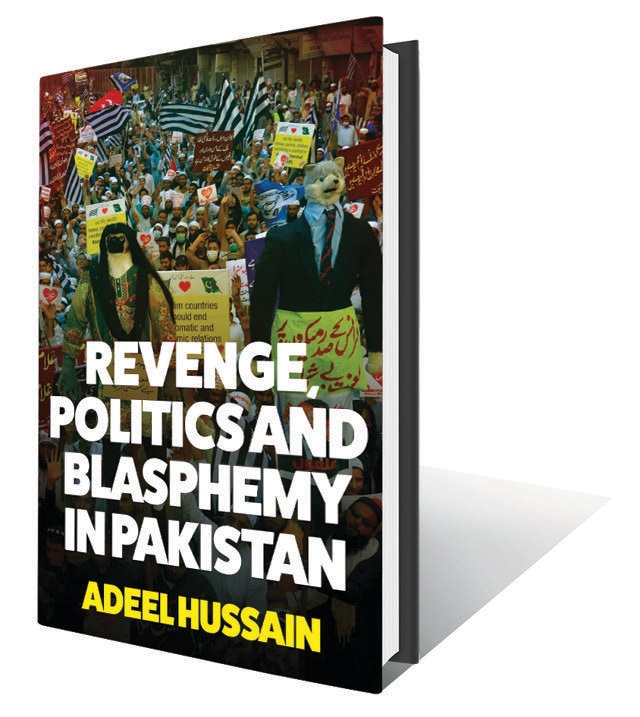
Review: Revenge, Politics and Blasphemy in Pakistan by Adeel Hussain
A fascinating and uncomfortably timely new book looks at the extent to which the clash between the Arya Samaj and the Ahmadiyyas – which has vanished from public memory – propelled the tensions between Hindus and Muslims that led to Partition

 Prefer HTon Google


On Eid-ul-Fitr day in 1897, a man named Lekh Ram was fatally stabbed in his home in a narrow lane in the old walled city of Lahore in Punjab. He was a local leader of a Hindu reformist sect called the Arya Samaj. At the time of his stabbing, he had been chanting Sanskrit mantras in the company of a Muslim man he brought home that day for conducting a ceremony called shuddhi meaning “purification” to convert him to Hinduism – until the subject being converted suddenly drew a knife and stuck it in his stomach. “When Lekh died the following day, the local Arya Samaj community took him to the cremation grounds, where over 20,000 Hindus had assembled, making it one of the most attended funerals in Lahore that year. In their eulogies, Lekh Ram’s Arya Samaj companions declared him the ‘first martyr of his faith’. They were also quick to note that this looked like the work of a Muslim fanatic who had punished Lekh Ram for his ‘scholarly’ allegations against the Prophet Muhammad and Islam” writes Adeel Hussain in a fascinating and uncomfortably timely new book, Revenge, Politics and Blasphemy in Pakistan.
The obvious suspect in the case, named in newspapers at the time, was Lekh Ram’s long-time antagonist who had prophesied his death and celebrated when it happened: the founder of the Ahmaddiya sect, Mirza Ghulam Ahmad. For years before, Ahmad, according to Hussain, had attempted to start a debate with the founder of the Arya Samaj, Dayanand Saraswati, even mentioning him as the primary addressee of his own magnum opus, a series of books called the Barahin e Ahmadiyya. Saraswati simply ignored Ahmad, to his chagrin, but after Saraswati’s death, his follower Lekh Ram began enthusiastically to try and organise a public debate between himself and Ahmad. The broad topic was Hinduism versus Islam, with Lekh Ram positioning himself as the champion of Hinduism and Ahmad as the champion of Islam. Now it was Ahmad’s turn to ignore his challenger; Lekh Ram, unlike Dayanand Saraswati, had a relatively low status in the Arya Samaj hierarchy of the time. Despite Lekh Ram’s efforts, the event eventually never took place.
There was, however, a fierce exchange of heated letters between the two, and subsequent publications by both sides of their collected works insulting the other. “For the most part, Lekh Ram followed the well-trodden path of Christian polemicists, which positioned the Prophet Muhammad, and with him the entire Islamic faith, as infused with the desire to maximise sensual experiences in this world,” writes Hussain. He received retorts that essentially flung the charge back, accusing Hindus of widespread practice of niyoga, by which a woman would be sent to a Brahmin to beget a child if her husband was impotent.
That the trading of insults by a couple of Punjabis, both marginal to the faiths whose champions they professed to be, could nudge all of undivided India towards a division on religious lines and later lead both India and Pakistan towards religious fundamentalism is astonishing. Revenge, Politics and Blasphemy in Pakistan makes a good case that this is actually what happened by tracing the history of antagonism between the Arya Samaj and the Ahamadiyyas in the late 1800s and early 1900s.
After the murder of Lekh Ram, his cause was taken up by others who shared his convictions, of which the cornerstones were the promotion of the Hindi language, the passionate protection of cows, and vehement opposition to Islam. Hinduism is not a proselytizing faith but the obscure religious innovation that led to Lekh Ram’s murder, the ritual of shuddhi for conversion, was later popularized by a friend of his who became an Arya Samaj leader of far greater reach and renown. This was Swami Sharaddhanand, a prominent leader of the Congress, who quit the party – like MA Jinnah and SC Bose – owing to differences with MK Gandhi. Shraddhanand, too, was shot dead nearly three decades after Lekh Ram by a Muslim fanatic at a time when a number of publications held to be blasphemous of the Prophet Muhammad that had been put out by Arya Samaj members were in the news.
Read more: Essay: The history of the politics of blasphemy in the Indian subcontinent
Hussain’s claim that blasphemy against the Prophet Muhammad sculpted and propelled Muslim nationalism in undivided India and defined the citizen-state relationship in Pakistan ever since is well supported by the chronology of events he lays out. The extent to which the clash between the Arya Samaj and the Ahmadiyyas – which has vanished from public memory – propelled the tensions between Hindus and Muslims that led to Partition is relevant to today’s India. Many of the same issues that were around then are still driving mainstream politics even now. Conversions and attempts to “reconvert” Muslims, the promotion of Hindi, protection of cows, and militant vegetarianism are all frequently in the news. The continuity from the Arya Samaj to the Hindu Mahasabha and the Rashtriya Swayamsevak Sangh may have brought the concerns and values of the forgotten small-timer from Lahore, Lekh Ram, to dominate India 125 years after his death.
Today’s Hindu nationalists often claim intellectual descent from figures such as Swami Vivekananda and Sri Aurobindo. The teachings of those gurus, however, differ in their thrust from concerns such as promotion of the Hindi language, militant vegetarianism, and enduring antagonism towards Muslims that are of evident centrality to today’s Hindutva.
A reading of Hussain’s lucidly-written and deeply-researched book suggests that the intellectual genealogy may actually be from Lekh Ram.
Samrat Choudhury is an author and journalist. His most recent book is The Braided River: A Journey Along the Brahmaputra


