
 E-Paper



Covid deaths drop below 10 after 6 weeks in Chandigarh tricity
On first day of June, Chandigarh records five casualties, followed by four in Mohali; in Panchkula, no death reported after 10 days

 Prefer HTon Google


Even as the tricity reported a spike in Covid-19 cases on Tuesday, with 399 people testing positive, up from the previous day’s 276, the number of fatalities dipped below 10 for the first time since April 20.
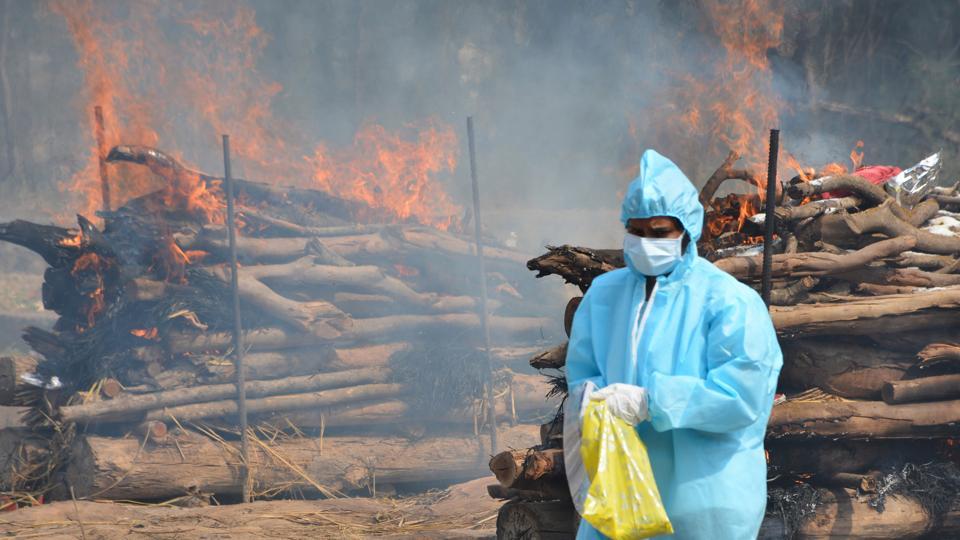
Nine people succumbed to the virus in the tricity on Tuesday. Even on April 20, nine deaths were recorded, after which the number consistently remained in double digits, peaking at 38 on May 5.
While the number of daily cases has seen a steep drop after the peak of 2,612 on May 10, pointing to a receding second wave, the death count has kept mounting and was recorded at 19 on Monday.
May proved to be the deadliest month, with 373 patients succumbing in Mohali, 275 in Chandigarh and 142 in Panchkula, which accounted for more than a third of the total death toll in these three jurisdictions since the outbreak last March.
However, on the first day of June, Chandigarh recorded five casualties, followed by four in Mohali. In Panchkula, there was no death reported after 10 days.
In terms of cases, Mohali recorded 197, followed by 108 in Chandigarh and 94 in Panchkula.
With more people being cured and discharged than those testing positive, the cumulative active case load of the tricity dropped to 4,774 from 5,482 the previous day and the peak of 24,201 on May 12.
While daily positivity rate, which remained around 20-25% during the peak of second wave, was recorded below 8% across the tricity, even recovery rate jumped above 94% in the three jurisdictions. Case fatality rate stands at 1.4% in Mohali, followed by 1.3% in Chandigarh and 1.2% in Panchkula.
‘Need to wait for 2-3 weeks’
“We expect that the downward trend in deaths to continue,” said Dr VK Nagpal, joint director, Chandigarh health department. “The number of Covid-19 patients requiring intensive care treatment is also decreasing. As the pressure on health facilities will ease, focused care will be available to patients, which will decrease fatalities.”
Meanwhile, Dr Jagat Ram, director, PGIMER, said we will have to wait for another two to three weeks to see the number of deaths drop to the levels seen before the second wave.
“We witnessed a huge surge in cases in the early part of May, and many patients who tested positive then are still undergoing treatment. Even though the infection numbers are decreasing and even the occupancy of oxygen beds has decreased, the pressure on the ventilator beds is still there,” he said.
‘Time to remain vigilant’
Dr Jasjeet Kaur, civil surgeon, Panchkula, said: “The situation is a little better, but not completely under control as yet. We need to continue to be vigilant. Regular strategic sampling will be ensured for timely case detection and isolation. Adding infrastructure and strengthening of systems to deal with severe cases will also be taken up.”
“The numbers are coming down but now individuals have be to very careful and follow safety protocols. Those who have not got vaccinated should get it on priority. As the numbers are coming down, restrictions would be lifted; so we need to ensure strict compliance,” said Adarsh Pal Kaur, civil surgeon, Mohali.


