E-Paper



Worst December air spell holds Delhi in vice grip
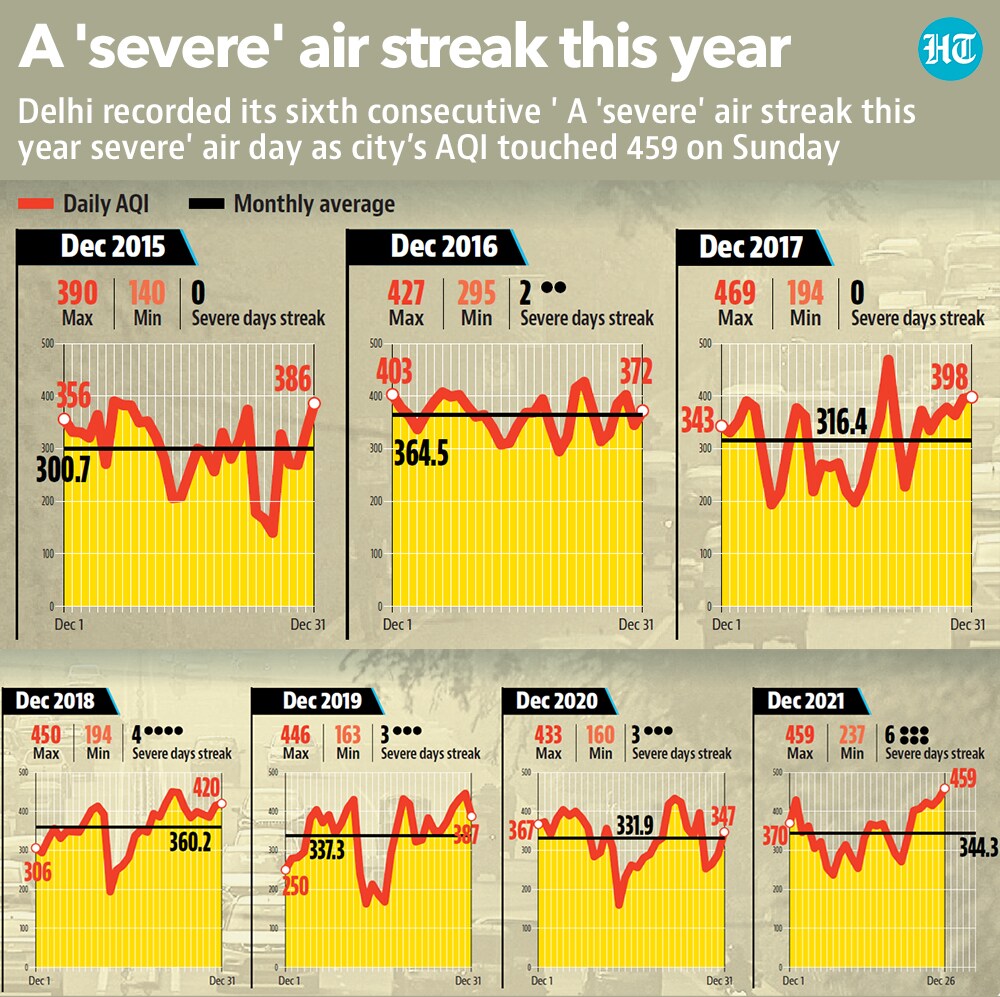
Delhi recorded an average Air Quality Index (AQI) of 459 on Sunday, the worst since November 12, when the index had a reading of 471.

 Prefer HTon Google


Air quality in Delhi remained severe on Sunday for the sixth consecutive day, the longest spell of such bad air since 2015, when the Central Pollution Control Board (CPCB) started maintaining detailed records.
Delhi recorded an average Air Quality Index (AQI) of 459 on Sunday, the worst since November 12, when the index had a reading of 471. Prolonged exposure to such air affects healthy people, and seriously impacts those with existing health conditions, according to the pollution watchdog.

Delhi’s average AQI this December so far is 344, higher than December 2020 (331) and 2019 (337). It was only worse in 2018 (360) and 2016 (364), the data show.
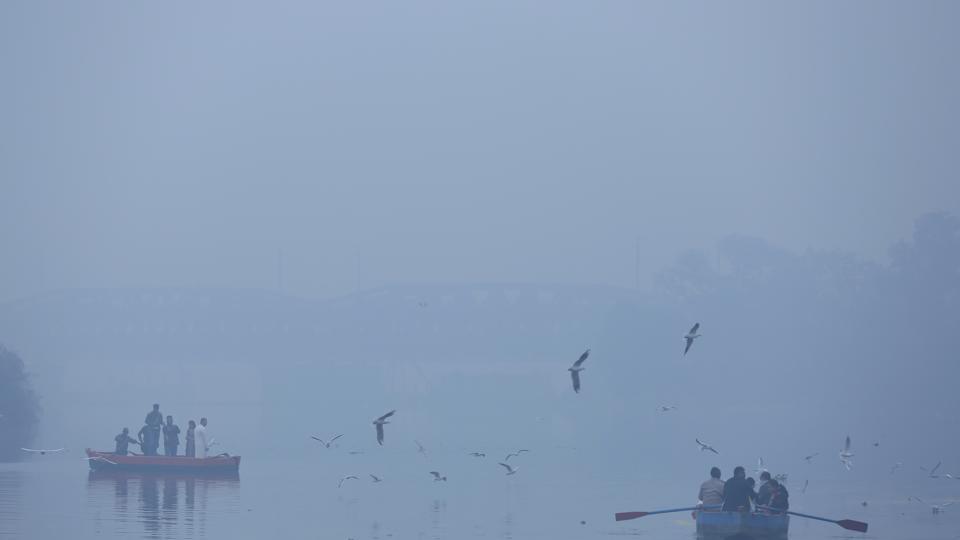
As a thick haze hung over the city, local sources of pollution, mostly open burning of biomass amid dipping temperature, and meteorological factors such as calm winds have led to higher concentration of pollutants close to the surface, experts said.
“It is time to weigh in emergency measures again if there is no improvement by Monday,” said Anumita Roy Chowdhury, executive director at the Centre for Science and Environment, an advocacy group. “This is certainly the longest episodic smog event in December for Delhi.”
Emergency restrictions under the Graded Response Action Plan (Grap), such as a ban on construction and demolition, and stopping the entry of trucks into Delhi, were lifted on 20 December by the Commission for Air Quality Management on an improvement in air quality. However, air quality slipped to the severe zone ever since. A meeting on Grap was held on 23 December, but emergency measures were not reimposed.
There might be some relief as parts of Delhi received light rain on Sunday evening. There could be light rain on Monday and Tuesday as well, the India Meteorological Department has predicted.
Delhi’s average PM 2.5 levels were in the emergency or severe plus range – 334 micrograms per cubic metre – for 18 hours, CPCB’s control room data showed at 5pm on Sunday. The safe limit is 60 micrograms per cubic metre.
The concentration of PM2.5 has to stay above a threshold of 300 micrograms per cubic metre for 48 hours for restrictions such as ban on construction and entry of trucks to kick in, according to Grap guidelines.
Unlike the bad air in November, burning of farm residue was not in play, and the pollution was from local sources, Roy Chowdhury said. “This shows background emissions are still high and, if meteorological conditions become adverse, we see severe air quality, particularly when wind speeds drop. This calls for stricter enforcement,” she said.
The western disturbance on 22 December led to a negative pressure zone around the region, with pollutants unable to disperse, said Dipankar Saha, former head of CPCB’s air laboratory.
“Air is not flowing from Delhi towards the Indo-Gangetic Plain after this western disturbance created a negative pressure,” Saha said. “Wind speeds have dropped and local pollution is accumulating in Delhi.”
It was unusual to see such a long polluted spell in December, and local factors required greater scrutiny, said Gufran Beig, project director of the System of Air Quality and Weather Forecasting and Research, a government forecasting body.
“The moisture content at the moment is also not too high, and we are not recording dense fog, so such a spike in pollution is surprising,” Beig said. “Relief from rain is not expected immediately and, as per our forecast, air quality could remain in severe for the next 48 hours.”
The AQI could return to the very poor category by Monday if Delhi receives enough rain, a forecast by the Early Warning System for Delhi showed.