E-Paper



Fog safety: Uttar Pradesh govt mulls halting traffic on expressways during low visibility
If implemented, the measure will be on the lines of suspension of flight operations and cancellation of trains when visibility drops sharply; transport dept examining legal provisions, practical aspects

 Prefer HTon Google


The Uttar Pradesh government is considering halting vehicular movement on expressways and National Highways (NHs) during spells of dense fog, on the lines of suspension of flight operations and cancellation of trains when visibility drops sharply.
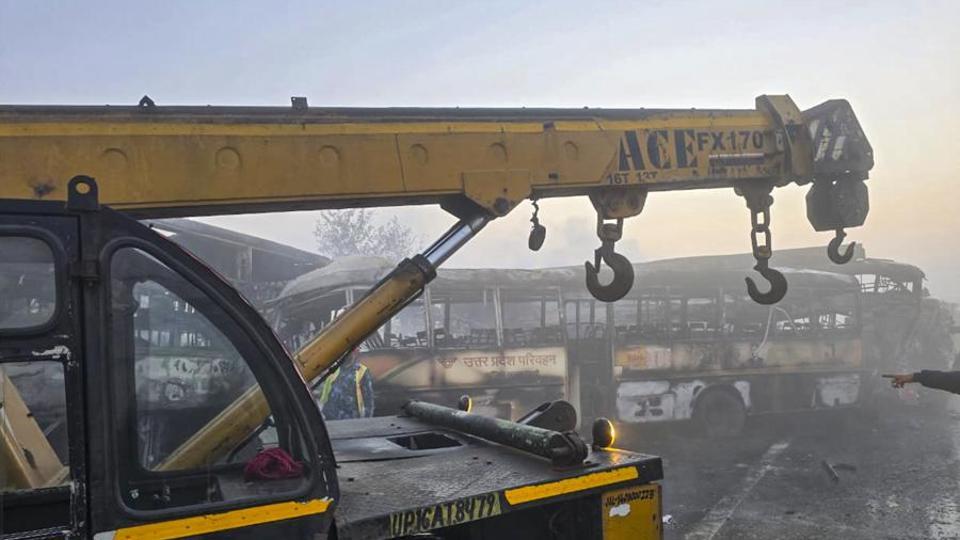
The move, according to officials, is aimed at preventing major accidents during extreme winter conditions, as expressways/NHs continue to witness pile-ups and fatal crashes during dense fog.
Directed by the government on recurrent fog-related collisions these days, the transport department is examining the possibility of such restrictions in keeping with the existing legal provisions and also keeping feasibility of such measures in mind.
“We are examining legal provisions and other practical aspects before proposing for halting the movement of traffic on expressways and important NHs during the dense fog when even flights and trains are cancelled to avoid a mishap,” transport commissioner Kinjal Singh said.
“The final call will be taken by the government only,” Singh said.
Another senior official indicated that an order in this regard might be issued in two-three days.
Under the plan being discussed, vehicles could be stopped at petrol pumps, facility centres, designated parking lanes or other safe holding points along expressways/NHs and later allowed to move in regulated convoys once visibility improves.
The transport, home and law departments are jointly examining the legal and operational framework for imposing such curbs. The issues under consideration include identification of safe holding areas, availability of basic passenger facilities, women safety, coordination with district administrations and police, and ensuring unhindered movement of emergency vehicles.
People aware of the matter said the government is assessing whether existing provisions under the Motor Vehicles Act are sufficient or if fresh standard operating procedures will be required. Any restrictions, officials stressed, would be time-bound and based on real-time weather advisories, and imposed only in extreme conditions.
Another senior transport official said that Section 115 of the Motor Vehicle Act and the Rule 178 of the UP Motor Vehicle Rules empower the government to temporarily restrict the movement of vehicles on any road in the public interest.
Section 115 of the MV Act says, “The State Government or any authority in this behalf by the State Government, if satisfied that is necessary in the interest of public safety convenience—prohibit or restrict, subject to such exceptions and conditions as may be specified in the notification, the driving of motor vehicles in any specified area or on any specified road.”
Similarly, Rule 178 of the UP Motor Vehicle Rules provides,“ Superintendent of Police within a Municipal Corporation or Municipality or Nagar Panchayat and Registering Authority in other areas within their respective jurisdiction may make such orders within their respective jurisdiction as they think fit restricting the speed of or restricting or prohibiting the use of motor vehicles—-in any area or on any road.”
Officials said there were sufficient legal proceedings empowering authorities to curb traffic movement in any area or on any road in public safety.
“The thing that has to be considered is public convenience and necessary arrangements when the traffic movement is restricted during fog expressways and NHs,” an official said.
A network of access-controlled expressways criss-crosses Uttar Pradesh, including the Agra-Lucknow Expressway, Purvanchal Expressway, Bundelkhand Expressway, Gorakhpur Link Expressway, Yamuna Expressway and the Delhi-Meerut Expressway. The Ganga Expressway and the Lucknow-Kanpur Expressway are under construction.
At least 26 people were killed in a series of accidents attributed to poor visibility on Tuesday, with the worst incident reported from the Yamuna Expressway in Mathura, where a multi-vehicle pile-up claimed 13 lives. The toll in the Mathura accident went up to 18 on Wednesday, according to Agra divisional commissioner Shailendra Kumar.