
 E-Paper



‘Ram’s name used for spreading hatred, but he was symbol of love’: Ch’garh CM
Chhattisgarh chief minister Bhupesh Baghel inaugurated a statue of Lord Ram and other developmental work in Chankhuri village in Raipur, as part of his government’s Ram Van Gaman tourism circuit project

 Prefer HTon Google


Chhattisgarh chief minister Bhupesh Baghel on Tuesday said that Lord Ram’s name was used politically to spread hatred, but Ram was a symbol of love.
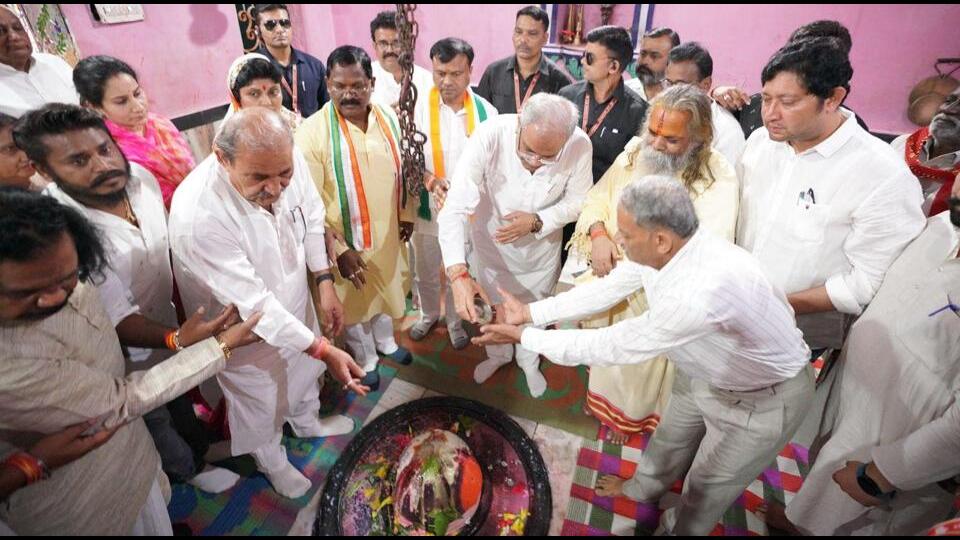
Inaugurating a statue of Lord Ram and other developmental work in Chankhuri village in Raipur, as part of his government’s Ram Van Gaman tourism circuit project, Baghel also said that Lord Ram was ‘Bhancha Ram’ (nephew Lord Rama) for Chhattisgarh.
According to the legends, Ram Van Gaman path is the path taken by Lord Ram to go in exile. The path runs from Ayodhya in Uttar Pradesh, then from Madhya Pradesh to Dandakaranya jungles in Chhattisgarh. The tourism circuit is being developed from Harchouka in Sitamarhi, Koriya district, till Ramaram in Bastar’s Sukma district (in Dandakaranya jungles).
Baghel launched the first phase of the project in December 2021 in Chandkhuri, the birthplace of Mata Kaushalya, the mother of Lord Ram, and unveiled a 51 feet-tall statue of Lord Ram.
Under the first phase of the project, nine sites have been selected where renovation and beautification of the temples will be done by the state government. The sites are Sitamarhi-Harchaika (Koriya), Ramgarh (Ambikapur), Shivrinarayan (Janjgir-Champa), Turturiya (Baloda Bazar), Chandkhuri (Raipur), Rajim (Gariaband), Sihawa-Saptarishi Ashram (Dhamtari), Jagdalpur (Bastar) and Ramaram (Sukma).
“We are working on the first phase of nine sites from Koriya to Konta and we are trying to develop these sites as a tourism circuit,” Baghel said.
He also added that his government is also working to preserve the tribal culture in the state.
A Congress leader said that the Ram Van Gaman project has helped the party to create a counter-narrative to the Bharatiya Janata Party (BJP)’s Ram Mandir campaign.
“The Ram Mandir campaign built the iconography of an angry Lord Ram en route to Lanka to wage a war on Ravana and bring back Mata Sitaji. ‘Jai Shri Ram’, the war cry of his army became the war cry of the campaign of the BJP and Rashtriya Swayamsevak Sangh (RSS) affiliates. Surprisingly, there was an inherent contradiction in the whole campaign as the temple was meant for ‘Ram Lalla’ (infant Lord Ram) but the infant Ram Lalla’s images were never made part of the BJP’s campaign. The Congress in Chhattisgarh used this gap and turned it in their favour,” a Congress leader said on condition of anonymity.
The leader said that the party worked in two ways -- firstly, the Chhattisgarh congress leadership asserted that since Mata Kaushalya belonged to the state, Lord Ram was a “Bhancha” or nephew of the state.
“Hence, in place of Jai Shri Ram, Jai Bhancha Ram is a more apt slogan as it highlights the relationship of Lord Ram with the people of the state. This invoking of the tradition and religion, with local culture- in sync with the Chhattisgarhiya sub nationalism of the Congress, went well with the public who accepted it wholeheartedly. Even the BJP had to use the ‘Jai Bhancha Ram’ slogan in the state due to its acceptance,” said the leader.
Secondly, the Congress government created new sites of pilgrimage for Ram devotees by forming the Van Gaman Path and advertising it aggressively.
“Before it, only Ayodhya (where Lord Ram was born), Chitrakoot and Rameshwaram (where Ram did Shakti puja) were the sites of pilgrimage for devotees of Lord Ram. Most of the area in between was left unnoticed. Sites falling on Van Gaman path were just local sites. Bhupesh Baghel as CM did invest a lot of effort and money to bring them to notice and make them accessible. Who knows, with time, the Van Gaman path might start attracting yatras like the Chitrakoot Parikrama,” said the Congress leader.
However, senior BJP leader and spokesperson Sachhinand Upasane termed the Congress’ move as a “mere stunt”.
“People of the state know how the Congress is fooling them. The Congress in its culture never believed in Lord Rama. This stunt to develop tourism circuit will not help them in winning elections,” he said.
Chhattisgarh- based political commentator Parivesh Mishra said that Congress is trying to project Lord Ram as religious symbol to connect with the majority community.
“Besides being a religious symbol to help the Congress present a majority-friendly face, Ram has become a sort of economic exigency for the funds-starved government in Chhattisgarh. The state has got more landmarks and mythological footprints of Ram and characters that appear in Ramayan than any other state,” he said.
Mishra further said that the prospects of religious tourism thus make a lot of economic sense for Chhattisgarh.
“The subject in fact has the potential of becoming the USP (Unique Selling Proposition) for tourism here. It is not a coincidence that the forest -Dandakaranya - where Ram is believed to have spent most of his time during the 14-year exile is the core area of Maoist activities. The development of tourism will perhaps be the most non-intrusive vehicle of development in the area,” said Mishra.
-kW0H-U20214218012MgB-250x250%40HT-Web.jpg)


