
 E-Paper



Ayodhya 2.0: Bhojshala a Hindu temple, rules MP HC; cites SC's principles in ruling on Dhar dispute
"For determining the character of the disputed area we have to keep in mind… 10 principles laid down [by SC] in the Ayodhya case,” says the high court judgment.

 Prefer HTon Google


The Madhya Pradesh High Court on Friday declared the Bhojshala-Kamal Maula Mosque structure in Dhar a Hindu temple of Goddess Vagdevi (Saraswati), in a ruling built, to a notable degree, upon principles from the Supreme Court's 2019 Ayodhya judgment.
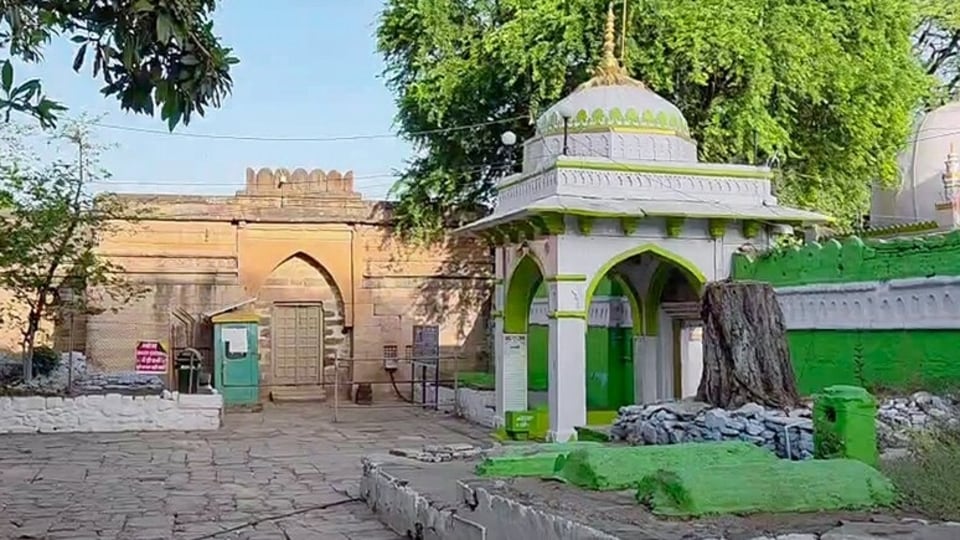
The HC bench of Justices Vijay Kumar Shukla Alok Awasthi quashed a 2003 ASI order that had regulated worship at the site between Hindus and Muslims; and instead asked the state government to consider allotting separate land within Dhar district to the Muslim community for a mosque. A Jain claim over the site could not convince the bench.
The dispute in the immediate was centred on an order of the Archaeological Survey of India in 2003 that allowed Muslims access to the complex for Friday namaz; Hindus were permitted to hold traditional ceremonies on Basant Panchami each year, and were given access every Tuesday. It was this arrangement, governing a monument that had been under ASI control since 1904, that the Hindu petitioners challenged as unconstitutional and illegal. It led to also the larger question of whether the main structure was a temple or a mosque.
Ayodhya framework drawn from 10 principles
To determine the religious character of the site, the court drew on the Supreme Court's 2019 Ram Janmabhoomi verdict. The Advocate General of the state had compiled 10 principles from that judgment and placed them before the court.
The court wrote in its 242-page judgment, “The judgment in Ayodhya case was arising out of a civil suit which was dealing with the claim of a title over the disputed area. In the present case, as we consider that we have to determine the character of the disputed area on the basis of historical literature, architectural features, ASI survey reports etc. For determining the character of the disputed area we have to keep in mind the aforesaid 10 principles laid down by the Apex Court in the Ayodhya case.”
The principles covered, among other things, the standard of proof, which apple of probability, not mathematical certainty; the scope of judicial inquiry, such as evidence of faith, worship, and continuity; and the weight to be given to ASI reports.
Objections to applying same principles
Several parties argued that the Ayodhya verdict — allowing a Ram Mandir to be built where the Babri Masjid was destroyed in 1992 — did not apply. Senior Advocate Salman Khurshid, for one of the respondents, submitted that in the Ayodhya matter the deity known as Ram Lalla Virajman was itself treated as a juristic person and a named party, which was not the case in the present proceedings.
The respondents also invoked the Places of Worship (Special Provisions) Act, 1991, arguing it barred the petition since the law freezes religious character as of August 15, 1947.
The court rejected this argument saying that the act excludes monuments covered by the Ancient Monuments and Archaeological Sites and Remains Act, 1958, and the Bhojshala was a protected monument since 1904. Also, the court said Article 226 of the Constitution gave wider jurisdiction to the HC which “cannot be overridden by any legislation” as it forms part of the Basic Structure of the Constitution.
As for a petition that claimed the idol recovered from the site was that of Ambika, a Jain deity, the court said historical evidence and the archaeological survey did not indicate that the disputed area was a Jain temple.
‘Associated with Raja Bhoj’
In its conclusion, the judgment said: "We have noted the continuity of Hindu worship at the site through regulated over time has never been extinguished.” It ruled that historical literature established that the character of the disputed area as Bhojshala, as a Centre of Sanskrit learning associated with Raja Bhoj of Parmar dynasty; “...and the literature and architectural reference including those connected with the period of Raja Bhoj indicate the existence of temple dedicated to the goddess Saraswati at Dhar.”
It thus quashed the 2003 ASI order regulating the extent of Hindu worship, and asked the ASI to retain overall administrative control of the monument.
Separate land for mosque
Another similarity with the Ayodhya judgment is in how there could be land now allotted to the Muslim community for a mosque elsewhere.
“In order to secure the religious rights of the Muslim community and to ensure complete justice between the parties,” the court said that if the relevant respondent submits an application for allotment of suitable land within the Dhar district for the construction of a mosque, “the State Government may consider the said application in accordance with law”. In case of the Ayodhya judgment, land measuring 5 acres was mandatorily to be allotted, and thus was at Dhannipur village. There, so far, building plans have faced rejections over issues related to clearances.
At heart of dispute, and a ‘misnomer’
The Bhojshala-Kamal Maula Mosque complex is actually on two distinct plots. The Bhojshala, the main disputed building, was originally a Hindu temple of the 11th or 12th century, later converted by the Muslim rulers of Malwa, as per literature cited in the case. G Yazdani, Director of Archaeology in the Nizam's Dominions, writing in 1929 and quoted by the court, described it as built from “the remains of a Hindu temple”. The Imperial Gazetteer of India, 1908, also quoted by the court, called the mosque designation a “misnomer”.
There is a component that is a separate cemetery enclosure near the gate of the Bhojshala building, sitting on a different survey number. It has four tombs, including one of Shaikh Kamal Maula, the Sufi figure from whom the complex takes its name. The cemetery is mentioned by the state government too as "separate and distinct".


