
 E-Paper



FM: 6-yr mission to boost pulses output
Finance Minister Nirmala Sitharaman announced a six-year mission to boost pulses output for self-sufficiency by 2029-30 amid rising inflation and import dependence.

 Prefer HTon Google


Finance minister Nirmala Sitharaman, presenting the Union Budget 2025-26, announced the launch of a six-year mission to boost output of pulses to help achieve self-sufficiency of three widely consumed varieties.
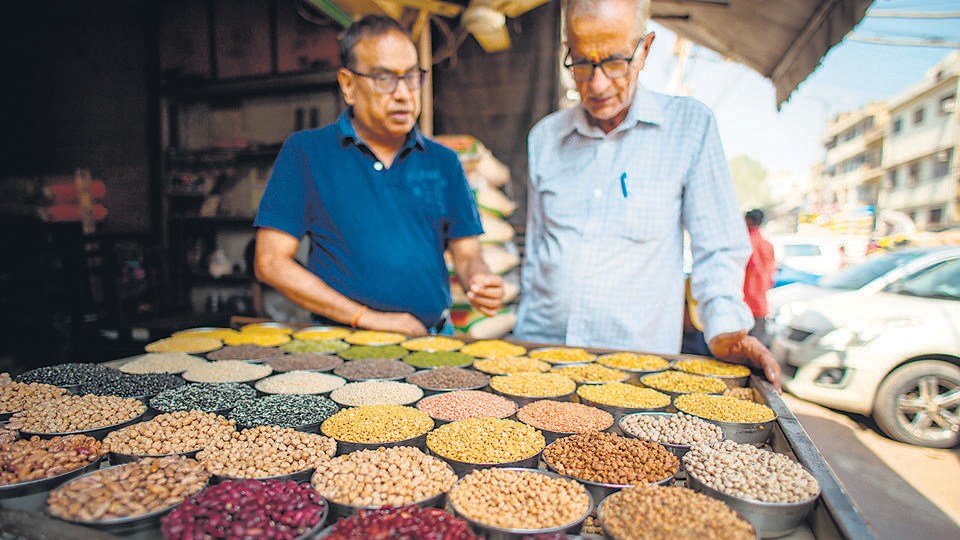
Pulses are the commonest source of protein, which saw a high spell of inflation in 2024, peaking to 18% at the retail level in August.
The pulses mission will focus on development of climate-resilient seeds, remunerative prices for growers, and post-harvest management as well as storage, according to the objectives laid out in the budget.
A key target handed down to Union agriculture minister Shivraj Singh Chouhan is to end India’s dependence on imports to meet the country’s pulses demand by 2029-30.
“Our government will now launch a six-year mission for aatmanirbharta (self-sufficiency) in pulses with a special focus on tur (pigeon pea), urad (black gram) and masoor (yellow lentils)...central agencies will be ready to procure these three pulses, as much as offered during the next four years from farmers who register with these agencies and enter into agreements,” Sitharaman said, presenting her eighth budget in a row and the first in the Modi government’s third term.
However, the government is yet to make allocation for the same in the budget documents.
In early 2008, a global surge in food prices led to a domestic price spiral. Between 2004-05 and 2013-14, pulses, as a group, saw a price spike of 143%, stoked by global prices and rising protein demand due to better purchasing power, according to a Reserve Bank of India paper by the late former deputy Governor of the central bank, Subir Gokarn. He calculated that many Indians had crossed an income threshold beyond which protein intake -- pulses, eggs, meat etc. -- increases.
Shortly after the Modi government assumed office during its first term in 2014, it focused farm and trade policies to raise pulses output to avoid reliance on volatile imports. Long-term import deals with nations, such as Mozambique, were signed to hedge against rise in global commodity prices.
According to the agriculture ministry’s data, a campaign to distribute improved seeds raised pulses productivity by 34.8%, from 727 kg/hectare in 2018-19 to 980 kg/hectare in 2021-22. The policy push to boost output led to a fall in imports.
Overall, the output of pulses as a group, at 27.5 million tonne in 2023-24, is slightly higher than the previous year’s production of 27.3 million tonne, according to official data. Yet, extreme weather can roil output, increasing dependence on imports.
Increasing weather uncertainties can quickly firm up prices if output drops. Last year, prices of pigeon pea (tur) and black gram (urad) were elevated because of a patchy monsoon in rain-fed growing belts in Karnataka, Andhra Pradesh and Telangana.
Maharashtra, a major tur grower, saw unseasonal heavy rains in October. This led to a drop of 18.3% and 3.7% in production tur and urad, although overall output went up slightly, according agriculture ministry’s estimates.
Pulses are not a homogenous group of crops. The output and productivity of key pulses varieties vary widely, depending on where and how they are grown. India still imports 5-6% of its domestic needs, and consequently, ‘imports’ inflation when global commodity prices go up. The government had to impose caps on the quantity of tur (pigeon pea) and urad (black gram) that retail shops and traders can store, a measure known as stockholding limits that is invoked to control inflation.
On January 4 last year, during the Modi government’s previous term, Union home and cooperation minister Amit Shah had declared that India will stop importing pulses by 2027, setting an ambitious goal.
“By December 2027, the country should become self-reliant in pulses. We will not import even one kilo of pulses from January 2028,” Shah had said, while launching a programme to procure tur (pigeon pea) by the National Agricultural Cooperative Marketing Federation of India Ltd (Nafed).
To ramp up output of key deficit pulses, such as tur, urad and chana (chickpea), the government will need to ensure remunerative prices, experts say. According to the Situation Assessment Survey of agriculture (2018-19), nearly 45% of cultivators of pulses said they got lower than market prices for urad, tur and moong (green gram).
In the last financial year, imports went up 84% higher year-on-year to 4.65 million tonne, the most in six years. In value terms, the country’s spending on imports rose 93% to $3.75 billion. India largely imports from Canada, Australia, Myanmar, Mozambique, Tanzania, Sudan and Malawi.
According to the farm ministry’s plan to achieve self-sufficiency, model pulses villages will be set up from the current kharif or summer-sown season. The ministry is also working with states to bring fallow land for cultivation of lentils. It is set to create 150 hubs to distribute high-yielding seeds. Alongside, the farm department will collaborate with the department of agricultural research to promote climate-resilient varieties.
“Pulses are group of crops. They are not single crop. The government will have to ensure crop diversification and incentivise farmers sufficiently across varieties to stop imports. At times, shortage of one variety increases demand for other varieties,” said Avishek Agrawal, an analyst with Comtrade.


