E-Paper



India, Maldives still in discussions on continued operation of Indian aircraft
Two advanced light helicopters (ALH) and a Dornier aircraft provided by India in recent years have been extensively used for humanitarian assistance and disaster relief operations in the Maldives

 Prefer HTon Google


NEW DELHI: India and the Maldives are in discussions on the continued operation of aircraft provided by New Delhi to the Indian Ocean archipelago, people familiar with the matter said on Sunday after Maldivian President Mohamed Muizzu said the Indian government has agreed to withdraw military personnel from his country.
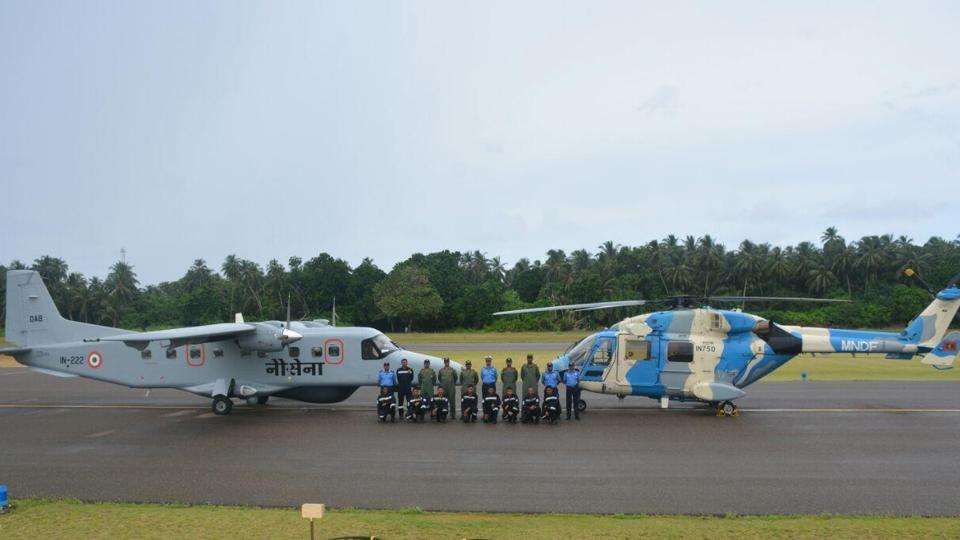
Two advanced light helicopters (ALH) and a Dornier aircraft provided by India in recent years have been extensively used for humanitarian assistance and disaster relief operations in the Maldives, especially for ferrying people in medical emergencies from outlying islands to better medical facilities. Muizzu, who is seen as pro-China, has been demanding the withdrawal of all Indian military personnel, including those who operate the aircraft.
Soon after returning from a visit to the United Arab Emirates (UAE) to attend the COP28 Summit, Muizzu told a media briefing that the Indian government has agreed to withdraw its troops from the Maldives. Prime Minister Narendra Modi was among the leaders with whom Muizzu held bilateral meetings in Dubai.
“In the discussions we had, the Indian government has agreed to remove Indian soldiers,” Muizzu told reporters. “We also agreed to set up a high-level committee to solve issues related to development projects.”
Muizzu expressed the hope that the withdrawal of the Indian troops will be expedited and that the entire process will be completed through diplomatic procedures, said a statement issued by Muizzu’s office.
There was no immediate response from Indian officials. The people cited above said on condition of anonymity that discussions are underway on ways to keep the helicopters and aircraft operational.
“Discussions on how to keep the Indian platforms operational are ongoing. The core group that both sides have agreed to set up will look at details of how to take this forward,” one of the people said.
The continued usefulness of the Indian aircraft, as recognised in earlier discussions, needs to be “looked at in a proper perspective”, the person said.
The issue was “briefly discussed” by the leadership of the two countries in Dubai, the person added.
The Maldivian side has acknowledged the utility of these aircraft, and the fact that this is an important segment of the bilateral development partnership is recognised by both sides, the people said.
The contrasting views offered by the two sides reflects the gap between them on the continued operation of the aircraft. Over the past five years, more than 500 medical evacuations have been carried out by the Indian personnel, saving 523 Maldivian lives. During the same period, more than 450 multifaceted missions were also carried out to safeguard the maritime security of the Maldives.
Muizzu won the presidential election in September after campaigning to move away from his predecessor’s “India first” policy. He also promised to remove some 77 Indian military personnel present in the country. Most of these personnel are involved in operating and maintaining the three aircraft.
A day after taking over as president, Muizzu made a formal request for withdrawing the Indian troops to minister for earth sciences Kiren Rijiju, who represented India at the swearing-in.
The statement from the president’s office quoted Muizzu as saying that he would not be hostile to any country, though he would “widen the red line of independence and sovereignty” of the Maldives and no country would have the opportunity to cross it.