
 E-Paper



Airport turbulence: IndiGo requests relief, no solace for travellers after 600 flights cancelled
The low-cost giant, which commands 60% of India’s domestic market, has now cancelled more than 600 flights since Tuesday.

 Prefer HTon Google


India’s biggest airline IndiGo cancelled over 400 flights on Thursday — the third consecutive day of chaos — as the carrier admitted to aviation regulators that its operational meltdown stemmed from “misjudgment and planning gaps” in adapting to crew fatigue rules it had two years to prepare for.
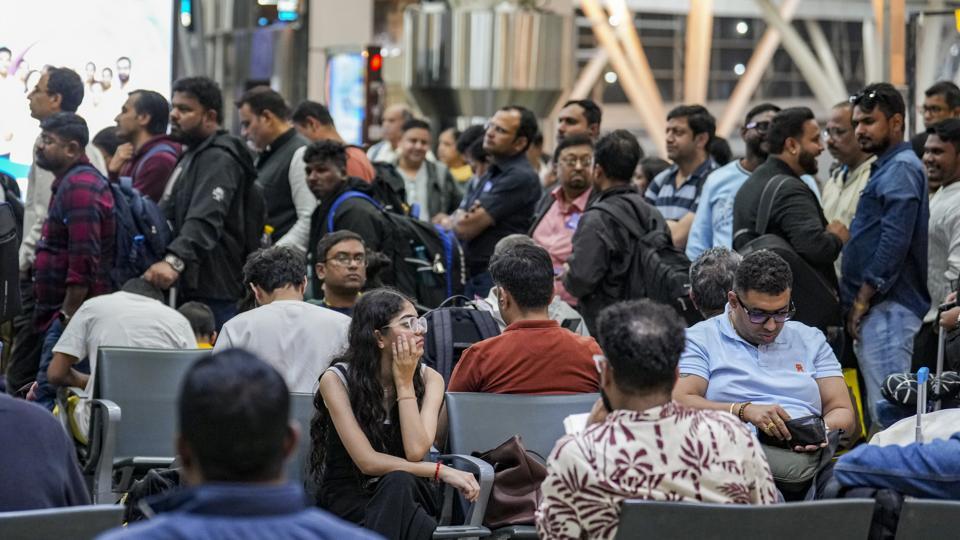
The low-cost giant, which commands 60% of India’s domestic market, has now cancelled more than 600 flights since Tuesday, stranding tens of thousands of passengers and laying bare the fragility of a business model predicated on relentless cost optimisation with minimal operational buffers. The crisis has also exposed the lack of choice for passengers in India’s aviation sector that now is largely a duopoly between IndiGo and Air India, with the embattled low-cost carrier being the only option in many sectors.
The airline issued an apology for the second time in two days on Thursday. IndiGo has now asked the regulator for relief from the provisions limiting pilot duty hours at night — the very rules it struggled to adapt to — and said full restoration of operations would take until February 10, 2026, more than two months away. The airline warned that more cancellations would continue for the next two to three days as part of schedule stabilisation efforts, with flight reductions beginning December 8. The Directorate General of Civil Aviation (DGCA) did not say whether it accepted the request.
“The disruptions have arisen primarily from misjudgment and planning gaps in implementing Phase 2 of the (Flight Duty Time Limitations), with the airline accepting that the actual crew requirement exceeded their anticipation,” DGCA said in a statement late Thursday after IndiGo representatives briefed the regulator.
Civil aviation minister Ram Mohan Naidu convened a high-level review on Thursday with senior ministry officials and IndiGo’s leadership, directing the airline to normalise operations “at the earliest” and ensure the crisis does not trigger fare increases. The regulator has instructed Airport Authority of India directors nationwide to monitor the situation and provide support to stranded passengers.
At least 99flights were cancelled at Bengaluru airport on Thursday, 79at Hyderabad, around 150at Delhi and 118 at Mumbai, according to airport officials in these cities. This followed at least 150 cancellations on Wednesday and scores more on Tuesday, when the crisis first erupted into public view. IndiGo has been experiencing a sharp rise in cancellations, reaching approximately 170-200 flights per day—substantially higher than normal, according to the civil aviation ministry.
“IndiGo operations will be back to normal within two days. However, if the airline hasn’t done its roster planning in line with the fog season well, then delays towards the end of the month can also be expected, especially in North India,” a senior airline official requesting anonymity said.
Crew shortfall confirmed
The cascading failures have exposed how IndiGo’s low-cost strategies—pilots additionally allege there have been hiring freezes, non-poaching agreements with rivals and pay freezes—left the airline with insufficient crew when new Flight Duty Time Limitations came into force on November 1.
In data submitted by IndiGo to DGCA, the airline’s requirement for pilots-in-command increased from 2,186 in October to 2,422 in November under the new norms. As of December, IndiGo has 2,357 pilots-in-command—a deficit of 65. For first officers, the requirement rose from 1,948 to 2,153, with the airline currently employing 2,194.
The airline also told regulators that because expansion slots are only available during night hours, “this has resulted in further impact on operations. The sharp increase in duty share during night-time operations has further constrained crew availability.”
The Airline Pilots Association of India, which represents over 6,000 pilots, said in a letter to DGCA that “despite the two-year preparatory window before full FDTL implementation, the airline inexplicably adopted a hiring freeze, entered non-poaching arrangements, maintained a pilot pay freeze through cartel-like behaviour, and demonstrated other short-sighted planning practices”.
A former aviation operations expert, speaking on condition of anonymity, said the disruptions cannot be attributed solely to the new FDTL norms. “The disruption was also caused due to the tight roster,” the person said.
“Some airlines try to stretch pilot utilisation to 70 hours a month. When you operate at the limit, there’s room for disruption. Sometimes you save pennies and end up paying pounds,” a former bureaucrat said.
Ground operations also overwhelmed
DGCA teams conducting field inspections at Delhi Airport’s Terminal 1— which witnessed the highest passenger impact—found IndiGo’s passenger-handling manpower “inadequate to manage disruption-induced crowding”. The airline has been instructed to urgently increase staffing and strengthen passenger-support services at all affected terminals.
At airports on Thursday, frazzled and furious passengers stood in serpentine queues inside crowded terminals. “My grandfather is hospitalised in Jammu and I need to reach today. There is no other flight to Jammu today but I still came to the airport because I need to get home,” said 22-year-old Hussain
A Reuters photographer said she was trapped inside her IndiGo aircraft for three hours after it landed in Pune on Wednesday night, with the pilot citing operational issues and lack of permission to dock the plane until others had departed.
Social media continued to overflow with videos of confrontations between passengers and airline staff, with many travellers reporting they received no assistance with accommodation or alternative arrangements despite missing connecting flights or important events.
DGCA has directed IndiGo to submit a detailed roadmap covering projected crew recruitment aligned with aircraft induction, along with crew training plans, roster restructuring and safety-risk assessments. The airline must provide progress reports every 15 days covering operational improvements, crew availability and roster stability.
The regulator has also ordered its regional offices to conduct real-time field inspections at major airports to evaluate IndiGo’s management of flight disruptions, focusing on passenger-handling arrangements, crew-deployment practices and on-ground coordination.
The regulator has indicated it will review IndiGo’s schedule ahead of the holiday season and audit the airline’s staffing levels. It remains unclear whether DGCA will impose penalties for the hundreds of November cancellations or grant IndiGo’s request for relief from the very rules designed to ensure pilot safety.
IndiGo shares fell 3.4% on Thursday and are down 6% for the week. The airline, which operates more than 2,000 flights daily with a fleet of over 400 aircraft—predominantly Airbus A320s—generated ₹84,000 crore in revenue in the past business year.
IndiGo did not respond to requests for comment on Thursday. In its earlier statements, and an internal email sent to employees on Thursday, the airline attributed disruptions to a confluence of factors including technology glitches, weather conditions, aviation system congestion and FDTL implementation, saying these had “a negative compounding impact on our operations in a way that was not feasible to be anticipated”.
As of December 2, IndiGo had 416 aircraft in its fleet, with 366 in operations and 50 grounded, up from 47 the previous month.
The FDTL regulations, designed to combat pilot fatigue and aligned with global standards, increased mandatory weekly rest periods from 36 to 48 hours and limited night-time landings to two per week, down from six. The revised norms were implemented in two phases on July 1 and November 1, pursuant to Delhi High Court directions.


