
 E-Paper



Judges should make litigants feel at ease, says CJI Ramana
On the infrastructure front, CJI said the present condition of judicial infrastructure in the country is far from satisfactory with courts operating from rented accommodations and in deplorable conditions.

 Prefer HTon Google


New Delhi: Judges should make litigants feel at ease, said Chief Justice of India (CJI) NV Ramana on Saturday underlining that the district judiciary, which acts as the first contact with the justice seeker must be conscious of the fact that litigants coming to court are under a lot of psychological stress.
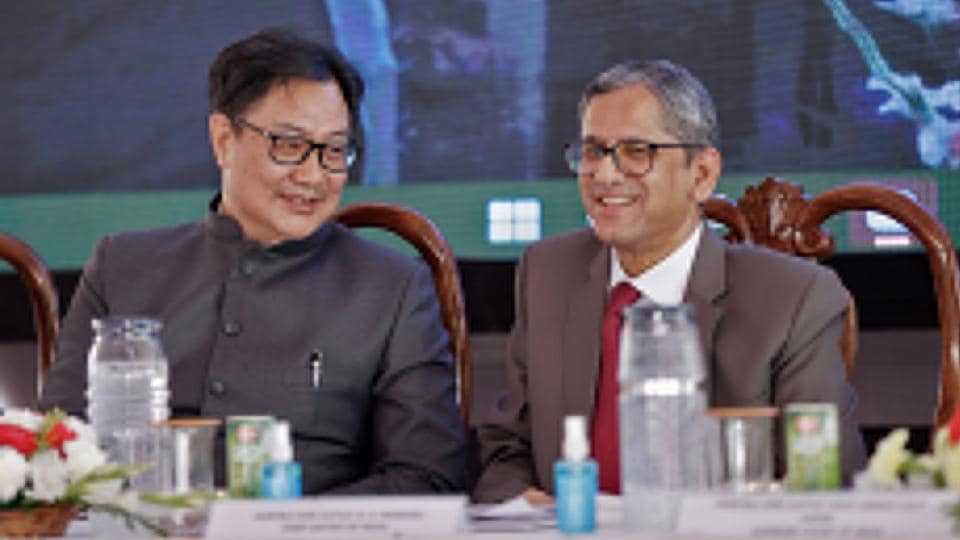
Addressing a gathering of judges, court officers and district judicial officers at Srinagar, CJI said, “Create a congenial environment for the litigants. Often, litigants are under a lot of psychological stress. Litigants may be illiterate, unaware of law and have various financial issues. You should try to make them feel at ease.” The CJI was speaking at the foundation stone laying ceremony of the new building complex of the Jammu and Kashmir and Ladakh high court at Srinagar.
Urging the district judiciary to always bear this fact in mind, the CJI said, “You (district court judges) are at the grass root level, and are the first contact for the justice seeker with the judicial system. You have a direct link with the people. You must persuade parties to choose ADR mechanisms whenever possible. This will not only help the parties, but also will help in reduction of pendency.”
The new high court premises is spread over 1.7 lakh square meters and is being constructed at an estimated cost of ₹310 crore. Justice Ramana, who was accompanied by two other judges from the Supreme Court - Justice UU Lalit and Justice Sanjay Kishan Kaul, said, “Although the persons who will occupy this building will be members of the bar, the bench and their support staff, we must not forget that the focal point of any justice delivery system is the litigant, who is the justice seeker.”
At the same time, the CJI spoke of the challenges facing the judiciary, saying, “One of the major challenges to the protection of rule of law and human rights is the inability of the formal justice system to deliver speedy and affordable justice to all. The justice delivery mechanism in India is very complex and expensive. 22% of the posts in the district judiciary are still lying vacant. Steps have to be initiated immediately to fill this gap.”
Union Law Minister Kiren Rijiju along with Lieutenant Governors of J&K and Ladakh, namely Manoj Sinha and RK Mathur were also present at the event. CJI also spoke of the need to provide security and accommodation to judges, an issue that was discussed by CJI with states at the recently concluded meeting of the Chief Ministers and Chief Justices in Delhi.
Justice Kaul, described as a “son of the soil” by CJI, spoke at the event saying that he never misses a chance to visit Kashmir. “Kashmir has a tradition and ancient architecture and it is important the high court should reflect it,” said Justice Kaul. He further stated that the courts exist for the common man and a balance needs to be struck by making justice time-bound as citizens keep waiting for justice.
On the infrastructure front, CJI said the present condition of judicial infrastructure in the country is far from satisfactory with courts operating from rented accommodations and in deplorable conditions. “Sadly, post-independence, judicial infrastructure has not been over-hauled to meet the demands of growing needs of modern India. We are far behind in making our Courts inclusive and accessible. If we don’t attend to this urgently, the constitutional ideal of access to justice would stand defeated.”
In his speech, CJI quoted two Urdu couplets by Ali Jawad Zaidi and Rifat Sarfarosh and one by poet Raja Basu, all describing the beauty of Kashmir. Describing Kashmir as the confluence of three great religions - Hinduism, Buddhism and Islam, CJI said, “It is this confluence which is at the heart of our plurality which needs to be sustained and cherished.”
Solving the problem of infrastructure is close to my heart, said CJI. He had recently unveiled his plans to have a special purpose vehicle in the form of a National Judicial Infrastructure Authority with a similar structure at the state level to expedite and monitor timely completion of construction of court complexes and related infrastructure.
“The justice delivery system in India is very complex and expensive,” said Justice Ramana, pointing out that “Peace shall only prevail, when people’s dignity and rights are recognized and protected.”


