
 E-Paper



Just Like That: Folk tales and earthy wisdom that grounds India’s philosophies
In our ancient past, kings had jesters in their court to provide wisdom, and sometimes even bring down a notch or two the king’s vanity.

 Prefer HTon Google


India is often described as a civilisation of grand metaphysics, soaring philosophies, and intricate systems of thought. Yet, beneath the elevated abstractions of the Upanishads and the theological disputations of learned schools, there thrives another India — earthy, unschooled, sharp-witted, and instinctively wise. This India speaks through its folk tales. In these seemingly simple narratives — told by grandmothers at dusk, sung by wandering bards, enacted in village squares — resides the distilled wisdom of generations. They reveal a people who, despite deprivation and hierarchy, have evolved a resilient pragmatism, a democratic intelligence, and an irrepressible sense of humour.
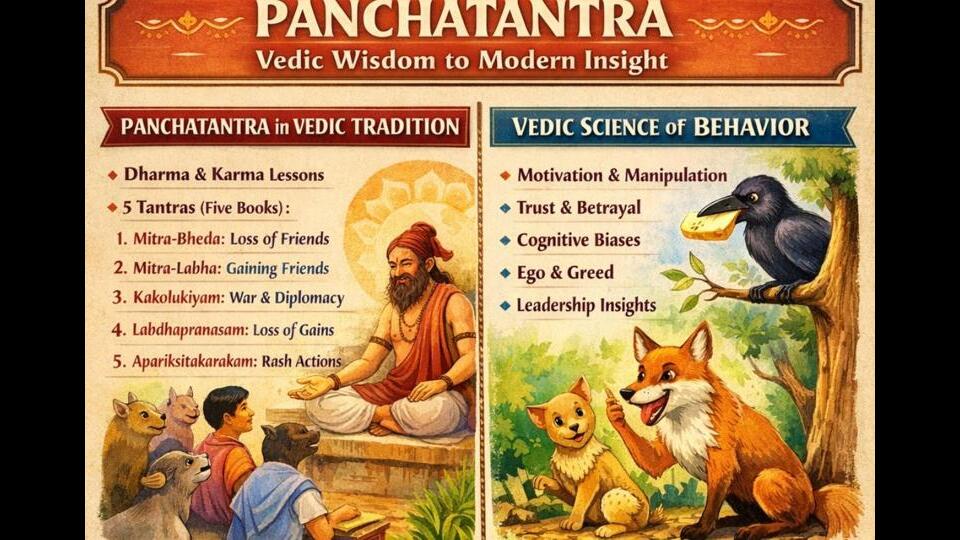
Consider the vast corpus of the Panchatantra. Compiled more than two millennia ago, these interlinked animal fables were ostensibly written to instruct errant princes in statecraft. But their deeper appeal lies in their unvarnished realism. In the tale of ‘The Lion and the Clever Rabbit’, brute strength is undone by intelligence. The rabbit, faced with certain death, tricks the lion into leaping into a well by convincing him that his reflection is a rival. The lesson is that power without discernment is self-destructive; intelligence, however small its bearer, is transformative, and ingenuity is often as important as might.
One folk tale, which I remember as a child, is about a king and his ‘wazir’ (political advisor). One day the king mentioned to his ‘wazir’ that eggplant was an absolutely useless vegetable. The wazir agreed wholeheartedly, denouncing the poor vegetable. A few days later, on the advice of the ‘raj vaid’ or personal physician, the king waxed eloquent on the health benefits of eating eggplant. The wazir said that he couldn’t agree more. Suddenly, the king remembered that on the last occasion the wazir had roundly condemned the vegetable. Angrily, he asked the wazir how he could maintain two absolutely contradictory points of view. The wazir’s answer came from centuries of distilled wisdom: ‘My Lord, I work for you, not for the eggplant. What good would it do to me if I disagree with you, and agree with the eggplant’.
The same spirit animates the stories of Tenali Rama, the irreverent wit at the court of Krishnadevaraya of the Vijayanagara empire. When pompous courtiers attempt to expose him, he exposes instead their vanity. In one story, a group of scholars claim to possess knowledge of all languages. Tenali sets a trap by pricking one of them unexpectedly; the man cries out in his mother tongue. The story gently mocks intellectual arrogance and hollow erudition.
In the north, the tales of Birbal, the trusted advisor of Akbar, echo similar themes. In the celebrated story of ‘The Khichdi’, a poor man claims a reward promised for standing all night in a cold river. When courtiers argue that he survived only because he could see a distant lamp, Birbal exposes their sophistry by attempting to cook khichdi suspended high above a fire. The absurdity lays bare the injustice, affirming that authority must be tempered by fairness, and that clever reasoning can defend the powerless against arbitrary power.
Equally revealing are the stories of Gopal Bhar in Bengal. Gopal’s irreverence is sharper, sometimes bordering on subversion. He ridicules greed, punctures hypocrisy, and often turns the tables on wealthy landlords. In one anecdote, when rebuked for arriving late, Gopal replies that he had been “waiting for time to arrive.” The playful inversion reflects a deeper philosophical ease with paradox — an understanding that time and hierarchy are human constructs, not divine absolutes. Through laughter, the powerless reclaim agency.
What is striking in these tales is their unsentimental understanding of human nature. Unlike the idealised heroes of epic literature, folk protagonists are flawed, vulnerable, and calculating, aware that to survive pragmatism is essential. In the Panchatantra’s ‘The Monkey and the Crocodile’, the monkey saves himself by claiming he has left his heart on the tree. The moral is clear: innocence without awareness invites danger.
Yet, this pragmatism is leavened by humour. It is humour not of cruelty but of resilience. In a society long stratified by caste and class, humour becomes a subtle instrument of social critique. It allows dissent without direct confrontation. The jester survives precisely because he speaks truth through wit.
There is also, in these tales, a deep democratic instinct. Wisdom is rarely monopolised by kings or priests. Often, it is the poor farmer, the village woman, or the smallest animal who perceives the truth. This inversion of hierarchy suggests a collective belief in the moral intelligence of ordinary people. The folk imagination refuses to accept that power alone confers superiority. Instead, it celebrates presence of mind, integrity, and adaptability.
Ultimately, India’s folk tales are not merely children’s stories. They are repositories of a civilisational temperament. They reveal a people who have learned, through centuries of upheaval, to combine scepticism with faith, cunning with compassion, and laughter with endurance. If the epics provide the moral grandeur of India, its folk tales illustrate its adaptive wisdom.
In our ancient past, kings had jesters in their court to provide this wisdom, and sometimes even bring down a notch or two the king’s vanity. It is a pity — as the intolerance to our stand-up comics shows — that the powerful today rarely realise the importance of this asset.
(Pavan K Varma is an author, diplomat, and former Rajya Sabha MP. The views expressed are personal.)


