
 E-Paper



Manhattan to Washington ‘Desi’? Indian twist in House fight
Patel, 38, could well become the first Indian-American, the first of South Asian descent, indeed the first non-White, to represent the heart of Manhattan in the Representatives later this year

 Prefer HTon Google


Suraj Patel often thinks in Gujarati, and even does his math calculations in the language (“That’s how I learnt it!”). His maternal grandparents live in Bardoli in Gujarat. He eats Indian food five times a week. He visits India almost every year, has already taken his fiancé on a trip there, and plans to return to India to get married in December 2023.
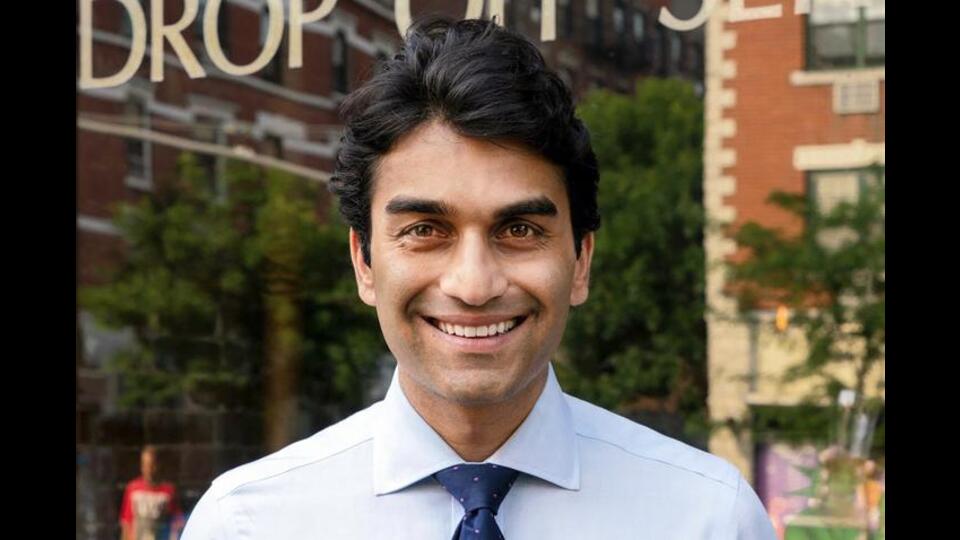
Patel went to the universities that would make parents, definitely Indian parents with their overwhelming focus on education, proud — Stanford, Cambridge, New York University (NYU). And combining a background in business (he has helped run his family business), law and academia (he teaches business ethics at NYU), he can come across as yet another successful Indian-American who has ticked the right professional boxes, remained culturally rooted, and made it in the land of opportunities.
But Patel, 38, is not the average desi, the term Indian-Americans often use to describe themselves. He could well become the first Indian-American, the first of South Asian descent, indeed the first non-White, to represent the heart of Manhattan in the United States (US) House of Representatives later this year.
Sipping a cold coffee on an unusually hot Sunday afternoon at a cafe on East 52nd Street in the city that he hopes to represent, Patel says, “It is an incredible story. My father used to fix bicycles for a few paisa in Nagod, which was our village in Gujarat. You don’t even see or count in paisa anymore. My parents came from Gujarat to the US in the 1960s and 1970s. They struggled. And for their son to be here in New York City, running for Congress, in one of the most visible and large districts in the world, in the immigrant capital of the world, in 2022 is remarkable.”
Patel’s battleground
Indeed, New York’s 12th district, Patel’s battleground, is among America’s richest and most educated districts — 65% of the voters are graduates. It is the hub of global finance, multilateral diplomacy, popular culture, and global cuisine. It is the home of dreams and aspirations.
After a recent round of redistricting, the Manhattan constituency spans across both sides of the city’s iconic Central Park. And it is here that Patel is challenging two established and veteran Democratic leaders in a party primary on August 23. The winner of the primary, in a seat seen as safe for Democrats, is almost certain to be elected to the House in November.
If he wins, Patel will emerge as a giant-killer, slaying Carolyn Maloney — who has been in the US Congress since 1993 and is the chair of the House Oversight Committee — and Jerrold Nadler, a 15-term Congressman and chair of the House Judiciary Committee. Maloney is the incumbent, and Nadler represented parts of Upper West Side but shifted his seat after the redistricting.
A Patel triumph will be among the most stunning upsets in American politics this year. And it will mark yet another step in the rise of liberal Indian-Americans within the Democratic Party and in US politics. In victory, Patel will join the ranks of Pramila Jayapal, Amy Bera, Raja Krishnamoorthi and Ro Khanna, the four Indian-Americans who have already made it to the House and informally call themselves the “samosa caucus”. Patel will also break a geographical barrier, for there is no representative from the community in the national legislature from east of Chicago (Bera and Khanna are from California; Jayapal from Seattle; and Krishnamoorthi from Illinois).
But here comes the reality check.
At the moment, Patel is only a dark horse who is betting on the division of establishment votes between Maloney and Nadler and the yearning of younger voters for change. This is his third attempt to win the Democratic primary. He lost in 2018 and 2020, inching closer to the incumbent the second time around, with only a three percentage point difference.
New York’s 12th district is also an overwhelmingly White constituency, though Patel rejects suggestions that he should move to a district with a larger Indian-American population in neighbouring New Jersey. “I refuse to be ghettoised,” he says, claiming that he got White votes in his previous attempts and asserting that he will win a plurality of White votes this time around.
But even if he doesn’t win the race, Patel has stamped his place as the next in line of succession for the Congressional seat, and set the foundations to become a key figure in the politics of the city. In defeat, he will join the ranks of other younger progressive Indian-Americans who have challenged established Democrats in this election season. Kesha Ram, who traces her lineage back to Sir Ganga Ram, is a state senator in Vermont and threw her hat in a primary race for the Congress but withdrew in favour of another progressive candidate. Victoria Virasingh, whose father is Sikh and whose mother is Latina, contested in Virginia but lost to a Democratic veteran. They are not big national names yet but Patel, Ram, Singh represent the deepening of Indian-American participation in American politics from the progressive end of the spectrum.
But how did Patel get here? What is his politics? And what is his future?
The early years
Patel’s father was an engineer with the Metropolitan Transportation Authority in New York and worked on the night shift. The family lived in New Jersey, with 13 people sharing a two-room apartment. They owned a bodega, a corner grocery story, with all family members chipping in at all hours of the day.
But in what is characteristic of the struggle and success that marks the Indian-American story, the family’s fortunes grew. They acquired their first motel in Indiana and moved there. Slowly, with help from loans given to small businesses, the Patels built up a motel chain, employing thousands of people. “My parents really worked their way up dime by dime…I grew up bussing tables, filling vending machines, doing motel laundry, and helping out on construction sites,” Patel says.
But while struck by American warmth “including in the reddest parts of the country”; Patel recalls how he was made to feel different. “I tried very hard to fit in. But it wasn’t always easy. People found it difficult to pronounce my name. And then there was the Appu character in Simpsons which became the stereotypical representation of Indians.”
But Patel, like so many of his generation from the community, found their voice and passions in the world’s best universities, as he headed to Stanford, Cambridge and then NYU.
Two elections, a new life
It was while he was reading law in New York that another “skinny man”, with a “funny sounding name” unfamiliar in American political discourse, launched his presidential bid. The Barack Obama candidacy changed Patel’s life.
Patel was inspired and took a break as headed to Colorado to become a field organiser for the Obama campaign. “I used to do advance work for the campaign, attended seven to eight rallies a day, and saw the power of persuasion in politics.” Obama made history, Patel returned to New York.
But this was also the time when the global financial crisis hit, affecting his family business. Patel’s legal training helped, as he dived into helping the family business overcome the shocks caused by the recession.
In 2012, he returned to the Obama campaign and then stayed involved in the administration, as an associate on the White House advance team.
Among Patel’s most memorable experiences in this stint was heading to India in 2015, a week before Obama headed to New Delhi to become the first US President to be the chief guest at Republic Day. “I helped organise the meetings with the CEOs…I was there at Rajghat when the President paid tribute to Gandhi and planted a sapling…And I took my fiancé back to the site to show what it meant. This is what makes America exceptional. Decades after my father was fixing bicycles in Gujarat, I was on Air Force One with the American President.”
And then another election happened and altered Patel‘s trajectory.
Donald Trump’s victory in 2016 caused a convulsion in the country, and among younger Democrats. “He was the exact opposite of all that I stood for. But his win also exposed to me the infirmities within the Democratic Party”. Incidentally, Trump Tower is now a part of Patel’s constituency, though Trump has moved to Florida.
Patel — and many like him — began calling out the Democratic establishment for its positions. “Maloney backed the Iraq War. She opposed Obama’s Middle East diplomacy. Many of these people were elected back in 1992, some back in 1982. They are not in touch with what people today want and seek.” Drawing a contrast with the economic policy of many of the establishment figures — “The last economist they draw ideas from was probably Milton Friedman” — the young Indian-American candidate positions himself as expossing the structural and systematic crises in America, with the power of cutting edge academia behind him.
“It was time for a generational change,” Patel says, explaining his plunge into electoral politics with primary bids in 2018 and 2020. He lost. But he drew solace from his own family’s struggles, and discovered Indian classical texts — Ramayana, Mahabharata, Arthashastra — to draw political and life lessons.
Patel stands to the left of the Democratic establishment and wants his party to push progressive economic policies and take on the Republicans, frontally and aggressively, on its culture wars — on abortion, on guns, on education.
At the same time, he appears to be careful to distinguish himself from those who may be considered too far Left within his party. Instead of de-funding the police, the rhetoric deployed by a segment of the party’s base, Patel calls for smart policing. Instead of only critiquing capitalism, he appreciates the power of free markets.
Defining himself, at various points in the conversation, as a liberal democrat, a pragmatic and progressive Democrat, and an Obama democrat, Patel is not too enamored of the labels that have come to define the fault lines within his party. Instead, he bats for what he calls “evidence based policymaking” on critical issues facing the country.
On foreign policy, Patel agrees that China’s rise and the need to compete with China has strengthened the strategic logic of the India-US partnership and is a votary of stronger ties. He is struck by the vibrancy and pluralism of Indian democracy, and argues that any impulse towards authoritarianism would be a “fool’s errand”. It may seem tempting to believe that authoritarianism, like in China, can resolve problems, but in the long-term, Patel says, it is only democracy that is sustainable.
Reflecting on the broader challenge, Patel says, “Liberal democracy globally is under attack, especially with the rise of misinformation…This often seems to happen with the rise of new modes of communication..there is a turn towards populism.”
At home, it is this right wing populism that Patel has set out to challenge. But before he can do that in the US Congress in Washington DC, he still has to beat his own party veterans who have been at the forefront of New York politics for three decades.
Whether Patel is third-time lucky will be known only on August 23, but his rise tells a broader story — the story of how an Indian-American is pushing the frontiers of politics in the city of New York, and the story of how a key segment of second-generation Indian-Americans are squarely placing themselves within the progressive tradition of American politics.


