
 E-Paper



NEET PG counselling has to begin in national interest: Supreme Court
A bench of justices Dhananjaya Y Chandrachud and AS Bopanna, which heard the matter for two consecutive days, said, “In national interest, counselling has to begin” as it finished hearing the petitioners on their challenge to the July 29 order and the submissions by the Centre in support of the decision.

 Prefer HTon Google


Counselling for NEET-PG courses has to begin in the national interest, the Supreme Court said on Thursday as it reserved its order on a demand by the Centre to hold counselling on the basis of its July 29, 2021 notification granting 10% reservation to the economically weaker section (EWS) in the general category and 27% quota for other backward classes (OBC) in the All India Quota (AIQ) seats.
The court will pronounce its decision on Friday.
A bench of justices Dhananjaya Y Chandrachud and AS Bopanna, which heard the matter for two consecutive days, said, “In national interest, counselling has to begin” as it finished hearing the petitioners on their challenge to the July 29 order and the submissions by the Centre in support of the decision.
Solicitor general Tushar Mehta appearing for the Centre informed the court that while OBC reservation has been provided in central educational institutions under the Central Educational Institutions (Reservation in Admission) Act, 2006, the EWS quota, which was introduced by the Constitution (One Hundred and Third Amendment) Act 2019, has been applied in postgraduate admissions in central education institutes and in appointments. He submitted that the challenge in these petitions cannot be sustained as the basis for the July 29 order was the 2006 Act and Article 15(6) introduced by the 103rd Constitution Amendment, 2019.
By a January 17, 2019 notification, EWS was defined as persons having annual family income below ₹8 lakh. Those with five-acre agricultural land or a residential flat of 1,000 square feet also stood excluded from getting EWS benefits.
The bench made pointed queries to the Centre on arriving at the ₹8 lakh figure to identify EWS when income tax exemption is available to persons earning up to ₹2.5 lakh per annum and with rebate up to a maximum of ₹5 lakh per annum. Referring to a recent report by a three-member committee formed by the Centre that upheld the ₹8 lakh income criteria for EWS, the bench said, “The question is about persons between ₹5 to ₹8 lakh. Is this something the court should defer to by saying it is not an atrociously arbitrary view?”
The Sinho committee, headed by Major General (Retd) SR Sinho was constituted in 2005, which gave an exhaustive report in 2010 for identification of economically backward classes. While the Sinho committee said the creamy layer cannot be the criterion to identify EBC (economically backward classes) and suggested the BPL (below poverty line) as benchmark for identification, the three-member committee headed by former finance secretary Ajay Bhushan Pandey justified the ₹8 lakh figure.
The court reminded Mehta that in October 2021, the Centre justified the EWS cap by adopting the creamy layer criteria for OBCs that stood at ₹8 lakh in 2017. “When you first fixed ₹8 lakh income limit for EWS, you followed the creamy layer criteria and now you decided to revisit... It appears they (the Pandey committee) have tried their best to justify the figure of ₹8 lakh.”
The court also wished to know from the Centre what consultation was done prior to the January 17 notification prescribing the ₹8 lakh income limit for EWS as the decision to introduce EWS quota in jobs and admissions was decided three days earlier on January 14, 2019.
The petitioners represented by senior advocates Arvind Datar and Shyam Divan argued that in a country with vast disparity in per capita income, land holding capacity, and distribution of unreserved (general) category population, ₹8 lakh cannot be a criterion for all times.
Solicitor general Mehta said, “By the term EWS, we are not trying to find who is poor. These persons may not be BPL, but slightly above this mark….If we do not live in a utopian world but a realistic one, we will be convinced that the figure of ₹8 lakh appeals to common sense. After all, it is just ₹70,000 per month and we know how costly everything is today.”
On the argument whether income tax limit can be applicable to EWS, Mehta said that income tax limit applies to individuals while EWS criteria is on family income. “This is to give a push to students who are economically weaker but are lacking opportunities to compete with others. If there are three persons in the family earning ₹3 lakh each, the family will be pushed out of EWS,” the Centre argued.
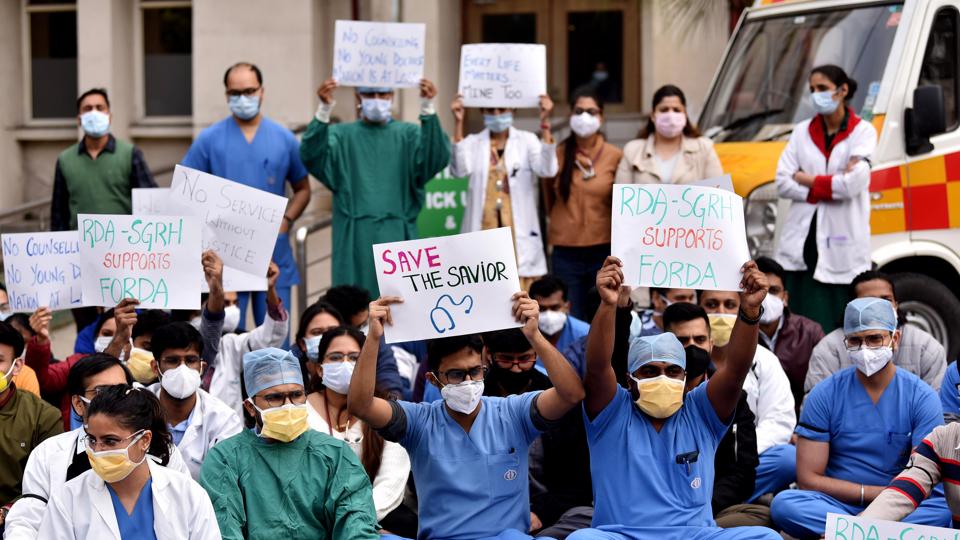
The Federation of Resident Doctors Association (FORDA) through advocate Archana Pathak Dave told the court that every year, 45,000 candidates are inducted as postgraduate resident doctors through the NEET-PG process. Counselling being stuck has resulted in a deficiency of around 33% of the medical workforce constituted by the first-year postgraduate doctors, who constitute the backbone of the medical workforce, Dave said. In the Capital’s Safdarjung hospital, out of 850 PG resident doctors, only 550 are working, of which 60 are down with Covid. A large chunk of this strength will pass out in the next four months, she added.
In one of the petitions, advocate Vivek Singh filed a chart pointing out that in 14 postgraduate streams including dermatology, gynaecology, psychiatry, and orthopaedics, there is no further specialisation and any further reservation in AIQ seats will be crucial for general category doctors.
The bench, allaying concerns of the FORDA, said, “Your concerns are not just of doctors but of citizens. Rest assured, your concern is well taken and is shared by the bench as well.”


