
 E-Paper



Sukhbir Badal, with plaque around neck, undertakes Akal Takht's ‘punishment’ at Golden Temple
The religious punishment - called 'tankhah' in Sikh belief - was pronounced for SAD leader Badal and other leaders of the party by Sri Akal Takht Sahib.

 Prefer HTon Google


Undertaking religious punishment, Shiromani Akali Dal (SAD) leader Sukhbir Singh Badal was seen sitting in a wheelchair by the gate with a plaque around his neck and spear in his hand at the Golden Temple in Punjab's Amritsar on Tuesday morning.
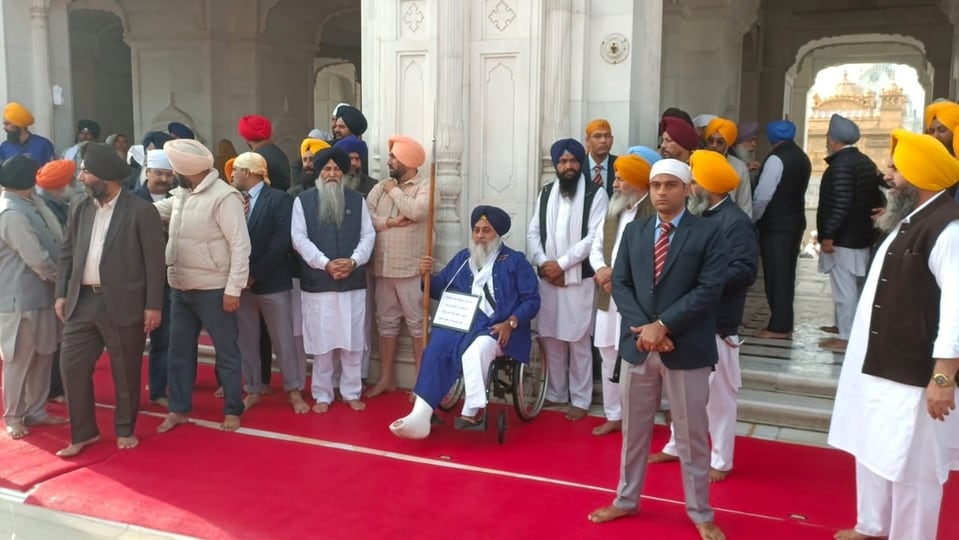
The religious punishment - called 'tankhah' in Sikh belief - was pronounced for Sukhbir Singh Badal and other leaders of the party by Sri Akal Takht Sahib on Monday.
As part of the religious punishment, which is said to be for the "mistakes" committed by the Shiromani Akali Dal government in Punjab from 2007 to 2017, the senior Akali leader was directed to perform as a 'sewadar', and wash dishes and clean shoes at the Golden Temple in Amritsar.
The Shiromani Akali Dal leaders were asked to wear small boards around their necks acknowledging their "misdeeds", and perform the service of 'sewadar' at Takht Kesgarh Sahib, Takht Damdama Sahib, Darbar Sahib at Muktsar and Fatehgarh Sahib for two days each.
Badal's religious punishment
The Sikh clergy at the Akal Takht in Amritsar, Jathedar of the highest temporal seat for Sikhs - Giani Raghbir Singh - pronounced the religious punishment on Monday. Pronouncing the order from the 'faseel' (podium) of the Akal Takht in Amritsar, Giani Raghbir Singh also announced to withdraw the title of 'Fakhre-e-Qaum' bestowed upon former chief minister late Parkash Singh Badal, father of Sukhbir Badal.
Five-time Punjab chief minister Parkash Singh Badal passed away in April last year.
Also Read: Why Akal Takht asked Sukhbir Badal to clean toilets, serve langar at Golden Temple
The Jathedar also directed the working committee of the Shiromani Akali Dal (SAD) to accept Sukhbir Badal's resignation as party chief and form a committee to hold elections for the post of SAD president and other office-bearers within six months.
Sukhbir Singh Badal tendered his resignation as the SAD president in November.
The five 'Singh Sahibans' (Sikh clergy) also pronounced religious punishment for other Sikh leaders who served as ministers in the Akali Cabinet and were part of the core committee of the party from 2007 to 2017.
Giani Raghbir Singh said Sukhbir Badal and rebel leader Sukhdev Singh Dhindsa have been asked to sit outside the Golden Temple wearing the dress of 'sewadar' and holding a spear for one hour each for two days.
Both Sukhbir Badal and Sukhdev Dhindsa were asked to clean utensils and shoes of devotees at the Golden Temple for one hour each, besides listening to 'kirtan'.
Sukhbir Badal came in a wheelchair because of a fractured leg, and so did Sukhdev Dhindsa due to age-related issues.
Before the pronouncement of the edict, Sukhbir Badal admitted the mistakes, including pardoning Dera Sacha Sauda chief Gurmeet Ram Rahim Singh in a 2007 blasphemy case during the SAD rule in Punjab.
The punishment came nearly three months after Sukhbir Badal was declared 'tankhaiya' (guilty of religious misconduct) by the Akal Takht.


