E-Paper



Twisha case: Former judge Giribala, son sent to 14-day judicial custody
A CBI court in Bhopal remanded Samarth Singh and his mother to 14 days' custody in connection with the death of former model Twisha Sharma.

 Prefer HTon Google


A special Central Bureau of Investigation (CBI) court in Madhya Pradesh’s Bhopal on Tuesday remanded former model and actor Twisha Sharma’s husband Samarth Singh and mother-in-law Giribala Singh to 14 days of judicial custody.
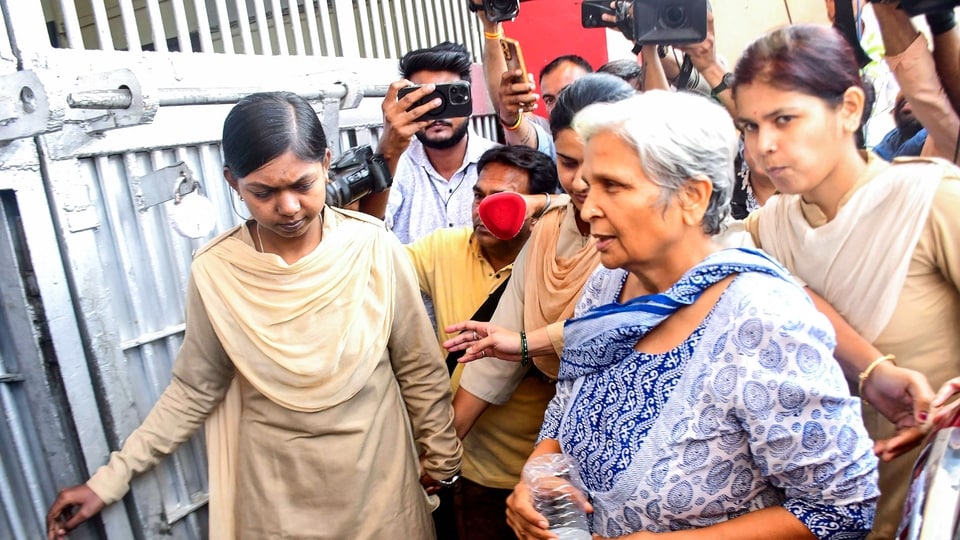
Twisha was found dead at her marital home in Bhopal on May 12. Her family accused her husband Samarth and his mother, retired judge Giribala Singh, of dowry torture, while the accused insist it was suicide. Initially registered by Bhopal police, the case was later handed over to CBI on the recommendation of the state government.
The magistrate Shobhna Bhagave directed authorities to ensure special security arrangements for Samarth and Giribala Singh, after the latter expressed fears for their safety. Giribala Singh pointed out that many hardened criminals lodged in Bhopal Central Jail had once faced her strict judgments, and their presence posed a threat to her and her son.
The court ordered that both be kept in Bhopal Central Jail until June 16, but in secure, separate cells. Representing herself, Giribala said: “To remain with jail inmates whom I had punished in the past will be dangerous for our lives.”
She also urged the court to stop what she described as a media trial and expressed fear for their safety. “False allegations are being levelled against us. We have not released any CCTV footage of the incident. I have no idea how the media got this,” she said.
Referring to Monday’s crime scene recreation, she said: “Wherever we go, the media follow us. Yesterday, we were taken by foot to the house so that the media could cover it.”
The court directed CBI to transfer Samarth and Giribala Singh to jail discreetly, and said that they be escorted from the courtroom to the vehicle in secrecy to avoid public exposure.
During the hearing, Giribala Singh alleged that Twisha’s lawyer, Anurag Srivastava, had physically assaulted her son at the Jabalpur district court when he went there to surrender. Srivastava denied the charge, saying: “CCTV cameras are installed at the court premises. Facts can be verified. No such incident happened.”
Throughout interrogation, both Samarth and Giribala Singh maintained their innocence, claiming they never harassed Twisha physically or mentally. Meanwhile, Twisha’s family has demanded recovery of jewellery given at the time of marriage, which CBI has agreed to pursue.
The CBI produced Samarth and Giribala Singh before the chief judicial magistrate after five days of interrogation, which included crime scene recreation and virtual reconstruction of the timeline. The agency informed the court that questioning will resume once crucial evidence is received—including the second post-mortem report, viscera analysis, and forensic examination of mobile phones, laptops, and other materials—to cross-check facts and strengthen the investigation, said advocate Srivastava.