
 E-Paper



Laws can’t stop attacks on doctors. Focus on fixing health care gaps
Violence against doctors is a symptom of the multi-organ failure of our public health care system that needs radical treatment

 Prefer HTon Google


We are all moved by stories of soldiers martyred on the battlefield. But imagine a health care worker fighting death and diseases, losing her life on duty while trying to save someone else — and more shockingly, at the hands of the man she was trying to heal.
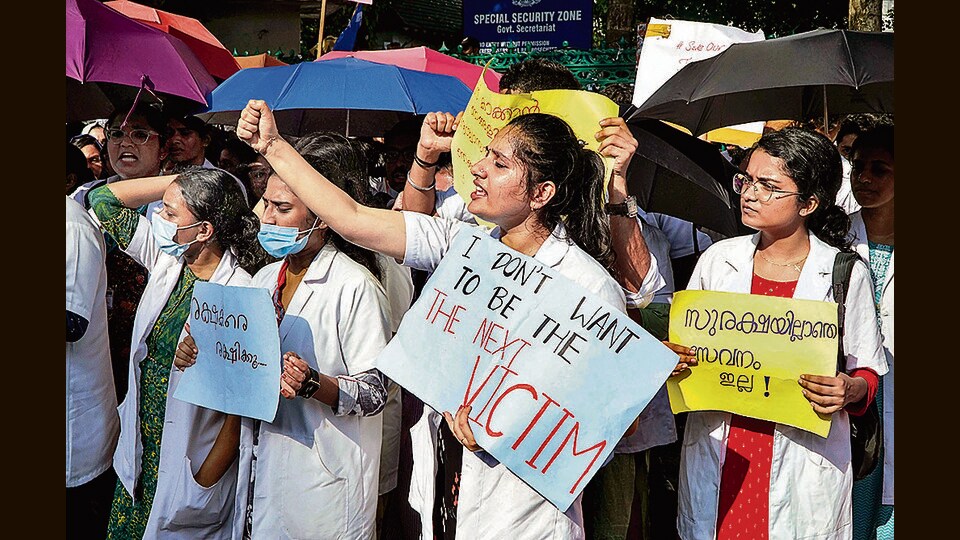
On May 10, 25-year-old house surgeon Vandana Das was attacked and stabbed to death at a taluka hospital in Kottarakkara, Kerala, by an injured patient in police custody. The incident shook the medical community, sparking demands for accountability. Kerala health minister, Veena George, who initially stated that the young doctor lost her life because she was not experienced in handling such attacks, has now agreed to bring about an ordinance to ensure the safety of health workers in the state. But this may do little to repair the fraying ties between doctors and patients.
There have been long-standing demands for central legislation with stringent measures to protect health care workers and health establishments against such violence. The Union ministry of health and family welfare proposed a law, but the ministry of home affairs turned it down. It argued that there cannot be specific laws for different sets of professionals and that the existing provisions of the Indian Penal Code are sufficient to tackle such violence. Some states, however, enacted laws and used the provisions under the epidemic diseases act to tackle attacks on doctors.
The demand by doctors for stringent central legislation on violence against health care workers is justified. The last thing a doctor should worry about while caring for her patients is safety. The government protects specific sections of workers at a higher risk of violence — for example, police personnel, armed forces, and officers on election duty. Also, as part of the right to life, every citizen needs safety against such violence — and one way of doing this is by risk assessment and providing safety measures.
The state provides graded security to many categories of at-risk citizens. Therefore, the argument that if we make laws for doctors, we must make them for others is wrong. Not all health care workers face equal risk. For example, a doctor handling an emergency department in a busy government hospital will be more at risk of violence than a dermatologist doing private practice. The government must look at equity while providing security based on risk assessment.
Yet, this is not the whole story. While medical associations demand laws, one must also realise that more laws don’t necessarily translate into more rights or safety if the implementation is poor. So, while doctors must demand stringent laws, they should not consider it a panacea.
The epidemiology of violence in providing health care needs to be studied to manage this. Most cases of violence happen in busy government hospitals with overflowing emergency departments and ICUs with high patient mortality. These establishments are often understaffed, with junior doctors dealing with anxious relatives. These doctors often pitch in to manage crowds, break the bad news to relatives, and communicate to relatives that there are no empty ICU beds or ventilators. These tasks, which should be ideally done by specialised staff, are left to doctors who don’t receive specific training for such communication or have the resources for it. Imagine a 25-year-old resident at the end of a 17-hour-day, telling a horde of anxious relatives that their loved one isn’t doing well, or has passed. Tempers run high and patience low. The Kerala high court rightly called this a systemic failure. “At 3 am in the morning, she was there to serve. She was serving the people. The system has failed her, her parents and us,” the court remarked.
Violence against doctors is a symptom of the multi-organ failure of our public health care system that needs radical treatment — an upgradation of the public health care system with improved human resources, training, and infrastructure — and not the band-aid of a central law or knee-jerk ordinances. Until that is done, doctors will continue to be victims of violence at the hands of angry patients and relatives.
Aqsa Shaikh is an associate professor, Hamdard Institute of Medical Sciences and Research, NewDelhi. The views expressed are personal


