
 E-Paper



MSEDCL policy hurdles eclipse Pune’s ‘maximum solar city’ dream
The state electricity distribution company has been unenthusiastic about solar power generation under net metering as it would lead to huge revenue losses. Unless the company is compensated, Pune’s solar power potential will continue to go waste.

 Prefer HTon Google


In 2016, Pune international centre (PIC), the city’s leading think tank, had released a policy paper highlighting the enormous solar power potential of the city. The paper, ‘Making Pune Smarter’, said that the city could become a ‘Maximum Solar City’, far beyond the solar city criteria, which requires five per cent reduction in fossil fuel use every five years. The paper emphasised that Pune has the potential to target 10 per cent reduction in thermal power usage every five years.
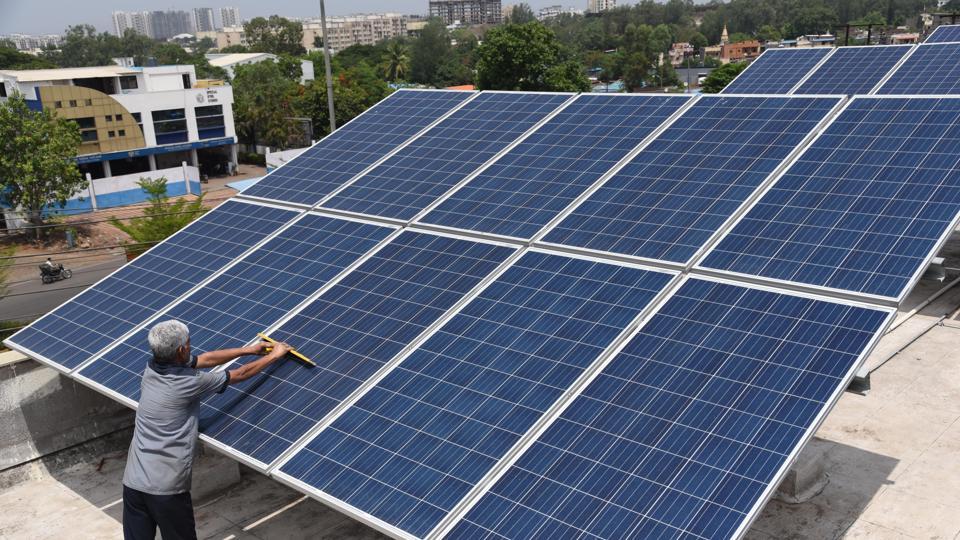
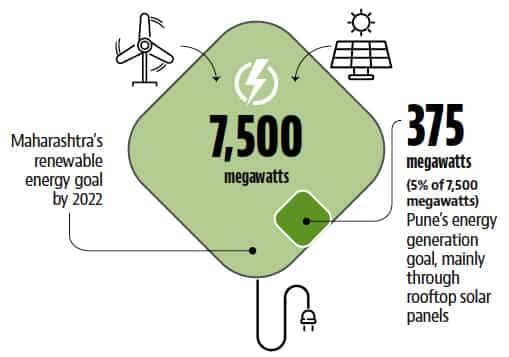
“Aggressive use of solar photovoltaic system would be a key step in making Pune become a carbon neutral city by 2024, without compromising any of its development goals or other ambitions,” PIC said in the paper.
It noted that Pune’s population was expected to grow to 50 lakh by 2030 and the per capita electricity demand was projected at 1,200 units within the Pune municipal corporation (PMC) limits. This would take the total power consumption to 60,000 lakh units per year by 2030.
Pune, with high solar radiation for over 300 days a year, can produce 1,500 units kilowatt-hour of electricity per year for every 10 square metre of solar photovoltaic panel surface at the current efficiency. To meet the demand of 6,000 million units per year by 2030 through solar photovoltaic, the city will need about 70 square kilometre area, is achievable with the right efforts, PIC added.
Sadly, a serious effort to work towards achieving the potential has been missing even though Prime Minister Narendra Modi has been enthusiastically promoting solar power. While rooftop solar photovoltaic power with net metering has been a major success in many advanced countries, it has failed to pick up at the desired pace in Pune. According to experts, what is missing are user-friendly procedures and delays in getting permissions for net metering.
Explaining the situation, Ashwin Gambhir, a fellow at Prayas Energy Group, said, “Currently, the cost of rooftop power generation by using solar photovoltaic systems is around Rs 5 to Rs 6 lakh per unit, which is a better option especially for industrial and commercial users. The present solar rooftop power generation is becoming financially feasible for many users, mainly because of net metering, which is a billing mechanism that credits solar energy system owners for the surplus electricity they put back into the grid after their own usage.
“For example, if a residential customer has a PV system on the home’s rooftop, it may generate more electricity than the home uses during daylight hours. If the home is net metered, the electricity metre will run backwards to provide a credit against what electricity is consumed at night or other periods where the home’s electricity use exceeds the system’s output. Customers are only billed for their ‘net’ energy use.”
Gambhir said that it should be understood that presently, the industrial and commercial consumers are cross subsidising power tariff of residential and agriculture users.
“If industrial and commercial users shift to solar rooftop or captive power generation, it would be a huge loss for Maharashtra state electricity distribution company limited (MSEDCL). Also, residential electricity consumers are further divided into slabs according to their electricity consumption. The higher consumption slabs also cross subsidise the lower ones. Hence, with the current net metering rules, the loss of MSEDCL would be huge if more and more consumers start shifting to solar power,” said Gambhir.
He added that under net metering, MSEDCL has to, ‘in notion’, buy the solar power injected into the grid by the users at a rate equal to their energy tariffs. Since this is much higher than the price of solar power available from the large projects (Rs 3/kWh), it adds to its financial woes.
“Considering all these aspects, even as the popularity of rooftop power generation is growing rapidly in the city, the distribution company has not implemented user-friendly mechanisms for consumers to switch to solar power generation and there are delays in getting permission for net metering. There is a need to make the net metering rules more balanced in the future, in which the distribution company (MSEDCL) is adequately compensated for the energy banking services it provides to the customers which avoid the use of batteries. Such a fee for energy banking will reduce their losses,” he added.
According to Gambhir, apart from the administrative delays, lack of roof space, old buildings which cannot carry the weight of large solar panels, and a heavy initial investment for setting up the solar power system are some of the factors due to which solar power generation is catching up at a slow pace in the city.


