
 E-Paper



Liquid water in Mars: New hope of finding life after NASA's Insights Lander evidence
Liquid water exists deep underground rocks. Finding is crucial to understand the cycle of water and the evolution of Martian climate.

 Prefer HTon Google


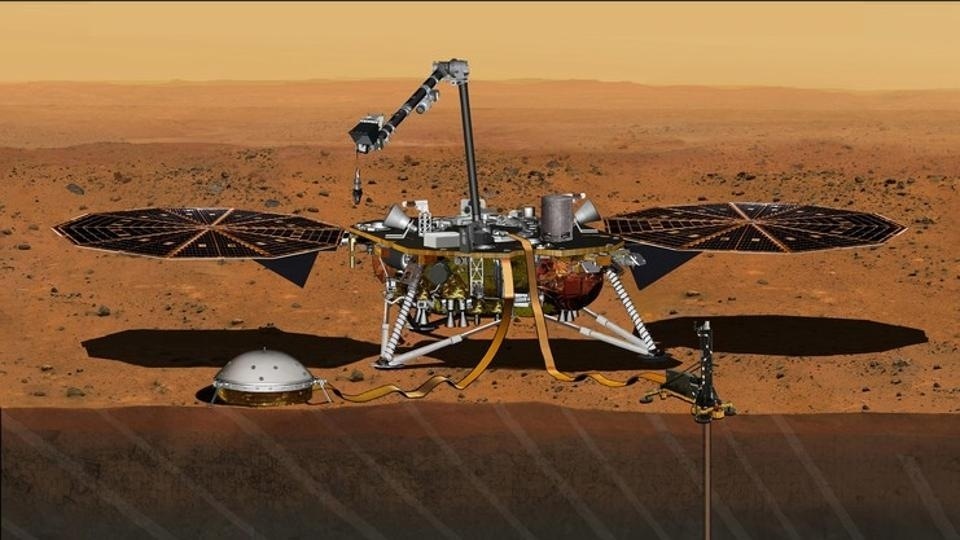
New seismic data from NASA's Insights Lander has discovered that a huge reservoir of liquid water may reside deep under the surface of Mars. Previous studies have established the presence of frozen water at Martian poles and the evidence that water vapour existed in its atmosphere. But this is the first time that liquid water has been found on the planet.
Prof Michael Manga, from the University of California, Berkeley told the BBC that water was "the most important molecule in shaping the evolution of a planet". This finding, he said, answers a big question of "where did all the Martian water go?".
Also read | NASA's ‘mind-blowing’ accidental Mars discovery was ‘like finding an oasis in the desert’
Studies have found evidence of water channels and ripples which prove that rivers and lakes did exist on Mars in ancient times. But the planet has been a desert for three billion years as it lost all its water to sun after losing its atmosphere, a protective blanket to life or molecules on surface.
Prof Manga added that much of Earth's water exist underground and there was always a possibility that it could be similar in Mars, called the Earth's twin.
As life cannot exist without water, the finding indicates the possibility of discovering habitable environments deep underground.
Studying water's cycle on Mars is critical for the understanding the evolution of its climate, the outer surface and its interiors.
Also read | THIS newly found Mars rock may be hiding signs of ancient life, claims NASA
NASA's Insight completed its mission in December 2022, but the lander will continue to record seismic waves on the Mars surface for four years.
The lander has recorded almost 1,319 quakes and by measuring the speed of seismic waves, the scientists have figured out the kind of material likely to exist underground. The findings are published in the Proceedings of the National Academy of Sciences.
Similar techniques are used in Earth to prospect for water on Earth or scout for oil and gas.


