
 E-Paper



How Jannik Sinner turned the table against Daniil Medvedev in thrilling Australian Open final
Medvedev's domination at the Australian Open final lasted until 6-3, 5-1 on serve. It was all Sinner thereafter.

 Prefer HTon Google


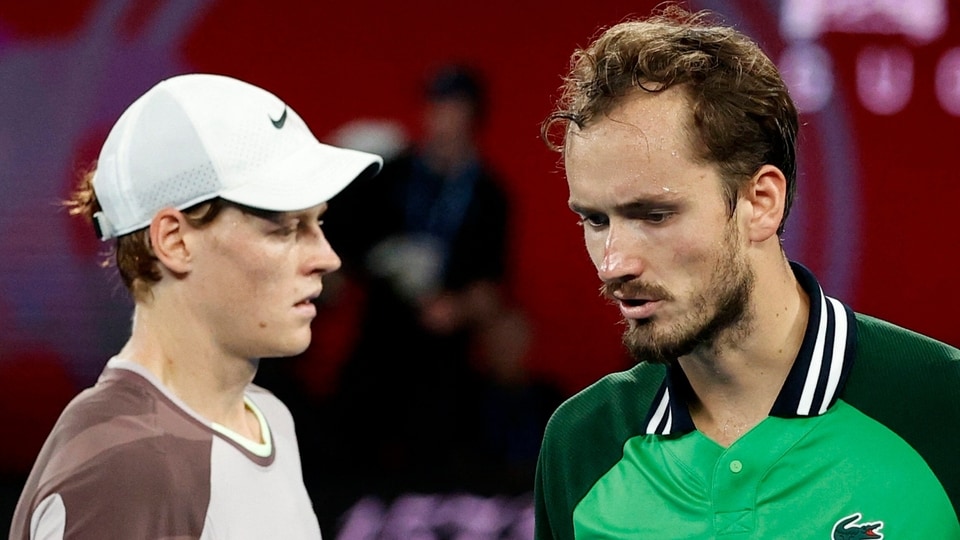
For the first 85 minutes of the Australian Open final at the Rod Laver Arena, Jannik Sinner looked disoriented. Yes, there were nerves early on, and why not for a person playing his first Grand Slam final? But the Italian, who was the overwhelming favourite heading into the contest, given his semifinal win against defending champion Novak Djokovic, was never allowed to settle into the contest. The master strategist that is Daniil Medvedev, who, for the first time in his career, was up against a player not named Rafael Nadal or Djokovic in a major final, had done his homework. But the world No. 3 failed to capitalise on his scintillating start, while the No. 4 seed gradually improved throughout the game, and eventually, Melbourne had its new king in 22-year-old Sinner.
ALSO READ: Sinner's historic Australian Open triumph against Medvedev has Nadal, Djokovic going ga-ga
Medvedev's aggressive start
There were two noticeable changes in Medvedev's approach on Sunday night, perhaps having learned from his three-straight losses against Sinner in late 2023. The more significant one was his return position. Contrary to his usual spot, almost close to the advertisement board, Medvedev stood closer to the baseline against the Sinner first-serve and almost hugged the line against the second delivery to take that time away from the Italian and return the serve with more intent. The other was peppering the forehand corner of Sinner more often, rather than the usual tactic of going to the backhand.
Medvedev came up with an aggressive approach against Sinner, rather than holding a deep-court position and soaking up pressure in lengthy baseline exchanges. Of the 29 points the Russian won in the first set, 15 of those came in rallies of 0-4 shots, five more than Sinner. He also fired nearly triple the amount of winners than Sinner (14-5).
ALSO READ: How much did Jannik Sinner win in prize money after clinching first major at Australian Open 2024?
How did Sinner flip the story?
Medvedev's domination lasted until 6-3, 5-1 15-15 on serve when his forehand return hit the net. Sinner, for the first time in the match, had break points, and converted it in the seventh game. The former US Open winner did manage to survive and take a two-sets-to-love lead, but Sinner by then had shown glimpses of a repeat of what Nadal had pulled off in 2022 in Melbourne.
He suddenly found more accuracy in his returns and was hitting with greater depth, which pushed Medvedev back to his usual deep position, while the Russian lost the sting on his groundstroke, which played a key role in the opening two sets, as he was hitting at 10 clicks faster than what he recorded throughout the tournament. Sinner hence dominated from the baseline more in the final two sets than in the opening two (63 per cent to 38).
The other significant factor in Sinner's comeback was the rally length. In the first two sets, Medvedev dictated the proceedings with shorter rallies where the 22-year-old struggled, winning 44 per cent of the points (22/50). It improved to 61 per cent (20/33) in the third set. But with Medvedev beginning to wear down, having spent over 24 hours on the court through the tournament stretch, Sinner began to play the extra point. The average rally length increased, making it a contest of who missed first. 21 per cent of the points played in the first three sets were of rallies comprising nine or more shots. It increased to 30 per cent of the last two sets. Sinner won 66 per cent of those points.


