
 E-Paper



‘Matter of survival’: Focus on climate crisis, Indian Ocean and Pacific Island states tell big powers
Abdullah Shahid, the Maldivian foreign minister who just stepped down after completing his tenure as the president of the 76th United Nations General Assembly (UNGA), said that he had told all UN member-states that as president, he would be impartial on all issues - ‘except climate’


NEW YORK: At a time of intensified geopolitical competition across the Indo-Pacific, smaller island states of both the Indian Ocean and Pacific Island states have sent out a clear message to all actors in the strategic theatre - what matters to us is the climate crisis, everything else is secondary.
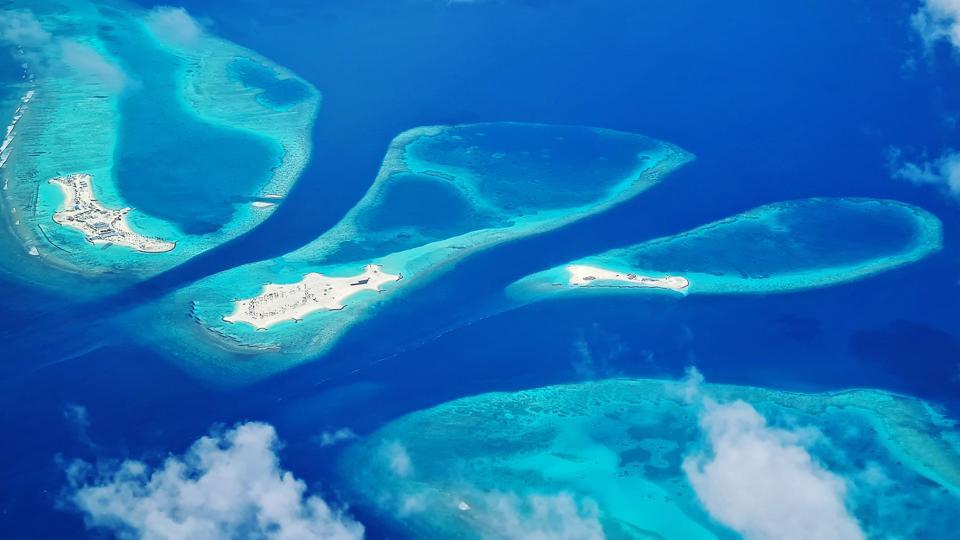
Abdullah Shahid, the Maldivian foreign minister who just stepped down after completing his tenure as the president of the 76th United Nations General Assembly (UNGA), said that he had told all UN member-states that as president, he would be impartial on all issues - “except climate”. “It is a matter connected to our survival.”
From the other end of the Indo-Pacific space, Tonga PM Siaosi Sovaleni said that the onset of rise in sea levels means countries like his were living on “borrowed time”.
He recalled how volcanic eruption, tsunami and ashfall earlier this year had destroyed one-third of Tonga’s GDP. “We are the second most disaster prone country in the world. Our people live with uncertainty every day.”
Satyendra Prasad, the permanent representative of Fiji to the UN, sent out a message to all major powers vying for influence in the Pacific Islands. “If you are committed to zero by 2050, you are with us; if you are not committed to zero by 2050, you are against us.”
Speaking at Ocean Nations: An Indo-Pacific Islands Dialogue, a conference organised by the Carnegie Endowment on the sidelines of the UNGA in New York, leaders from smaller island states expanded the definition of security in the region to emphasise the urgency of climate crisis. Their comments come at a time when the United States and China are locked in a fierce competition for influence in the Pacific Islands, triggered by a security understanding between Solomon Islands with China, while New Delhi and Beijing have increasingly been at odds in the Indian Ocean islands.
In its sixth assessment report, the Intergovernmental Panel on Climate Change (IPCC) observed an increase in warming, ocean acidification, marine heatwaves and a rise in sea levels and storm surges in island states. These will “exacerbate coastal inundation...cause shorelines to retreat”, and smaller islands will face more intense tropical cyclones. In the western Indian Ocean, the report flagged decreasing trends in rainfall, while in the western tropical Pacific, heavy rainfall events will increase.
Speaking about the Pacific Islands, Fiji’s Prasad said that the Blue Pacific was large (it covers 15% of the planet area); it was diverse (it was home to 900 languages, with 10 million people being the stewards of one third of the world’s linguistic diversity); it was thriving and was an oceanic superpower. “Our core message is work with us, not against us to protect the world’s assets.”
He claimed for island states, their own agency and sovereignty mattered given their colonial history. “Pacific island states cannot be bought,” he said, in what could be seen as a reference to commentary about the push by both China and the US to woo the island states.
While highlighting the importance of multilateralism, he also spoke about the inequities inherent in the global financial architecture, the fact that smaller island states had to go through the same process as other big emitters in accessing finance and support, and sought support. “We get angry. Large emitters are embarking on the path to suicide and have no interest in saving us. But it affects all of us.”
Shahid, who became the first leader of an Indian Ocean island state and only the sixth from any island state to become the UNGA president, pointed out that while island states were “exceptionally vulnerable”, they were not powerless.
He recalled that Maldives has been at the forefront, back in 1989, in setting up the alliance of small island states. “For us it is clear. From where we stand, we are at heart of Indian Ocean. For the body to survive, it needs the heart to be strong..and have peace, stability and good health.”
Nilanthi Samaranayake, director of the strategy and policy analysis programme of Central for Naval Analyses in Washington DC and an analyst of Indian Ocean security affairs, said that it was important to develop a framework that placed the perspective of smaller island states at the centre. “They are diverse, but they have a set of shared needs, shared concerns and have surprising strengths. They are thought leaders in the climate agenda.”


