In his poem Inventory of Places Propitious for Love, Angel Gonzalez begins by noting, with un-gentle irony: “there aren’t many”. On the night before the Supreme Court’s decision in Navtej Johar case, I shared an auto ride with a lover. It was late, the streets were empty, our fingers were entwined. As the auto came to a halt, he leaned in and kissed me tenderly. It should have been a casual moment of intimacy, a final grace note to a lovely evening. Instead, I felt my body go rigid with panic. It is one thing to slide into the easy anonymity that comes from holding hands with a member of the same sex in public spaces, delinked as it is from desire in the public imagination. The kiss in that moment, however, was an act of rupturing that veil and dragging our sexuality out into the open, to render what was safely private now suddenly vulnerable in public.
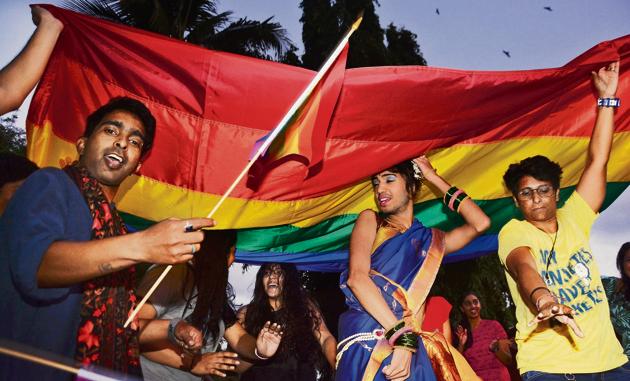
When a nine-judge bench of the Supreme Court of India affirmed the existence of a right to privacy in the Puttaswamy decision last year, it was a largely theoretical document. The Court thoroughly mapped out the contours of what this right could encompass but left the matter there. These principles included the notion of carrying privacy in public spaces: the right to privacy, we were told, recognised personal choices governing a way of life, such that it is not lost or surrendered merely because an individual is in a public space. This was a powerful idea; it was then left up to successive courts to breathe life into it. One of the many marvels of Navtej Johar case is how it has taken forward this promise.
Take the final declarations by the successive opinions in the case. In three out of the four opinions (Justice Indu Malhotra being the outlier), the judges find that Section 377 is unconstitutional insofar as it penalises consensual sexual relationships between adults. There is a crucial phrase that is missing from these statements: “in private”. Back in 2009, when the Delhi High Court had initially read down Section 377, it placed that phrase in its declaration in what was one of the few mis-steps of that decision. Even as it noted that privacy included both zonal aspects (in terms of acts done within the four walls of a house) as well as decisional aspects (in terms of personal choices made by individuals that enabled them to exercise their autonomy), the use of the words “in private” connoted that acts done in public spaces would still be open to criminalisation. With the removal of the private space rider from its multiple holdings, Navtej Johar case carves out a space for protecting public intimacy as well.
{{/usCountry}}Take the final declarations by the successive opinions in the case. In three out of the four opinions (Justice Indu Malhotra being the outlier), the judges find that Section 377 is unconstitutional insofar as it penalises consensual sexual relationships between adults. There is a crucial phrase that is missing from these statements: “in private”. Back in 2009, when the Delhi High Court had initially read down Section 377, it placed that phrase in its declaration in what was one of the few mis-steps of that decision. Even as it noted that privacy included both zonal aspects (in terms of acts done within the four walls of a house) as well as decisional aspects (in terms of personal choices made by individuals that enabled them to exercise their autonomy), the use of the words “in private” connoted that acts done in public spaces would still be open to criminalisation. With the removal of the private space rider from its multiple holdings, Navtej Johar case carves out a space for protecting public intimacy as well.
{{/usCountry}}In his opinion, Chief Justice Dipak Mishra begins with an understanding of privacy that is decidedly zonal in nature but then goes on to open it out: “any display of affection amongst the members of the LGBT community towards their partners in the public so long as it does not amount to indecency or has the potentiality to disturb public order cannot be bogged down by majority perception.” The indecency standard here has the potential to undercut the larger point, but it is bolstered by Justice Chandrachud’s opinion.
Noting how the conception of a private space for certain individuals is utopian, he goes on to assert that relegating “homosexual acts” into the private sphere would in effect reiterate the “ambient heterosexism of the public space”. This is the transformative potential of the judgment in practice: Justice Chandrachud’s statement effectively elevates the casual act of public intimacy into something that has more world-altering consequences.
Love is a word that resonates through the judgment, and it begins indeed with an invocation of a great love story. Towards the start of his opinion, the CJ quotes from Shakespeare: “What’s in a name? That which we call a rose by any another name would smell …” Perhaps as if to illustrate this point, Justice Mishra omits the name of the play. It is, of course, Romeo and Juliet, these lines from Juliet being uttered at the start of the famous balcony scene. Later in the same scene, as Juliet implores Romeo to flee and take cover in the night, he stands firm: “…for stony limits cannot hold love out, And what love can do that dares love attempt”. To protect the expression of love and intimacy is to protect the right to love. Navtej Johar case’s rupturing of the public and private does precisely that.
Danish Sheikh is assistant professor, Jindal Global Law School, Sonipat
The views expressed are personal