The burning of stubble left in the fields of north India after the harvesting of paddy causes a severe spike in air pollution. To farmers, this is the cheapest way of clearing their fields in a short period before the wheat crop’s sowing season starts. However, severe air pollution leads to a health emergency. There is panic and outrage, the odd/even scheme is introduced, and schools are shut. In international media, the key takeaway is to avoid India.
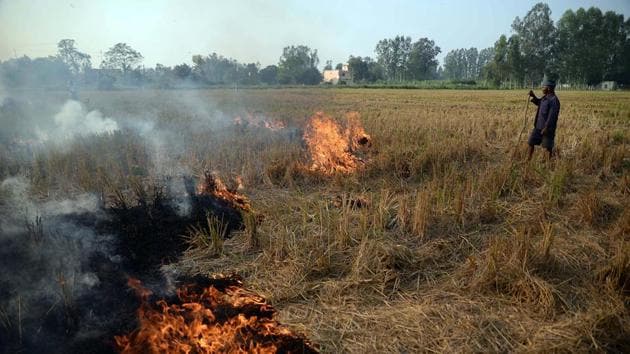
Banning the burning, and implementing the ban effectively, is the obvious response. However, the use of coercive State power against farmers for enforcing such a ban is just not feasible. The state governments know this. Weaning farmers away from growing paddy would do away with the problem. This has been advocated for some years now to conserve groundwater, which is being depleted rapidly and would result in a water crisis. It would reduce state subsidies in providing free electricity for irrigating such a water-intensive crop, and procuring it at the Minimum Support Price (MSP). With lower subsidies, farmers’ incomes could rise with the appropriate cropping pattern. But so far, this has been too difficult to attempt for the political leadership, and illustrates how difficult it is to change any entrenched subsidy regime.
It is unrealistic to expect farmers to forego income for the sake of the environment. However, if they see economic gains in switching to alternative crops and patterns, they will come forward. There is a successful example of triggering fundamental transformation in farm practices. The ITC, known for its e-choupal initiative, ran a Baareh Mahine Hariyali (greenery for the whole year) programme in four districts of Uttar Pradesh last year. It saw the doubling of incomes among farmers who adopted the full programme. Farmers who adopted the programme partially saw incomes going up from between 30% to 70%. This led to a public-private partnership between ITC and Niti Aayog to take the programme to 27 districts in eight states. Here, an attractive solution was the use of Happy Seeder, where the stubble is cut and left on the field to mulch enriching the soil, and the wheat seed is planted. The government has a scheme to provide a 50% subsidy for the purchase of Happy Seeders by farmers, and this goes up to 80% if, say, 15 farmers form a cooperative.
{{/usCountry}}It is unrealistic to expect farmers to forego income for the sake of the environment. However, if they see economic gains in switching to alternative crops and patterns, they will come forward. There is a successful example of triggering fundamental transformation in farm practices. The ITC, known for its e-choupal initiative, ran a Baareh Mahine Hariyali (greenery for the whole year) programme in four districts of Uttar Pradesh last year. It saw the doubling of incomes among farmers who adopted the full programme. Farmers who adopted the programme partially saw incomes going up from between 30% to 70%. This led to a public-private partnership between ITC and Niti Aayog to take the programme to 27 districts in eight states. Here, an attractive solution was the use of Happy Seeder, where the stubble is cut and left on the field to mulch enriching the soil, and the wheat seed is planted. The government has a scheme to provide a 50% subsidy for the purchase of Happy Seeders by farmers, and this goes up to 80% if, say, 15 farmers form a cooperative.
{{/usCountry}}There are other ideas, too. With some treatment, the crop residue could be used as cattle feed. But this has to make the journey from concept to the market. The other idea is to convert crop waste into biofuel for use in transport. A Mahindra group Company has tied up with Indraprastha Gas Limited for this. Stubble can also be converted into bales for which there is potentially a niche market. If other usages emerge, as it is for bamboo, the potential becomes much larger. All these possibilities must be pursued. But the crisis needs an immediate solution. This sense of urgency has led to the idea of giving the farmer additional cash along with the MSP if the paddy waste is not burnt, to compensate him for the extra cost of not burning it. The subsidy required for full compensation is far too high.
There are solutions which will not require any subsidy. The crop waste can be converted into briquettes, which work as a substitute for coal. The National Thermal Power Corporation has successfully blended these with coal, to the extent of 10% in their thermal plants. The market-discovered price through procurement of briquettes has not added to the cost of power. This, then, is a market-based solution that has worked. To scale it up to solve the problem fully over the next two to three years, it must be announced that the briquettes made from crop residue would be purchased at an attractive price for use in the thermal plants in north India. This price signal would drive market forces to deliver. Briquette-making plants, which do not cost much, would buy the crop waste from farmers at a price which earns them a reasonable amount after covering the cost of collecting the stubble and delivering it. Briquettes made would be sold to thermal plants, and it will give returns on investment.
This will eliminate the burning of the crop waste in the next two to three years. Policies would need to be continuously calibrated to support the best outcome for farmers as well as the environment, factoring in technological progress and behavioural changes.
.