One of the most striking images at the beginning of 2020 was that of the anti-Citizenship (Amendment) Act (CAA), protesters reading aloud the Preamble to the Constitution. It is truly significant then that 2020, with all that happened in between, ended with farmers from across three states expressing their dissent against three agricultural laws passed earlier that year. Let us review how the Constitution fared last year with the hope that key constitutional values, which were invoked and tested in 2020, remain pivotal to the lives of the Indian citizens in 2021 and beyond.
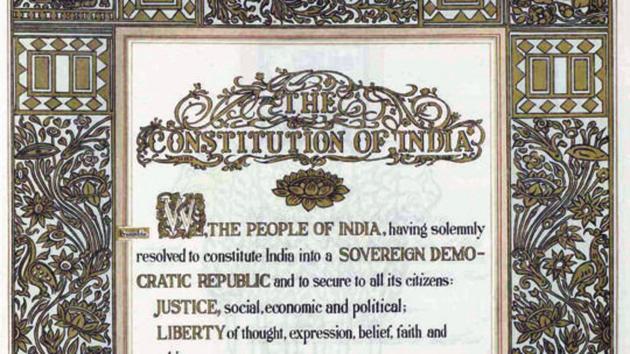
Constitutional challenges to CAA ranged from suits filed by several states to petitions alleging infringement on the fundamental right to equality and the secular character of the Constitution. However, the most significant challenge to CAA was mounted outside the courtroom — while the streets were marked by protests against the implementation of the law, social media platforms saw genuine attempts by users to educate themselves on both CAA as well as the Constitution.
The first quarter of 2020 witnessed a political and constitutional crisis in Madhya Pradesh. This crisis attracted attention to the Tenth Schedule — the anti-defection law — of the Constitution. The events in Madhya Pradesh were just one of many instances of this law being bypassed. It also lay bare why the Tenth Schedule can often magnify the problem it was intended to solve.
What marked the beginning of the second quarter was Covid-19. After an initial response to the pandemic led by states, the Centre stepped in by invoking the provisions of the Disaster Management Act, 2005. The National Disaster Management Authority, while notifying the lockdown on March 24, emphasised the need for “consistency” in the application of measures across the country. This perceived need for consistency, where the constitutional framework envisages roles for the State as well as local governments to reign in an epidemic, inevitably put a dent in the federal balance. The sudden nature of the first lockdown, and the halt on vital economic activities debilitated state finances, severely shifting the balance in India’s fiscal federal architecture. The other striking image which characterised 2020 was that of migrant workers compelled to walk long distances after the lockdown. It was a failure of policymakers that the drivers of key economic activity were not assured the dignity they deserve. The Constitution and all the institutions were collectively at their lowest when certain states remained unwilling to allow entry of migrant workers, and the Supreme Court (SC) merely approved the steps taken by the Centre to redress their grievances.
{{/usCountry}}What marked the beginning of the second quarter was Covid-19. After an initial response to the pandemic led by states, the Centre stepped in by invoking the provisions of the Disaster Management Act, 2005. The National Disaster Management Authority, while notifying the lockdown on March 24, emphasised the need for “consistency” in the application of measures across the country. This perceived need for consistency, where the constitutional framework envisages roles for the State as well as local governments to reign in an epidemic, inevitably put a dent in the federal balance. The sudden nature of the first lockdown, and the halt on vital economic activities debilitated state finances, severely shifting the balance in India’s fiscal federal architecture. The other striking image which characterised 2020 was that of migrant workers compelled to walk long distances after the lockdown. It was a failure of policymakers that the drivers of key economic activity were not assured the dignity they deserve. The Constitution and all the institutions were collectively at their lowest when certain states remained unwilling to allow entry of migrant workers, and the Supreme Court (SC) merely approved the steps taken by the Centre to redress their grievances.
{{/usCountry}}Parliament, an institution increasingly characterised by political grandstanding, could not redeem itself enough in 2020. Well into the third quarter, on September 20, the three agricultural bills were passed by a voice vote in Rajya Sabha, despite protest from the Opposition. The passage of these bills gnawed away at a foundational principle of the Constitution — parliamentary form of government characterised by debate, discussion, and accountability. The agricultural laws were passed with scant deliberation, a defect which even the most cogent drafting of their substantive provisions cannot rectify. The last quarter of 2020 witnessed the promulgation of the Uttar Pradesh Prohibition of Unlawful Religious Conversion Ordinance, 2020. Envisaging multiple declarations by individuals before and after conversions, the law is intrusive and its constitutionality dubious. Finally, there were constitutional questions that the SC did not hear (Article 370’s abrogation, CAA’s constitutionality), the pressing questions of access to certain resources in a near-virtual world, and some more. But there were positives.
There were assertions of federalism by some states on CAA; the Election Commission smoothly conducted its first post-Covid assembly election; and, most significantly, citizens came into their own and truly realised the import of the Constitution — for themselves and their fellow country people. Let us hope to build on this spirit this year.
Ritwika Sharma works at the Vidhi Centre for Legal Policy and leads Charkha, Vidhi’s Constitutional Law Centre The views expressed are personal