In the monsoon of 2015, defence minister Manohar Parrikar made a classified five-slide presentation on the Future of Air Power before Prime Minister Narendra Modi. Backed by facts and figures, Parrikar projected the strength and requirements of the Indian Air Force (IAF), taking into account its current fighter squadron status, attrition rates, requirements of single engine or twin engine fighters and how the force should look from now through the years of 2030-40. The presentation was attended by the National Security adviser, Ajit Doval, the then Air Chief, Arup Raha, the then defence secretary, G Mohan Kumar, and all the top officials of the Prime Minister's Office. At the end of the presentation, where complex technological details were simplified, Modi remarked that he had never seen such a good presentation. Modi told all the officials present that the country should be very proud to have Parrikar as the defence minister.
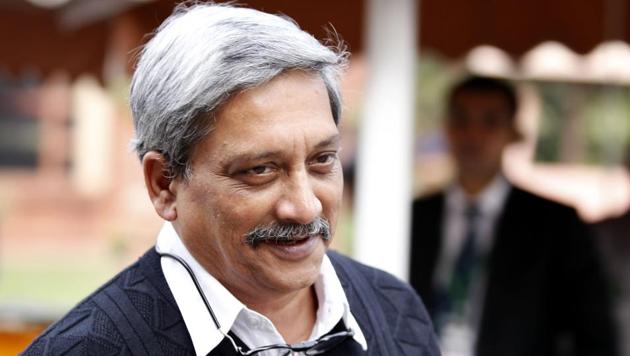
In his 28 months at South Block, Parrikar was defined by his trademark sleeveless linen shirt, magnetic reading glasses and strap free sandals. A half sleeved sweater was added to this attire during winter in Delhi. He lived alone in a bungalow in Lutyen’s Delhi. He disliked the city, its aggressive ethos and culture. And that is the reason why he refused to meet anyone outside his ministry.
Parrikar was a typical, carefree Goan who would not let go of any opportunity to go back to his beloved state. All the Akbar Road house had was standard issue white polyurethane PWD furniture and a Maharashtrian cook to cater to the workaholic occupant who had converted the master bedroom into a study. So when the Bharatiya Janata Party (BJP) asked him to go back to Goa as chief minister in March 2017, he was able to wrap up everything in a jiffy and leave for Panjim.
Parrikar lost his battle with cancer but he has left behind a huge legacy in the defence ministry and in the hearts of the armed forces. His single biggest contribution was the implementation of long standing one rank one pension (OROP) demand for the armed forces. He fought off all opposition within the defence and finance ministries and pushed for the implementation of OROP by personally preparing detailed briefs on the financial implication. In spite of the Raisina Hill mandarins’ reservations on the substantial impact on the fiscal deficit, Parrikar stood his ground against his other Cabinet colleagues.
{{/usCountry}}Parrikar lost his battle with cancer but he has left behind a huge legacy in the defence ministry and in the hearts of the armed forces. His single biggest contribution was the implementation of long standing one rank one pension (OROP) demand for the armed forces. He fought off all opposition within the defence and finance ministries and pushed for the implementation of OROP by personally preparing detailed briefs on the financial implication. In spite of the Raisina Hill mandarins’ reservations on the substantial impact on the fiscal deficit, Parrikar stood his ground against his other Cabinet colleagues.
{{/usCountry}}His logic was simple. He was committed to delivering on OROP as had been promised by Modi in the 2014 election manifesto. In his short tenure at South Block, he initiated major military reforms with the objective of having better teeth-to-tail ratio by setting up an expert committee under Lt General (retd) DB Shekatkar for enhancing combat capability and rebalancing defence expenditure. This report was cleared by his successor, Arun Jaitley, with the restructuring of the Army to be completed by December 31, 2019. When Parrikar took over as defence minister, the civilian bureaucracy dominated South Block and its negativity was focused on the armed forces. He changed all that by rebalancing the equation as he listened to the professional advice of the armed forces while allowing the bureaucracy to express itself on the files.
Defence ministry files of his tenure are witness to long handwritten notes by Parrikar in support or against received proposals. Given his engineering background, Parrikar was comfortable in dealing with complex technical issues and could hold his own with experts. An example of this tussle was on the ammunition inventory required for India to wage war. This was critical as it had huge financial as well as strategic implications since no country can hope to be able to provide ammunition indefinitely if hostilities ever broke out. The flip side was that the country could not spend thousands of crores of rupees while waiting for war to break out and then end up with expired ammunition.
A huge debate raged within the military establishment with the armed forces advocating ammunition for a 40-day intensive war. While Parrikar argued that the global community would not allow any subcontinental war to stretch beyond a week, South Block mandarins said that no country in the world produced or kept inventory for a 40-day intensive war.
Parrikar is no more, but the debate has been resolved with India equipped with a reserve inventory for a 10-day conflict. He tamed the Delhi bureaucracy by dealing with it in various instances in a quiet-yet-firm manner. With detailed logic and military consultation, he chose to either agree or overrule them. Parrikar left the centrestage to the military generals during the 2016 Uri surgical strikes despite being involved in the strike right down to the micro-detail along with Modi and Doval. He ensured that India purchased the Rafale fighters at a better price and conditions as compared to the previous UPA regime.
A true soldier of the party, Parrikar did not flinch when Modi and party president Amit Shah asked him to form a government in Goa. But in the Delhi interregnum, Parrikar ensured to stick to his work, and did not make any efforts to seek advice from or appease his neighbour, the all-powerful Amit Shah.
shishir.gupta@hindustantimes.com