The historian Dharampal has a wonderful anecdote about villagers in India in the 16th and 17th century. He said the archives revealed that whenever villagers were fed up with the king for the authoritarian way he treated them, they would abandon the kingdom and move to a new place. The king had to follow them and apologise for his behaviour if he wanted them to return.
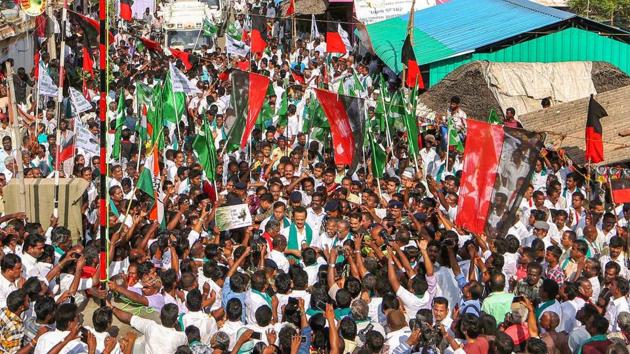
Dharampal’s research points out that secession has always been a part of folklore. One realises that even the disciplinary structures of the nation-state have not quite changed this mentality. The emerging nation-state always flaunted the story of Sardar Patel`s attempt to tame erring principalities as a counter legend. In the initial years, the federal framework tames the secessionist imagination except in Kashmir and the North East. But today, as the BJP’s centralism and the juggernaut of the RSS becomes more stark, some kind of secessionist statement is seen as part of an opposition identity.
Two events in recent times were extremely significant. The first was Chandrababu Naidu’s call for a federation of southern states to fight the BJP’s onslaught. Naidu visualised it within the electoral framework but also as a way of giving the South both financial and political breathing space from the BJP. The second call, raised by the DMK leader Stalin that raised memories of linguistic secession, was the project of Dravida Nadu.
The idea in fact was proposed decades earlier by Periyar’s Justice Party. It spread from Tamil regions to embrace all Dravidian languages. By the 1950s, the dream of Dravida Nadu faded, though language was still a pressing issue. But today one sees a resurgence of southern and Tamil nationalism, centring on a feeling that the South is different. What once centred on language has burgeoned into a general dissatisfaction. One saw evidence of it when a younger generation argued for jallikattu. One sensed it in the manner in which Tamils have reacted to the way the Centre has responded to the Sri Lankan problem. In 2017, it acquired a new dimension with the notification banning the sale of cattle for slaughter. A Twitter war ensued in which Kerala refused to comply with the diktats. By 2018, what was a shopping list of dissatisfactions turned into a political battle over the Centre`s economic neglect of Southern states. Stalin and Naidu provided variations of this demand. On Tuesday, ministers and officials from Kerala, Andhra Pradesh, Karnataka and Puducherry met in Thiruvananthapuram to discuss the concerns and views on the terms of reference of the 15th Finance Commission. Telangana and Tamil Nadu did not take part in the conclave.
{{/usCountry}}The idea in fact was proposed decades earlier by Periyar’s Justice Party. It spread from Tamil regions to embrace all Dravidian languages. By the 1950s, the dream of Dravida Nadu faded, though language was still a pressing issue. But today one sees a resurgence of southern and Tamil nationalism, centring on a feeling that the South is different. What once centred on language has burgeoned into a general dissatisfaction. One saw evidence of it when a younger generation argued for jallikattu. One sensed it in the manner in which Tamils have reacted to the way the Centre has responded to the Sri Lankan problem. In 2017, it acquired a new dimension with the notification banning the sale of cattle for slaughter. A Twitter war ensued in which Kerala refused to comply with the diktats. By 2018, what was a shopping list of dissatisfactions turned into a political battle over the Centre`s economic neglect of Southern states. Stalin and Naidu provided variations of this demand. On Tuesday, ministers and officials from Kerala, Andhra Pradesh, Karnataka and Puducherry met in Thiruvananthapuram to discuss the concerns and views on the terms of reference of the 15th Finance Commission. Telangana and Tamil Nadu did not take part in the conclave.
{{/usCountry}}What one is witnessing here is not the old demand for secession. What one is seeing is a larger demand for autonomy, for states to be seen as political entities . Within the electoral framework, one wants a distance not from the general idea of India and being Indian but from the BJP’s centralism. These are not alienated cries from politicians fighting for survival. These are acute political strategies by politicians who know the people on the ground. Instead of condemning this as unpatriotic or anti-national, the BJP must examine its own conduct. Democracy is based on negotiation and it is time the question of federalism comes in for a longer debate.
On the other hand, there is a temptation to read the idea of Dravida Nadu as a failed one despite being launched again and again. Kamal Haasan and Stalin were the latest to dwell on it. Yet one needs to understand that flagging the concept semaphores a set of ideas. First, the distinctness of culture and of region. Second, a sense of the arrogance of the North and its illiteracy about the South. Third, a sense that the South has been neglected when it comes to economic decisions. In each of these cases, one sees two tactics. It often expresses itself as a search for more autonomous states looking for special status or for a sense of the solidarity with the region. If the earlier moves were rhetorical, the new strategy seems more strategic. Tamil nationalism or southern regionalism becomes a bargaining chip one brings to the negotiating table, ever present in the psyche of the people. It is a force that can be tapped into.
These are warning signals which India needs to read. Present in it is a future sense that a centralised India run by majoritarian forces may not work. It is an appeal that India be plural in a many-faceted way and be seen as plural. The BJP may have to go back to the drawing board to rework its idea of the nation-state.
Shiv Visvanathan is professor, Jindal Global Law School and director, Centre for Study of Knowledge Systems, OP Jindal Global University
The views expressed are personal